
Install
Install with PiG
pig install npm:pi-wokeyInstall with Pi
pi install npm:pi-wokeyPackages run code with your permissions and influence agent behavior. Catalog inclusion is not a security audit. Review the source before installing a third-party package.
Pi manifest JSON
The pi field of package.json.
{
  "extensions": [
    "./index.ts"
  ]
}
README
Written by the package's publisher, shown as published in version 0.9.0 (README.md). PiG does not review it.
pi-wokey
A pi provider for wokey.ai's GPT and Claude models that checks every response against wokey's TEE proof and tells you when a reply cannot be proven.
What's included
| Extension | Command / shortcut | What it does |
|---|---|---|
index.ts | provider wokey | Registers the wokey lineup with pi. Routing, thinking levels, prompt caching and usage accounting run through pi's native adapters. |
index.ts | /wokey | Management menu (status, models). |
index.ts | /wokey status | Only changing or attention-worthy information: timestamped cards for failed exchanges (paged when there are more than three), the latest exchange summary, account balance, and conditional verification warnings. |
index.ts | /wokey models | Picks which models are registered with pi. Vendor tabs, rates, context window and thinking levels per row. |
index.ts | session_start hook | Reports readiness and refreshes the model catalog from wokey. |
No shortcuts, tools or CLI flags. /wokey key, unset and clear are retired and only
point at pi's own credential commands.
Install
pi install npm:pi-wokey
Other sources:
pi install git:github.com/kslamph/pi-wokey
pi install ./pi-wokey               # local clone
Try it without installing anything:
pi -e npm:pi-wokey
After installing, store your wokey API key and pick a model:
/login wokey        # key goes into pi's credential store
/model wokey        # select a wokey model
Usage
Ask for anything you normally would. Verification runs on every response and stays quiet unless something is wrong.
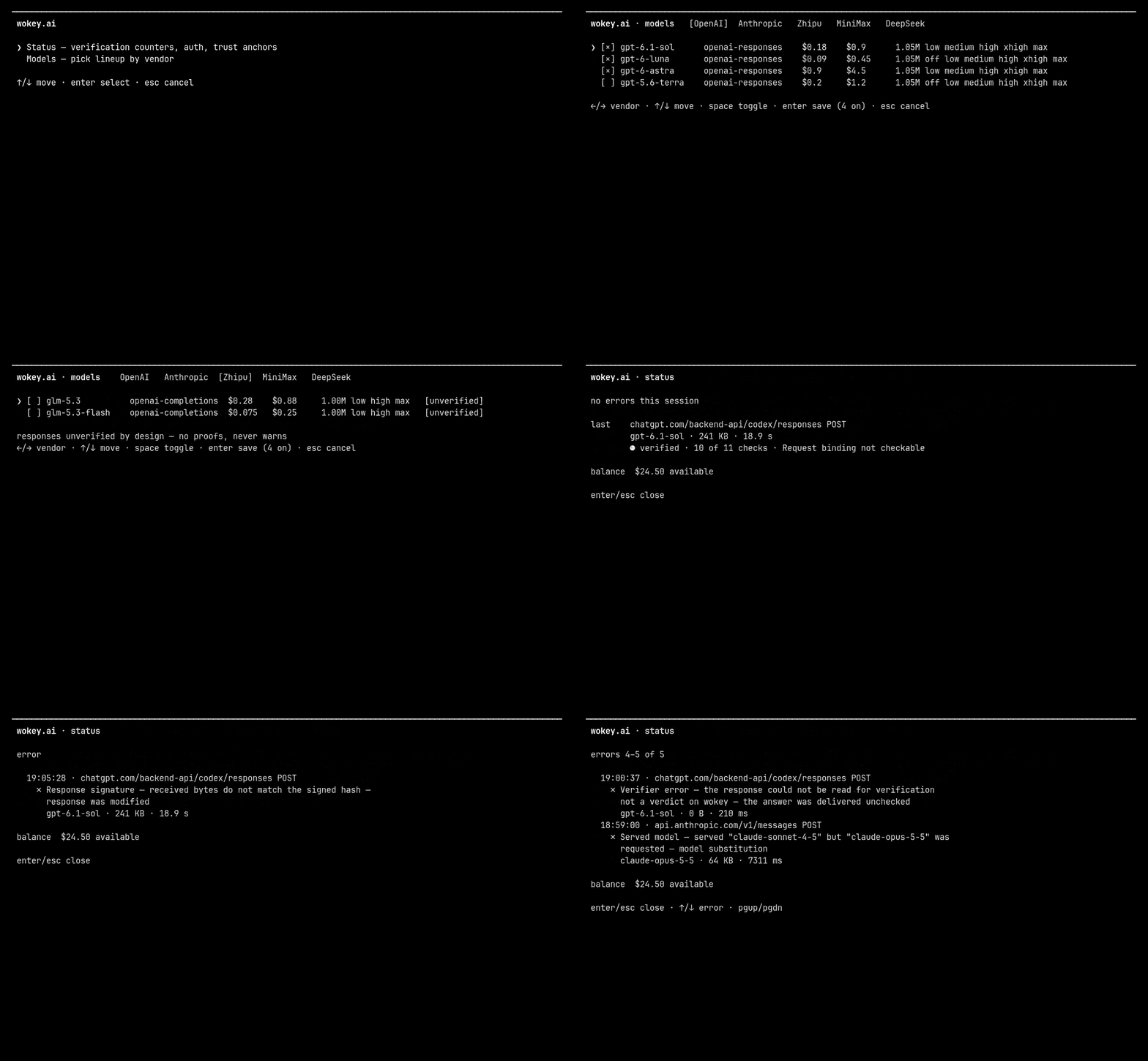
/wokey status       # any verification errors this session, and your balance
/wokey models       # add or remove models
Four models are registered by default:
| Model id | Vendor | Route | Proof |
|---|---|---|---|
gpt-6.1-sol | OpenAI | Codex Responses | verified |
gpt-6-luna | OpenAI | Codex Responses | verified |
gpt-6-astra | OpenAI | Codex Responses | verified |
claude-opus-5-5 | Anthropic | Anthropic Messages | verified |
To enable GPT-6.2 Sol (gpt-6.2-sol) or GPT-6.2 Astra (gpt-6.2-astra),
select them in the OpenAI tab of /wokey models, then use /model to switch.
The selector also offers more GPT and Claude models and chat models from Zhipu,
MiniMax, DeepSeek, Moonshot, Google, and xAI. The chat models are opt-in
because wokey publishes proofs
for the official Codex Responses and Anthropic Messages routes only — their exchanges are
recorded as unattested by design and never warn.
Configuration
Credentials are pi-managed: run /login wokey (and /logout wokey to remove the key).
This extension stores no key of its own and deliberately does not read WOKEY_API_KEY.
Everything else is optional, in ~/.pi/agent/wokey.json (defaults shown):
| Key | Default | Purpose |
|---|---|---|
verify | true | Probe every response. false turns verification off entirely. |
notifyOnFailure | true | Warn on a failed check, and once per session on an unattested response. |
expectedPcr0 | shipped constant | Your own pinned enclave measurement (96 hex digits). |
enabledModels | verified lineup | Model ids registered with pi, set by /wokey models. Unknown ids are ignored. |
Environment variables: WOKEY_CONFIG overrides the settings file path.
WOKEY_NO_VERIFY=1 and WOKEY_EXPECTED_PCR0=<hex> are test overrides and are not needed
in normal use.
Security
- Network. Model traffic and the catalog go to
https://api.wokey.aionly: the route base URLs,GET /v1/modelsfor the catalog, andGET /v1/dashboard/balancewhen you open/wokey status. No other host is contacted. Proof verification is local arithmetic — a P-384 certificate check, an Ed25519 statement check and a SHA-256 body hash — with no extra round-trip. - Files. Reads and writes
~/.pi/agent/wokey.jsononly. No shell commands, no child processes, and nothing read from the current directory or a project.env. - Permissions. Like any pi extension it runs in-process with your user's OS permissions.
- What a green verdict means. An enclave running the pinned image fetched these exact bytes from a genuine upstream TLS endpoint. It cannot prove that OpenAI or Anthropic served the model you asked for, because neither signs its responses.
- What
/wokey statusshows. Only what is new: a card for every exchange that failed verification (paged past three), the last exchange's model, size, latency and verdict, and your balance. Pinned trust anchors, the measured upstream tuples, the accepted limits and the full check roster are static, so they are documented here rather than reprinted on every open. Two conditions are worth watching and are shown inline when they occur:verification is OFF, andno audit PCR0 is pinned.
Update, remove, disable
pi update --extensions        # update all installed packages
pi update npm:pi-wokey        # update just this one
pi remove npm:pi-wokey        # uninstall
pi config                     # enable or disable the package's resources
Compatibility
- Voided turns. If the relay closes a Responses turn with no output items and
nothing billed — the shape wokey returns for a request whose replayed
function_callhas no matchingfunction_call_output— the extension retries it once and, if that is empty too, surfaces the failure instead of leaving a silent stall in the session. Retries are announced; the guard never runs on the Anthropic route, where nothing comparable has been observed. - Your prompt, not a generic one. Pi sends its system prompt as the leading
inputitem, so no defaultinstructionsstring is added alongside it. - Pi 1.0.2.
@earendil-works/pi-ai,@earendil-works/pi-coding-agentand@earendil-works/pi-tuiare supplied by pi (peerDependencies), not bundled. - Node.js 22 or newer (
enginesinpackage.json). - Developed and tested on Linux. macOS and Windows: TODO: confirm.
Development
git clone https://github.com/kslamph/pi-wokey
cd pi-wokey
npm install
npm test            # vitest run
npm run typecheck   # tsc --noEmit
pi -e ./index.ts    # load the working copy for one run
A local install (pi install ./pi-wokey) is loaded in place, not copied, so
edits take effect on the next start. Run npm install first — pi does not install
dependencies for local packages.
License and credits
Apache-2.0. See LICENSE and NOTICE.
Unofficial: an independent integration by a wokey subscriber, with no affiliation with or
endorsement from wokey.ai. verify/signing.ts, verify/verify-attestation-cose.mjs and
verify/tee-verify-core.ts are vendored from
focuxdot/proof-of-observation at
280e74c3fd7b859ae22d84a59d1fdd694b7c407c (dual MIT / Apache-2.0; Apache-2.0 exercised
here).