
Install
Install with PiG
pig install npm:pi-subagent-model-routerInstall with Pi
pi install npm:pi-subagent-model-routerPackages run code with your permissions and influence agent behavior. Catalog inclusion is not a security audit. Review the source before installing a third-party package.
Pi manifest JSON
The pi field of package.json.
{
  "extensions": [
    "./src/index.ts"
  ]
}
README
Written by the package's publisher, shown as published in version 0.5.3 (README.md). PiG does not review it.
pi-subagent-model-router
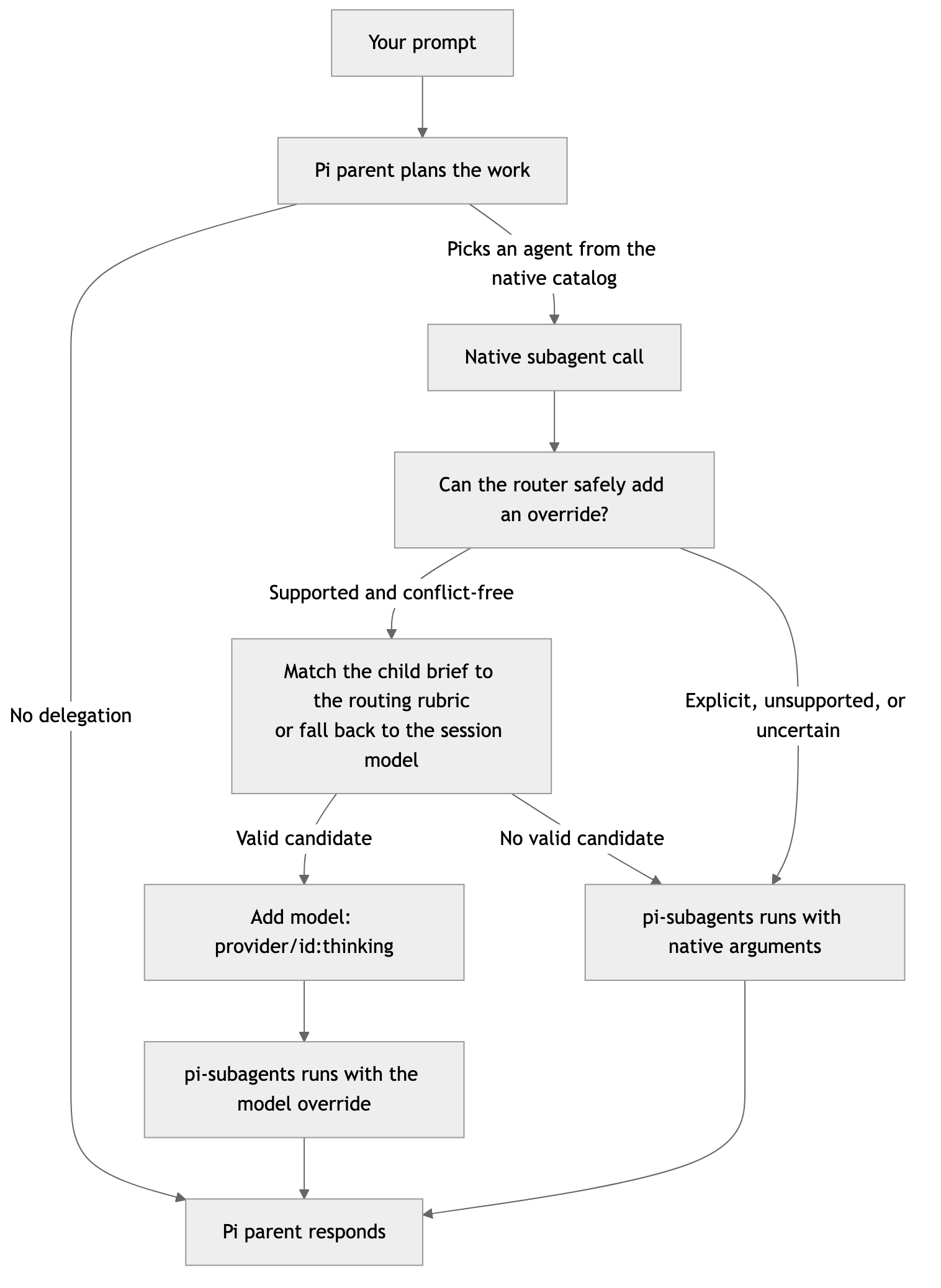
The router guides Pi to delegate fresh workspace work on ordinary prompts, including read-only repo investigation. It can guide Pi through subagents_enable if the direct tool isn't active yet. Pi still decides whether to delegate and which agent to use. For eligible native subagent calls, the router selects the child's model and thinking from router.json or falls back to the current Pi session model and thinking. It never changes the parent model or replaces the native tool or agent catalog.
How it differs from other routing approaches
The router makes a separate choice for each eligible native subagent call, not for the whole conversation turn:
| (blank) | This router | Whole-turn model switching | Fixed roles or tier pools |
|---|---|---|---|
| Unit routed | The task brief of each eligible native subagent call | The whole prompt or turn | Work assigned to a predefined role or tier |
| How a route is chosen | A classifier or optional routing_model matches the brief against when_to_use criteria you write in plain language | One model is picked for the turn | The role or tier determines the model |
| What a route sets | The child's model and thinking level; the persona Pi picked is kept | A model for the turn | The model configured for that role or pool |
| Final answer | Pi's parent, on its own unchanged model, uses the child result | The selected model answers directly | Depends on the setup |
This is a design difference, not a benchmark. We make no claims about quality, speed, or cost compared with other approaches. Routing adds a classification step to eligible calls. Without a usable match, an eligible call can use the session model and thinking as its fallback. Calls the router skips keep their native arguments.
Setup
Use Pi 1.5.2 and load both extensions. The router's npm dependency does not load the pi-subagents extension into Pi. Install pi-subagents separately if it isn't already loaded:
pi install npm:pi-subagents
The router does not require a specific pi-subagents version. It checks that the loaded pi-subagents exposes the public launch preflight and capability-ceiling APIs it uses. If they are missing, native routing stays off, the status shows Router: pi-subagents incompatible, and Pi shows one warning per session naming the detected pi-subagents version. CI runs the tests against the locked pi-subagents version, and Dependabot proposes updates that are merged only when the tests pass.
Install the router release that includes native routing, then restart Pi:
pi install npm:pi-subagent-model-router@0.5.2
To try a checkout without changing your Pi settings, see Local smoke test.
- Chat models: Sign in via Pi's
/loginor configure your provider's credentials. In Rubric and settings, replace any example route model IDs that your Pi catalog or account doesn't support. The current Pi session model and thinking level are used as the fallback. - Optional classifiers: To use Jev, set
TYPESAFE_API_KEYbefore starting Pi. OpenAI Decisions needs an OpenAI API key, not ChatGPT sign-in (Pi may need/logout openaibefore it will useOPENAI_API_KEY). Setclassifiers: []or clear Classifier order to use neither. Configure a chatrouting_modelif you want classification without a native classifier. - Try a call: Give Pi a normal workspace task, such as “Explain how native routing works. Don’t edit anything.” No special delegation prompt is needed. Check Routing decisions and the native tool result. If you want to test routing separately from Pi's delegation choice, name a known persona such as
scoutand omitmodeland other launch options.
Keep keys in Pi's supported credential sources, not in router.json or task briefs.
Local smoke test
Load only this checkout and its pinned pi-subagents so that no other copy of the router (for example, an old symlink in ~/.pi/agent/extensions/) loads alongside it. -ne skips discovered, configured and built-in extensions, including codemode; subagent calls made through codemode are nested and not routed.
npm ci
# Shows other router copies that a normal `pi` start would also load. `-ne` below ignores them.
ls -l ~/.pi/agent/extensions .pi/extensions 2>/dev/null | grep -i router
pi -ne -e ./node_modules/pi-subagents/bundle/index.js -e ./src/index.ts \
  --tools 'read,grep,find,ls,bash,subagent*'
The footer should show Router: enabled. Without TYPESAFE_API_KEY (Jev) or an OpenAI API key, classification needs a chat routing_model; otherwise eligible calls fall back to the current session model and thinking. Don't pass --models: scoped models make the router abstain. Then try:
- Routed: “Use the subagent tool with the
scoutagent and don't set a model or other options: explain howsrc/native-routing.tsdecides whether to add a model override. No changes.” With a working classifier, expect thecodebase_orientationmodel (openai-codex/gpt-6-luna,high) in the native tool result or completion card,scoutas the persona, and a parent turn on its original model. Naming the persona keeps the test repeatable. If you let Pi pick, it may guess a name that isn't in the catalog (for exampleexplorer); the router abstains and pi-subagents reports an unknown agent. Retry with a listed persona such asscout. - Fallback: Select an authenticated parent model and set a thinking level it supports, such as
medium. Temporarily setclassifiers: []and omitrouting_model. Ask: “Use theworkersubagent in the current working directory withasync: falseand labelFallback check. Don't set a model. List the top-level files.” Check Routing decisions for↺ fallbackand the native result for the current session model and thinking. Restore your classification settings afterward. - Explicit pin: “Delegate to the worker subagent with model
anthropic/claude-opus-5-5:low: list the files insrc/.” The router leaves the call unchanged, so expect the pinned model.
The native result confirms the child's effective model and thinking level. Use Routing decisions to distinguish a route match from fallback or a skipped call, even when the effective models are the same. For a recorded foreground run, Session history also shows the requested and effective model and thinking.
When the router sets a native call's model and the run finishes in the foreground, it records that run in Session history and the Cost dashboard (see See which models ran). It does not record calls it leaves unchanged, background (async) launches, runs detached or paused after an interrupt, or calls that are blocked or aborted before they run. Run a brief in /subagent-router is a separate, manual, text-only path.
Native routing: what changes and what doesn't
The hook supports a direct, top-level subagent call from pi-subagents with non-empty agent and task and optionally a boolean async, a string label (the run's display name), and a cwd that resolves to the session working directory. Both ordinary local background and foreground runs are supported. Pi can pick a built-in or a custom persona that the public launch preflight from the loaded tool's own package can resolve without ambiguity. The router changes only model, using pi-subagents' native provider/id:thinking suffix. Persona, tools, task, launch mode, label, cwd, and result handling stay native.
The router leaves the call untouched when:
- The call supplies a
model(with or without a thinking suffix), anyoptions,worktree, an alternatecwd, or other fields besides those supported above. This includes workflows, management, resumes and custom placement. Acwdspelled differently is eligible only if native path resolution produces the session working directory (for example,.); different symlink paths are not treated as equivalent. A parameter the router does not recognize, for example one added by a newerpi-subagents, also causes abstention, and Pi shows one warning per session naming it (Router skipped subagent call: unrecognized parameter(s) …); update the router when you see it. Nested tool calls (including via codemode), slash commands, RPC launches and the delegation bridge are not routed. - The selected definition cannot be verified, has shadowed candidates, uses an external or unknown runner, or declares a model pin (including
inherit), machine, launcher, or fast mode. Bundled persona thinking defaults are not model pins; the routing suffix supersedes them on an eligible call. - A Pi session has scoped models, or applicable user/trusted project settings contain a subagent model scope, model/provider/thinking defaults or limits, agent/provider override maps, or machine configuration. Project ancestors are checked conservatively without trying to reproduce settings precedence or evaluate scopes. A native capability ceiling, configured default worktree, custom runner binary/host package override, or unreadable/invalid policy inputs also cause abstention.
- The router is disabled, unavailable, or cannot validate the launch or target. Targets must be available with configured authentication and support the requested thinking level. Virtual models and providers registered by parent extensions are excluded because a detached child may not share the parent's runtime.
Abstention is not an error and does not block the native call. The router never launches or retries a native run itself. Use the native tool's result and diagnostics for launch failures. Verification is pre-execution, not an atomic guarantee against concurrent edits or later extension hooks, and configured credentials do not guarantee a successful provider request.
Router workspace
Run /subagent-router in Pi. The home screen and its controls open inline in the editor area at the bottom, not over the conversation. Choose Run a brief, Rubric and settings, Session history, Routing decisions, Router status, or Cost dashboard. Press Esc to back out.
In Rubric and settings, use ↑/↓ to preview a route’s criteria, model, and thinking level, and Enter to edit. In the model dropdown, type to filter Pi’s available chat models by name, provider, or ID. The thinking dropdown shows the levels supported by the selected model.
From the home screen, select Router status → Enabled or Disabled, then confirm Save. This writes enabled to router.json and updates Pi’s footer immediately to Router: enabled or Router: disabled. You can also edit the flag directly; the footer refreshes on the next run or when opening router settings or status. While disabled, the router stops adding delegation guidance, native subagent calls run with their original arguments, and Run a brief does not call a classifier or start a worker. The config menu and history remain available. The same menu can add or remove routes, reorder classifiers, and set or clear the routing model. Select When to use to view or edit the full criteria. Each change is validated and requires save confirmation.
router.json is the router’s rubric and model configuration. The router reads it from the extension’s checkout for every brief, regardless of Pi’s working directory. Saved edits apply to the next run without reloading and don’t change a worker already running. Use provider-qualified model IDs available in your Pi session. OpenAI’s Decisions API requires an API key; ChatGPT sign-in does not support it.
| Field | Meaning |
|---|---|
version | Required; 1. |
enabled | Optional boolean; defaults to true. Set to false to stop delegation guidance, new native model overrides, and manual briefs. Native delegation and already-running children are unaffected. |
debug | Optional boolean; defaults to false. When true, routing decision entries also store the full task text and Pi shows a notification for each decision. Toggle it with Rubric and settings → Debug decisions; saving writes debug only while it is on. See Routing decisions. |
routes | 1–32 rows. Each has a unique lowercase name (letters, digits, underscores; start with a letter), a human-readable label, when_to_use criteria, a provider-qualified model, and thinking. |
classifiers | Optional ordered list of up to four provider-qualified classifier IDs from Pi's catalog; defaults to typesafe/jev-latest, then openai/gpt-6-luna. [] disables native classifiers. |
routing_model | Optional chat { "model": "provider/id", "thinking": "low" } tried if no classifier can return a valid answer. |
Older base_agent and per-route agent settings are ignored. You can remove them manually; saving through Rubric and settings drops them automatically.
Supported thinking settings are off, minimal, low, medium, high, xhigh, and max; native routing abstains when the requested level is not supported by the candidate. Put the level in thinking, not in the model ID.
The router already uses Pi's native classifier API. Pi handles the model catalog, credential checks, and requests. No codemode or MCP setup is required, and classifiers don't appear in /model. To try another classifier, add its provider-qualified ID to Classifier order (for example, openrouter/typesafe/jev-1.14) and set up that provider's credentials in Pi. Available IDs vary with the installed Pi version and its catalog; the setup above targets Pi 1.5.2.
The classifier receives the brief, route names, labels, and criteria—not worker model settings. Each attempted backend has a 10-second deadline. Missing credentials, request failures or invalid answers try the next backend. A fit below 0.7, unavailable matched chat model, or exhaustion of all backends uses the current Pi session model and thinking if usable. Neither classification nor fallback changes the selected persona.
Manual text-only briefs
Run a brief is separate from native routing. It uses the public delegation bridge and the packaged router-spike-worker with a zero-tool budget. Briefs must be at most 1 MiB after trimming and UTF-8 encoding. It does not expose a model tool or edit the parent prompt. If the worker is unknown, install the router as a Pi package or start in the trusted checkout root. Loading only src/index.ts from another workspace does not register its packaged agents. Check for settings that disable the agent if it is still missing. The manual bridge requests pi-subagents' maximum foreground timeout (about 24.8 days) and waits until completion or session shutdown. Native runs keep their own timeout and cancellation behavior.
Validate software-engineering routes
router.json includes three implementation tiers: Luna 6 (low) for localized edits, Sol 6.2 (medium) for multi-module work within one repo, and Sol 6.2 (high) for inherently complex changes that need product context across repos. Routine CLI and Git work uses Luna 6 (openai-codex/gpt-6-luna, low), including running known checks and publishing an already-prepared patch (commit, push, open a pull request). If the main deliverable is to implement a change or review the patch for findings, use that route instead. Architecture discussions use Opus 5.5 (medium), LaTeX work uses Opus 5.5 (medium), and high-risk architecture or refactor planning uses Opus 5.5 (high).
Ask Pi to send one of the examples below to a native subagent without an explicit model, or use /subagent-router → Run a brief to test classification with a tool-free worker (which cannot perform workspace steps).
| Sample brief | Expected route |
|---|---|
Run git status --short and report the changed paths. | simple_cli_operations |
| Explain how a request moves from the HTTP controller through the service to the repository. No changes requested. | codebase_orientation |
| Add an optional CSV separator parameter to one existing export helper; behavior is specified and callers don’t change. | simple_coding |
| Implement CSV report export across the controller, permission checks, service, and storage layers in one application repo. | standard_coding |
| Implement a backwards-compatible billing change spanning the billing service, shared SDK, and web client repos, with coordinated rollout semantics. | complex_coding |
| Explain why a UTC date displays as the previous day for users west of Greenwich and suggest a targeted fix. | bug_diagnosis |
| Write table-driven tests covering empty input, duplicates, and Unicode for an existing slug parser. | test_authoring |
Review a proposed patch that replaces Promise.allSettled with Promise.all. Return findings only. | code_review |
| Show how to extract duplicated normalization into a helper without changing behavior. | refactoring |
| Compare a queue and a synchronous endpoint for thumbnail generation and recommend an architecture. | architecture_design |
| Design a phased migration away from the shared billing database across three services, including compatibility, rollout, and rollback. Do not implement it. | complex_architecture |
| Explain how to benchmark a JSON encoder that doubled p95 latency under load. | performance_analysis |
| Fix a LaTeX table that overflows a two-column paper and explain the typesetting change. | latex_authoring |
| Draft a runbook for onboarding developers to our local build and test workflow. | engineering_documentation |
| Recommend a side dish for a picnic. | No rubric match: current Pi session model and thinking for an eligible call |
See which models ran
Open /subagent-router → Session history to see routed native foreground runs, Run a brief requests, and older router receipts on the active session branch. Each entry shows the persona, route (base fallback when no route matched), classifier, run ID when available, outcome, and requested versus effective model and thinking. A submitted or unconfirmed entry is not proof the worker ran.
A routed native run is recorded only after its foreground tool result arrives. The router then saves the submitted and terminal receipts together, with the run ID, outcome, effective model and thinking, and reported usage from the subagent tool result. Outcomes use the same status names as the structured delegation bridge. Background (async) launches, runs detached or paused mid-run, and calls that never run report no final usage in their tool result. The router records nothing for them rather than leaving a receipt that stays unresolved. Background completions arrive only as an in-process pi-subagents event that is not replayed after a reload. If Pi exits, the session changes, or the router is reloaded before a routed foreground run finishes, that run is not recorded. Receipts are stored in the Pi session and survive reload/resume for saved sessions. They do not include the brief or worker output and are not sent to the model.
The native routing hook also saves a routing decision entry for every top-level subagent call it evaluates, including background launches and calls it leaves unchanged. See Routing decisions.
History includes earlier runs with saved router receipts, but it cannot reconstruct missing receipts. It also counts router requests with attributable usage observations across all branches of the current Pi session. Each active-branch row can show the terminal response's reported input, output, cache-read and cache-write tokens and USD cost. These are observations, not verified totals or invoice amounts. ? and unknown include zero-valued fields because the dependency can substitute zeros for missing data. Unidentified sessions, records inherited from a fork, older receipts without a session identity, missing or malformed reports, and ambiguous duplicate identities do not contribute observations. A count of zero means no eligible observations, not zero spend.
All-subagent totals and savings are not available from pi-subagents. The structured delegation response covers only requests sent through that bridge. Its optional aggregate can lose missing-field information and does not include per-attempt model/pricing or prove all usage was captured. Pi exposes the session tree and stored messages, but not a complete inventory of child launches and their priced usage. The native /subagent-cost command (also available via the subagent RPC cost method) is a best-effort branch report: it reads tool results, completion records and optional artifacts, can fill missing fields with zeros, and does not report per-model rates or prove coverage of every launch. Use it, the native tool result, or a completion card to inspect native runs that have no router receipt: unrouted calls and routed background or detached runs.
Routing decisions
Open /subagent-router → Routing decisions to see why each native subagent call was or wasn't routed. The list covers the active session branch, newest first, one row per call:
✓ code_review → openai-codex/gpt-6-luna:high: a route matched and the router set the child's model.↺ fallback → <model>: the call was eligible, but no usable route matched, so the Pi session model and thinking were used.↷ skipped · <reason>: the router left the call unchanged; see the reason codes below.✗ error: an unexpected error; the router left the call unchanged.
Each row shows the persona, the call's label or task preview, and the local time. The line under the title counts decisions by outcome, for example 12 decisions · 9 routed · 1 fallback · 2 skipped · active session branch. The preview explains the reason and a fix, and shows the task preview, each classifier or routing-model attempt (backend · kind · result · fit · route · ms · error), the final or candidate model and thinking, the router and pi-subagents versions, the tool call and request IDs, and linked receipts with their status, run ID, effective model, tokens and cost. Press Enter for a detail list of the task, each attempt and each receipt; press Esc to return. Without the TUI, the view prints the same report as text.
Jev attempts also show up to three probabilities returned for rubric routes, highest first. These are Jev's Choice probabilities, not the separate rubric fit score or a guarantee that a route was selected. They can appear on a fallback even when fit was too low to route. If Jev didn't return usable probabilities (for example, a one-route rubric only asks for fit), none are shown. Older decisions remain readable without this field.
After each recorded decision, the footer shows the latest one, for example Router: enabled · last: code_review → gpt-6-luna or Router: enabled · last: skipped (unrecognized_params). Router: disabled, Router: config unavailable and Router: pi-subagents incompatible take precedence. A decision with pi-subagents (version not recorded) may have been skipped before the compatibility check; that line does not mean the extension is missing.
Reason codes
| Code | Meaning | Fix |
|---|---|---|
native_placement_config | The pi-subagents extension config sets a default worktree, so placement stays native. | Remove worktree from that config.json. |
invalid_params | agent, task, async or label was missing or had the wrong type. | None; pi-subagents validates and reports the call. |
explicit_model | The call set model (detail lists all explicit options). | Omit model and other launch options to let the router choose. |
deliberate_params | The call set workflow, placement, output, management or option parameters. | For routing, use a plain launch and omit cwd unless it resolves to the session working directory. |
aborted | The call or session was cancelled before routing finished. | None. |
config_unavailable | router.json could not be read or is invalid. | Fix router.json or reopen Rubric and settings. |
routing_disabled | enabled is false. | Enable it under Router status. |
unrecognized_params | pi-subagents sent parameters the router doesn't know (named in the detail). | Update pi-subagent-model-router. |
pi_subagents_incompatible | The loaded pi-subagents lacks the preflight and capability-ceiling APIs. | Update the router, or report the version shown in diagnostics. |
settings_conflict | subagents settings in the named file may change model selection. | Remove its model scope, default, limit, override or machine keys, or accept native selection. |
scoped_models | Pi has scoped models (for example --models). | Start Pi without scoped models. |
capability_ceiling | A pi-subagents capability ceiling applies to the session. | None; routing resumes when no ceiling applies. |
baseline_contract | Preflight of the unchanged call failed or found a model pin, thinking ceiling, shadowed agent or error diagnostic. | Check the agent definition. |
agent_pins_model | The agent definition declares a non-Pi runner, model, machine, launcher or fast. | Remove that frontmatter key to allow routing. |
worker_model_unusable | The selected model is missing, unauthenticated, virtual, provided by a parent extension, or lacks the thinking level. | Choose a usable model in Rubric and settings. |
candidate_contract_mismatch | Preflight with the routed model differed from the unchanged call. | Check subagent settings and the agent definition; report it if it persists. |
An error decision names the step that failed (for example settings or routing), never provider output.
Debug mode and privacy
Decision entries are stored in the Pi session file with pi.appendEntry(). Per Pi's extension docs, custom entries do not participate in LLM context, so they are not sent to the model, and they do not count toward cost accounting. By default an entry keeps only the first 120 characters of the brief, whitespace-collapsed, and its SHA-256 hash. Turn on Rubric and settings → Debug decisions ("debug": true) to also store the full brief and show a one-line notification for each decision made after router.json is read. Turn it off when you are done; existing entries keep their full text.
Diagnostics bundle
Select Copy diagnostics in Routing decisions to open a redacted JSON bundle in Pi's editor; select and copy it, then press Esc. It contains the generation time; the router, pi-subagents (from the latest decision that recorded its version) and Pi versions; a config summary (enabled, debug, route names with models and thinking, classifiers, routing_model and the SHA-256 of router.json, without when_to_use text); and the last 50 decisions on the branch with task previews, hashes, and any recorded Jev route probabilities. The probabilities include only rubric route names and numeric values, not raw classifier responses. Full task text is removed even when debug mode stored it. The bundle never includes credentials or environment variables, and your home directory appears as ~. Review the task previews before sharing.
Cost dashboard
Open /subagent-router → Cost dashboard for the sum of estimated savings, the average per eligible session, and per-session reported spend and tokens. In the TUI, select a session to see the breakdown by observed provider/model and any unattributed usage; press Escape to return to the dashboard.
The estimate prices the same full-session mix of router-worker input, output, cache-read and cache-write tokens at each model actually observed in that session. It takes the highest of those priced mixes, then subtracts the workers' Pi-reported spend. Negative values are possible; this is a fixed-token comparison, not a prediction of alternate-model behavior or a billing report. Pi's total is provider-reported where supported and otherwise a catalog estimate.
Accounting is forward-only: older router receipts are not backfilled. Session totals use valid usage from the public pi-subagents completion response for briefs and from the native subagent tool result for routed foreground runs, including unsuccessful runs that report usage and runs without model attribution. If some runs are outside coverage or lack valid usage, displayed totals are partial. An unknown value is not zero. Pre-launch rejections do not count as usage.
For a new completed worker with valid usage, the router tries the inferred default child session file once at completion. It matches the assistant usage to the reported totals, attributes it to the actual providers and models, and checks flat registry rates against the recorded cost components. For Run a brief, the pi-subagents delegation response does not expose the child file path, so a custom child directory (defaultSessionDir) or a parent without a session file prevents this attribution. For routed native runs, the router reads the child session file named in the native tool result instead. A forked child's file also contains parent turns, so it cannot be attributed. The router does not search other locations. The dashboard reads only saved router receipts for accounting. It does not reopen child files or reprice historical usage.
Savings require at least one completed, attributed worker and full coverage with consistent, corroborated flat rates for every observed model. Legacy or ambiguous receipts, unsuccessful runs, missing files, incomplete usage, supplementary child charges, tiered rates and 1-hour cache writes can make savings unavailable without hiding reported totals.
Coverage is the current session and up to 50 other sessions from Pi's default saved-session store, selected in Pi’s recent-activity order, across workspaces and all recorded branches. Files over 8 MiB or unreadable files are skipped; this is not lifetime coverage. The dashboard covers only routed native foreground runs, Run a brief, and eligible older router-worker receipts. It excludes unrouted native runs, routed background or detached runs, the parent, classification calls, and nested workers. Session and run identities prevent counting copied fork receipts as new spend. Accounting stays in local Pi session entries and records IDs, model names, counters and rates, not prompt or result text.
Development
npm ci
npm run typecheck
npm test
Unit tests mock the model registry and delegation events. The offline integration test runs the locked Pi and pi-subagents versions with a loopback model endpoint and verifies the child model and thinking received by it, without live credentials. The coverage gate requires 100% of statements, branches, functions, and lines for each runtime source file.
Releases and changelog
Record user-facing changes in CHANGELOG.md under ## [Unreleased] in the same PR. The release PR renames that heading to ## [MAJOR.MINOR.PATCH] - YYYY-MM-DD and adds a new empty ## [Unreleased] above it. When the release tag is pushed, the release workflow checks that the version has a changelog section with at least one bullet, and after publishing to npm it creates a GitHub Release with that section as the notes.
Releasing to npm
One-time setup
An npm package maintainer configures trusted publishing in the existing pi-subagent-model-router package settings on npmjs.com. Select GitHub Actions and enter these exact values:
| Setting | Value |
|---|---|
| Organization or user | vichu |
| Repository | pi-subagent-model-router |
| Workflow filename | release.yml (filename only; the file is .github/workflows/release.yml) |
| Environment name | Leave blank |
| Allowed actions | Allow npm publish; npm dist-tag is not needed |
Configure this when the first automated release is ready: npm requires a first successful publish within two days of creating the connection. The package must already exist to configure its trusted publisher; this package is already on npm. If bootstrapping a different package, publish its first version manually with an npm account authorized to publish, satisfying npm's interactive 2FA requirements, then configure OIDC. After verifying trusted publishing, npm recommends Require two-factor authentication and disallow tokens for the package; this does not block OIDC. No npm token or GitHub Actions secret is needed. Restrict creation, updates, and deletion of v* tags to release maintainers with a GitHub tag ruleset: GitHub runs the workflow from the tagged revision, so permission to create release tags must be trusted.
Release steps
Open a version PR with a new stable
MAJOR.MINOR.PATCHin bothpackage.jsonandpackage-lock.json. On the PR branch,npm version <version> --no-git-tag-versioncan update both without creating a commit or tag. Rename## [Unreleased]inCHANGELOG.mdto the new version and date, and review any versioned install examples. Merge the PR intomain; merging alone does not publish or bump a version.Fetch
mainand deliberately tag the merged commit onmain(not the PR branch tip). Replace the placeholders, and stop if the ancestry check fails:git fetch origin main version=MAJOR.MINOR.PATCH release_commit=MERGED_COMMIT_SHA git merge-base --is-ancestor "$release_commit" origin/main && git tag -a "v$version" "$release_commit" -m "Release v$version" && git push origin "refs/tags/v$version"Watch Publish npm release in GitHub Actions. The tag must be annotated, match the version in the committed manifest and lockfile exactly, and point to a commit reachable from
origin/main, andCHANGELOG.mdmust have a section for the version with at least one bullet. The validation job runsnpm ci, typechecking, tests, and annpm packdry-run without OIDC. A separate GitHub-hosted job publishes from a fresh checkout of that same commit with OIDC. Packing and publishing disable lifecycle scripts; this package ships source and does not need a build hook. The workflow pins Node 24.22.3 (bundled npm 11.19.1 for publishing). Onlynpm ciuses npm 11.6.2 for compatibility with the current lockfile. npm trusted publishing requires Node 22.14.0+ and npm 11.5.1+ and does not support self-hosted runners. After publishing, a final job creates (or, on a re-run, updates) the GitHub Release for the tag with the version'sCHANGELOG.mdsection as its notes.Verify with
npm view "pi-subagent-model-router@$version" version dist.integrityand check the package page for provenance. Check that the GitHub Release for the tag shows the changelog notes.