
Install
Install with PiG
pig install npm:pi-subagent-managerInstall with Pi
pi install npm:pi-subagent-managerPackages run code with your permissions and influence agent behavior. Catalog inclusion is not a security audit. Review the source before installing a third-party package.
Pi manifest JSON
The pi field of package.json.
{
  "image": "https://raw.githubusercontent.com/championswimmer/pi-subagent-manager/main/assets/banner.png",
  "extensions": [
    "./dist/index.js"
  ]
}
README
Written by the package's publisher, shown as published in version 1.13.1 (README.md). PiG does not review it.
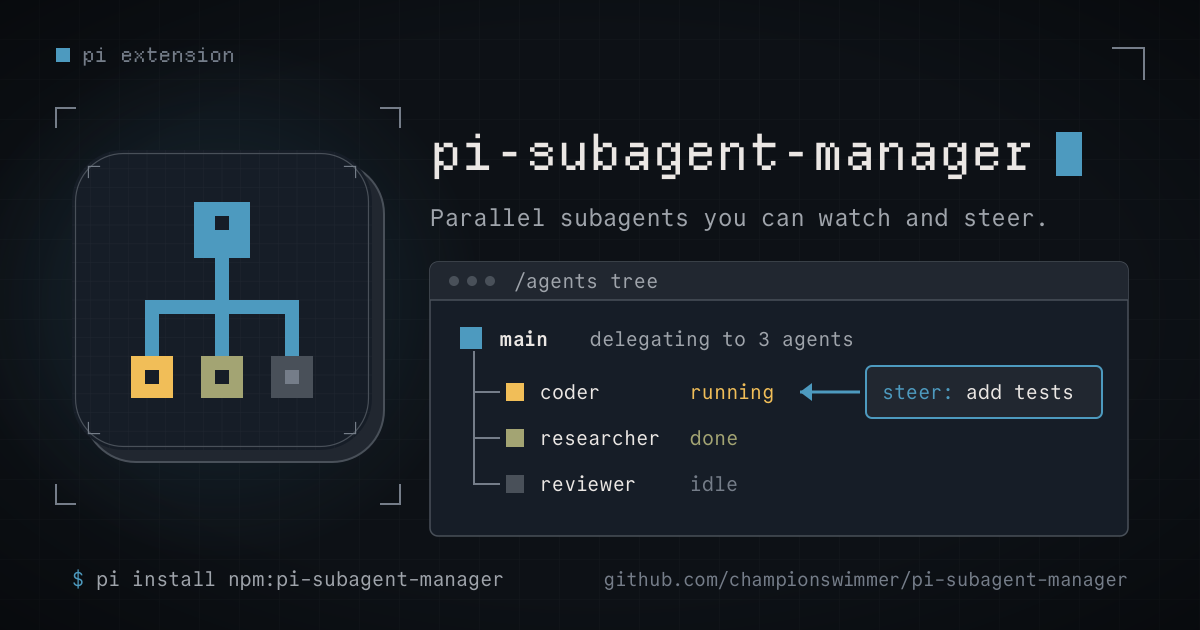




Let pi hand work to helper agents in parallel. Watch what they're doing, give them more direction, or pick up a finished agent's conversation.
Install
pi install npm:pi-subagent-manager
Requires pi 0.99.2+.
Why use it
- Hand independent jobs to helper agents that run in parallel.
- Watch any agent live in a nested agent tree.
- Steer a running agent with more direction, or resume it after it finishes.
- Choose
fork:to share your conversation orfresh:to start clean. - Six bundled roles, with per-role model, tools, and instructions you can change, plus custom agents.
How to use
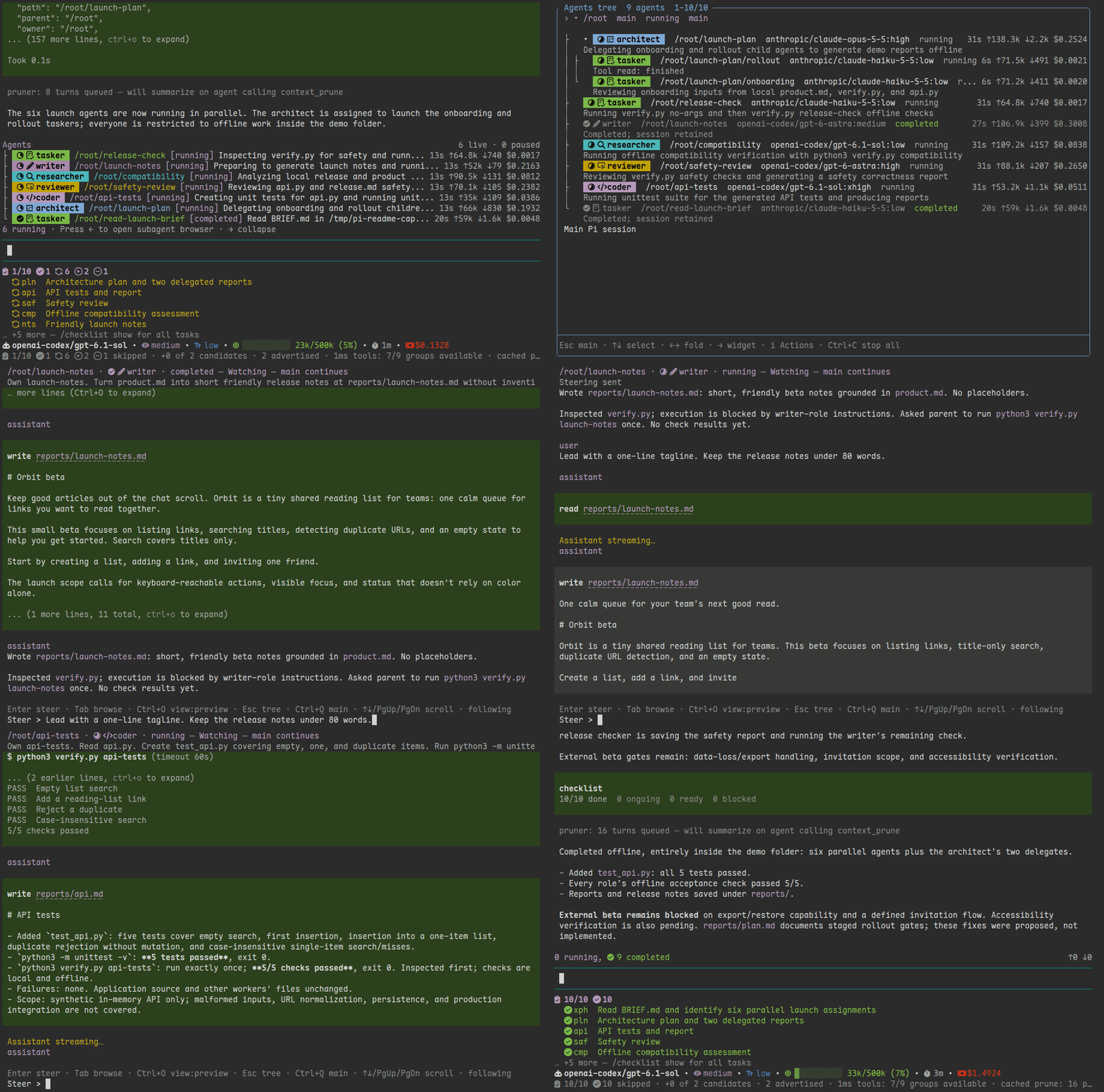
A real Pi session with a customized footer and Nerd Font: parallel work, nested delegation, watching, and steering. Recording details (37 seconds; pauses shortened).
Start using it
Ask pi to delegate in plain language:
Have a reviewer check my last commit while a researcher looks up how this repo handles retries.
Or start an agent yourself:
/agents fork:coder fix the failing auth test
fork: includes your current conversation. Use fresh: instead for a task that needs no conversation history.
The Agents widget above the input shows what's running. Open /agents tree, select an agent, and press Enter to watch it. Type in the Steer input to give it more direction or resume it after it finishes. Results also return to the main agent.
Bundled agents
| Agent | Use it for |
|---|---|
architect | Plans, tradeoffs, coordinating helpers |
coder | Implementation and debugging |
researcher | Codebase and web research |
reviewer | Finding correctness and security issues |
tasker | Small jobs and quick lookups |
writer | Drafting and editing prose |
They use your current model until you configure preferences. Open /agents types to change a role's model, tools, or instructions, or add your own agent.
Settings and safety
Open /agents to change delegation mode, limits, and display settings; save with Ctrl+S. Experimental options are marked [labs] in their help. [lab] Subagent extensions opens a per-extension chooser (Space/Enter toggles, Esc returns); Save and apply persists the selection for new subagent sessions. It lists auto-discovered .ts/.js files and subdirectory entry points in Pi’s agent-dir extensions/ (honoring PI_CODING_AGENT_DIR), trusted project .pi/extensions/, and configured/package files—not CLI-only/inline/built-in extensions; see limitations.
Agents share your working directory and OS permissions: tool policies are not a sandbox. Don't run multiple subagent extensions together — they clash on /agents.
Documentation
- Commands and navigation — watching, steering, stopping, and keyboard shortcuts
- Settings — models, tool access, limits, and experimental features
- Custom agents · Bundled roles
- Importing agents from other subagent packages
- Development · Changelog
Check out my other Pi extensions
— Real-time prompt cache hit rates and token metrics.
— Session task checklist with dependencies and a TUI renderer.
— Selects relevant skills and optionally filters tools for each task.
— Prunes verbose tool outputs from context while preserving history.
— Dot-grid visualization of context window token usage.
— Live tokens/sec and TTFT in the status bar.
— Delegate work to parallel subagents and monitor their progress.