
Install
Install with PiG
pig install npm:pi-review-panelInstall with Pi
pi install npm:pi-review-panelPackages run code with your permissions and influence agent behavior. Catalog inclusion is not a security audit. Review the source before installing a third-party package.
Pi manifest JSON
The pi field of package.json.
{
  "skills": [
    "./skills"
  ]
}
README
Written by the package's publisher, shown as published in version 1.1.0 (README.md). PiG does not review it.
Review panel
One model reviewing your PR is an opinion.
A panel is several exact models, on one pinned snapshot, that can report findings only through a structured channel, and a tool that is forbidden from saying the change is good. It reviews a committed change.
Most AI reviewers try to be the judge. They score the diff. They invent agreement. They print “ready to merge.” That is why you stopped trusting them.
Review panel does not judge. It seats the models you named, runs the lenses the change warrants, and hands you evidence. You keep or skip. You fix. It verifies the keep list. You merge.
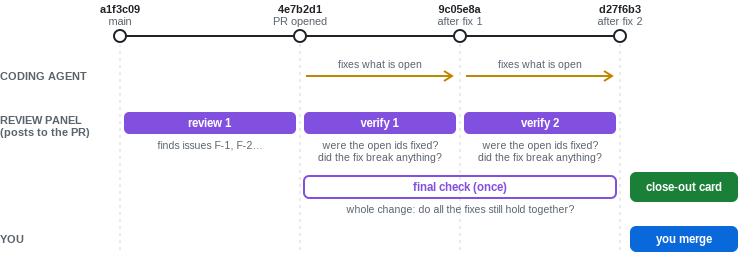
One PR with two fix rounds. Each verify compares only the commits since the last round. The final check runs once, over the whole change, before the close-out card.
Why this, not another “please review this”
Nothing else in this stack is a panel. A chat review is prose. A single-model CLI is one voice plus a correctness score. CI is the suite — reviewers here cannot run it, and they must not pretend they did.
What you get instead:
- Several models, not one. You pin exact
provider/modelseats. A dead seat is lost coverage, never a silent empty pass. - One snapshot. Review seats see the same committed
base…head. Uncommitted work is invisible on purpose. - Findings, not vibes. A finding exists only if a seat submitted it. The tool never parses a paragraph into a bug.
- Lenses when the change earns them. Holistic always runs. Security, tests,
contracts, and the rest fire when a trigger matches, or when the owner names them in
defaults.lenses. The example config namestests, so every review checks test value. - No verdict. No risk score. No “patch is correct.” Severity is an opinion you may drop or promote.
- Verify the keep list. After you fix, a new HEAD is checked against the
ids you kept — not a second full discovery circus. Each later verify chains
from the last one and checks only what is still open.
--recheck tests,securityalso hunts for new problems in that round's commits, at a review's cost in seats. - Each round on the PR. When the head is an open PR, the review and each
verify post a new comment there. The close-out card is posted once, as soon as
nothing is left open (
verify --close-out, orcommentright after a verify that left nothing open without it); the owner's say is needed only to stop the rounds with ids still open (commentthen lists them as open). One final check of the whole change runs first. The card shows counts by severity, each id with the verify round that resolved it or listed as still open, the verify seats, dismissals with reasons, leftover lows, and links to the review and verify comments. Never “fixed”, never “ready to merge.” A review with no findings and no verify after it needs no card: its comment says so. Turn it off per run with--no-pr-comment, or setdefaults.prComment: "ownerApproved"so every post needs the owner's yes.
Install
You need Node 26 or newer, git, and gh (for posting rounds to a pull request).
npm install -g pi-review-panel     # puts the `review-panel` command on PATH
review-panel skill install         # links the one skill into each coding agent
skill install links the review-panel skill into every coding agent it finds:
Claude Code (~/.claude/skills), Codex (~/.codex/skills), Grok (~/.grok/skills)
and Pi (~/.pi/agent/skills), each honouring the agent's own folder variable. It never
creates a folder for an agent you do not have, and never replaces a review-panel folder
that is not its own link without --force, which only works together with --agent. Details and options are in the
CLI guide.
The command runs the seats itself with the bundled Pi SDK, so Pi is not needed. It reuses
your Pi logins in ~/.pi/agent when you have them; otherwise:
review-panel auth providers           # the providers, and how each logs in
review-panel auth login <provider>    # sign in (or --api-key, reading the key from stdin)
review-panel models                   # the exact provider and model ids, with a roster row to copy
A provider that a Pi extension registers, such as claude-code, needs
review-panel extension install <source> first; it prints the path for the roster row.
Create ~/.pi-review-panel/config.json with the seats you want. Shape and location
rules are in the owner configuration guide, which walks through
setting up without Pi. Then:
review-panel diagnose
In any of those agents, ask:
/review-panel Review this change.
The agent runs the command, reads the report, and judges each finding.
Upgrading from 0.3.0 (Pi tool): the review_panel Pi tool is gone. Run
pi remove npm:pi-review-panel, then the two commands above.
How a run goes
review-panel diagnose
review-panel suggest --base origin/main --head HEAD
suggest runs no seat, but it reads the owner config for defaults.lenses. It
lists the lenses the diff's rules point at, each with its reason and evidence,
and marks the owner's default lenses as already on. The calling agent chooses
the lenses, with a reason for each, and passes the extras to review. The tool
never adds a lens by itself. When the diff cannot be read, it says
"Suggestions unavailable" with the cause; no rule ran, so choose from the
skill's trigger table.
review-panel review --base origin/main --head HEAD --lenses security
A review reply starts like this:
# Review panel
4/4 voted · 8 findings · 2m 57s · $1.6012
Seats: holistic (sol, opus), tests (sol, opus)
Record: `…/.review-panel/runs/…`
Seats: groups the seats by lens, failed seats included; a Lost: line under
it names any that failed. After the findings, a Suggest: block lists suggested
lenses that did not run, one per line with its reason and first evidence. Each
file name is shown as a code span, with any control or invisible format
character replaced:
Suggest:
- security: added line(s) touch auth/crypto/subprocess/deserialization (`src/run/record-key.ts:42`, +2 more)
When the owner names a grouping seat in defaults.consolidator, findings that
describe the same defect are shown once, as a group (G-1, …), with every
member's own id, seat, severity and evidence. Grouping never drops, rewrites or
re-rates a finding, and group size is never shown as agreement. Verify and
comment take G-ids as well as F-ids (see
Grouped findings).
review-panel verify --prior-run-id <run-id> --head HEAD --kept-finding-ids F-1
Pass the reasons for findings you chose not to fix, so the verify comment and the close-out carry them:
review-panel verify --prior-run-id <run-id> --head HEAD --kept-finding-ids F-1 \
  --dismissed '[{"id":"F-2","reason":"by design"}]' --low-advisory F-3
Later verifies chain from the latest verify and check only what is still open (see Verify rounds chain):
review-panel verify --prior-run-id <latest verify run-id> --head HEAD [--close-out]
Review and verify post their round to the open PR whose head is the run's head
(see Posting rounds).
Pass --close-out on the verify you expect to leave nothing open. comment is the manual
close-out card: run it right after a verify that left nothing open without --close-out, or
when the owner stops the rounds with ids still open:
review-panel comment --prior-run-id <run-id> --owner-approved --pr 29
review-panel resume --prior-run-id <run-id>
A review that was killed keeps every seat that had finished. resume
runs only the missing seats against the same head commit and writes the report.
Holistic seats always run. Optional --lenses add extras. Optional --scoping-note
focuses a large diff. Every command and flag is in the CLI guide.
Records land under .review-panel/runs/. The reply is coverage, findings
or dispositions, and lost seats. The tool computes no merge decision.
Status
1.0.0: one review-panel command and one skill, published from the
pi-review-panel npm package. Diagnose,
suggest, review, verify, resume, and comment are the public path. The
package ships a built dist/ (built at pack time, never committed) and depends
on the Pi SDK it runs seats with.