
Install
Install with PiG
pig install npm:pi-pretty-taskInstall with Pi
pi install npm:pi-pretty-taskPackages run code with your permissions and influence agent behavior. Catalog inclusion is not a security audit. Review the source before installing a third-party package.
Pi manifest JSON
The pi field of package.json.
{
  "image": "https://raw.githubusercontent.com/mystery4f/pi-pretty-task/main/docs/preview.png",
  "skills": [
    "./skills"
  ],
  "extensions": [
    "./src/index.ts"
  ]
}
README
Written by the package's publisher, shown as published in version 1.1.0 (README.md). PiG does not review it.
pi-pretty-task
Background processes and scheduled agent wake-ups for pi, behind one panel.



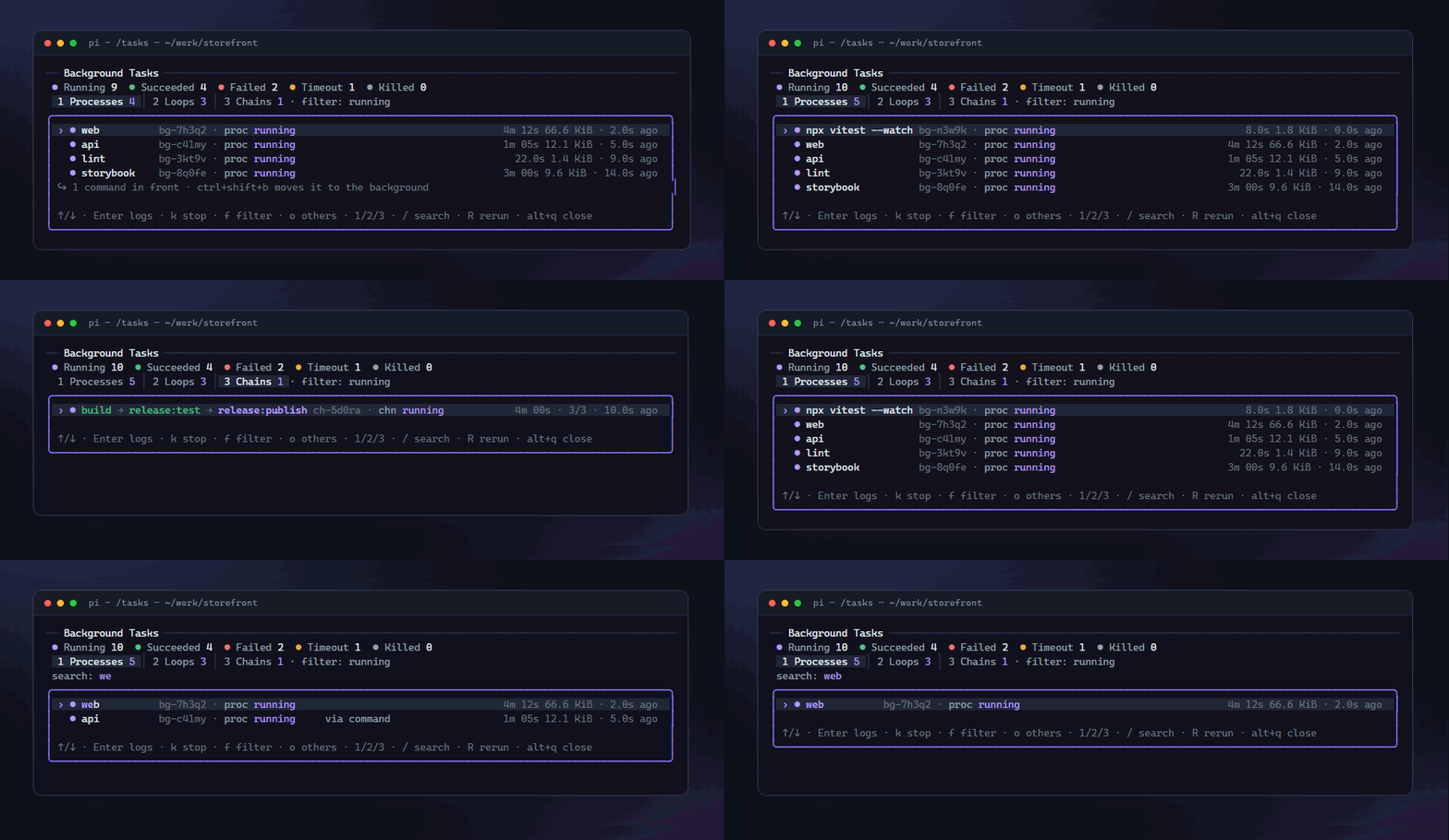
A build that takes six minutes. A watcher that runs all afternoon. A loop that wakes the model every ten minutes. They all land in the same list — readable, searchable, stoppable — and the output is still on disk when the turn is over.
Install
pi install npm:pi-pretty-task
Requires pi and Node >= 22.19. A local checkout works too: pi install ./path/to/pi-pretty-task, or pi install git:github.com/mystery4f/pi-pretty-task for the latest main.
Why use it
| You want to… | Use |
|---|---|
| Start a build, dev server or watcher and keep talking to the agent | pretty_task_bg_run |
| Wait for it without sleeping, polling or burning a turn | pretty_task_bg_wait |
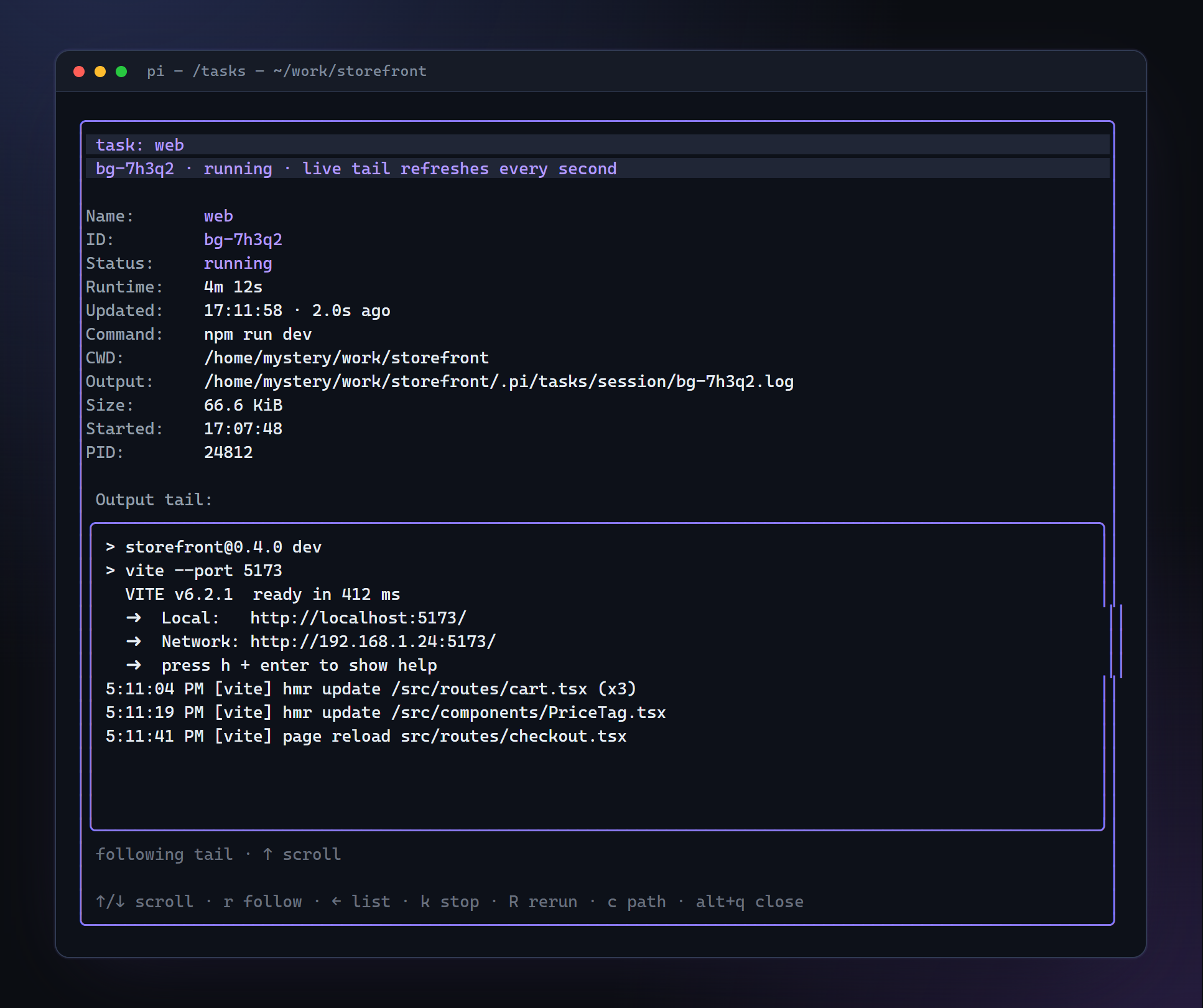
| Read what it printed — or only what is new since last time | pretty_task_bg_logs, add follow |
| Find the one error in 40 MB of output | pretty_task_bg_grep |
| Stop it and its children, not just the parent pid | pretty_task_bg_kill |
| Run something after another job succeeds, instead of now | pretty_task_bg_run with after |
| Wake the agent on a schedule — interval or cron | pretty_task_loop_create |
| Find out what that wake-up actually did | pretty_task_loop_list with an id |
| Just look at everything | /tasks, or shift+down |
One panel, three records
Task — a long-lived shell command in the background, watched, with its whole process tree killable. Output goes to a file, so "what did it print?" survives the turn.
Chain — a command queued behind another task or chain instead of started now. A step is recorded as
waitingand starts only after the step ahead ends with exit 0; a failing step leaves the ones behind itskipped.Loop / Iteration — wake the LLM on a schedule with a preset prompt (
30s/10m/2h, or five-field cron such as0 9 * * 1-5), and record every tool call of the turn that follows, so "what did that loop actually run?" has an answer. A fire that made no tool call prints its0 callsas a fact, and two in a row are marked — a turn that read files and thought before acting is not a stall on its first occurrence. A turn pi is retrying after a provider error says so —retry 2/4 · 529on the loop row, and a Retry field on the iteration page — so four failed attempts are not mistaken for one slow one. When the provider finally gives up, that fire is counted: the loop keeps the error, the time and a run of consecutive failures, its row counts the run (2 failedbeside the fire count) and its page prints the error the provider gave up with and reads that fire asfailedrather thancompleted, and its next wake is pushed back instead of hammering a provider that is down — while a turn you stopped yourself counts for nothing. Wakes wait for an idle agent instead of interrupting a turn.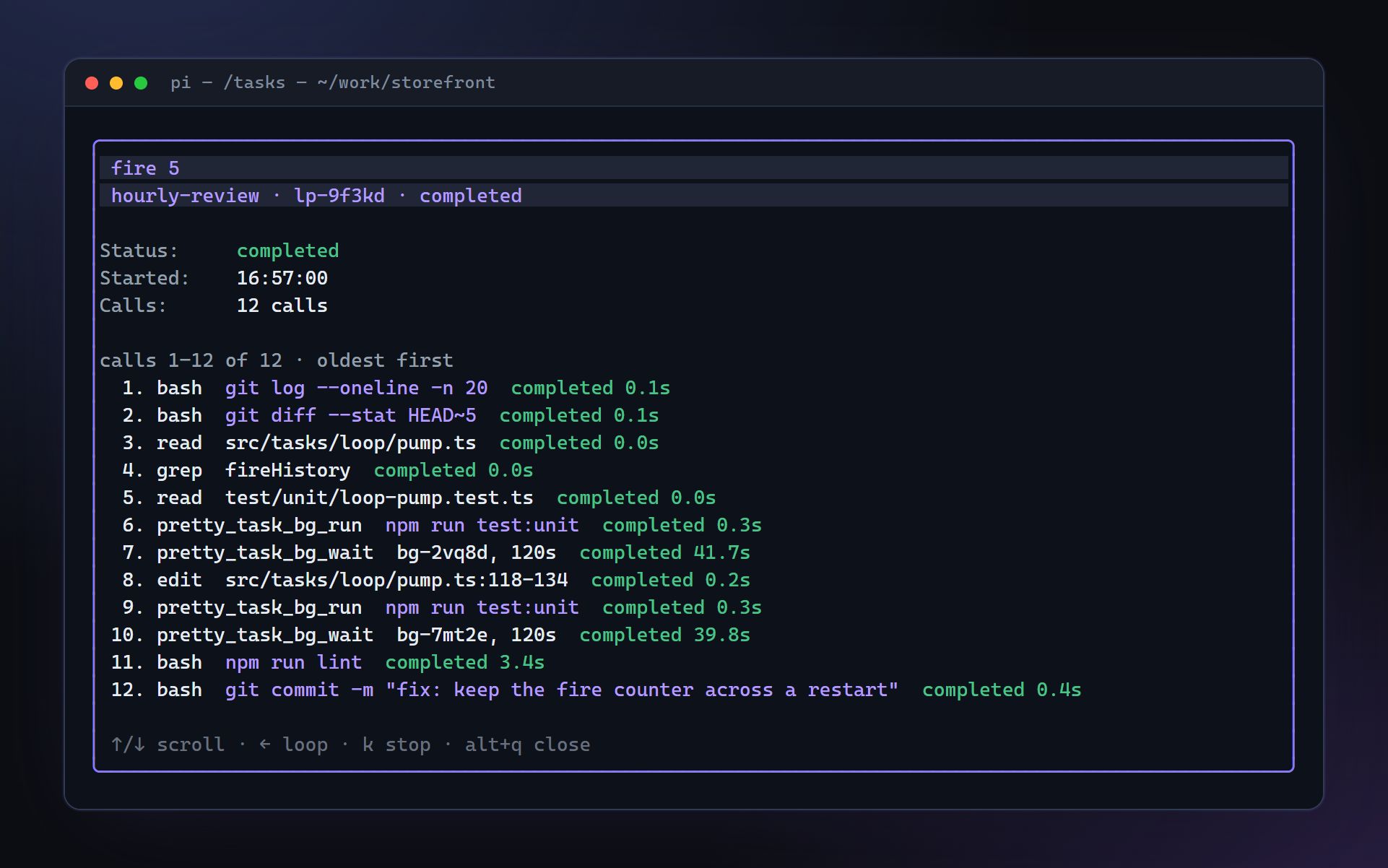
A fire that comes due while the previous one still runs is skipped and counted, never queued. An id says its kind on sight: bg- runs a command, lp- wakes the assistant, ch- is a chain.
Deliberately not here: subagent/delegate/fusion tools, monitors-with-shell, workflow/orchestration families, provider-attested runs. See docs/scope-v1.md.
The panel
Opens with /tasks or shift+down, and has three tabs — processes, loops, chains. One summary line above the editor stays after it closes; the footer row is shared with every other extension, so the count lives where it can be read.
List keys: ↑/↓ select, Enter open, ← back, k stop, a stop all, f cycle filter (all/running/failed/done), o toggle other sessions' records, R rerun, c show the output path, / search, x close from the list, alt+q close from anywhere (the first press leaves search mode).
↑/↓ · Enter logs · k stop · f filter · o others · 1/2/3 tabs · / search · R rerun · a stop all · alt+q close
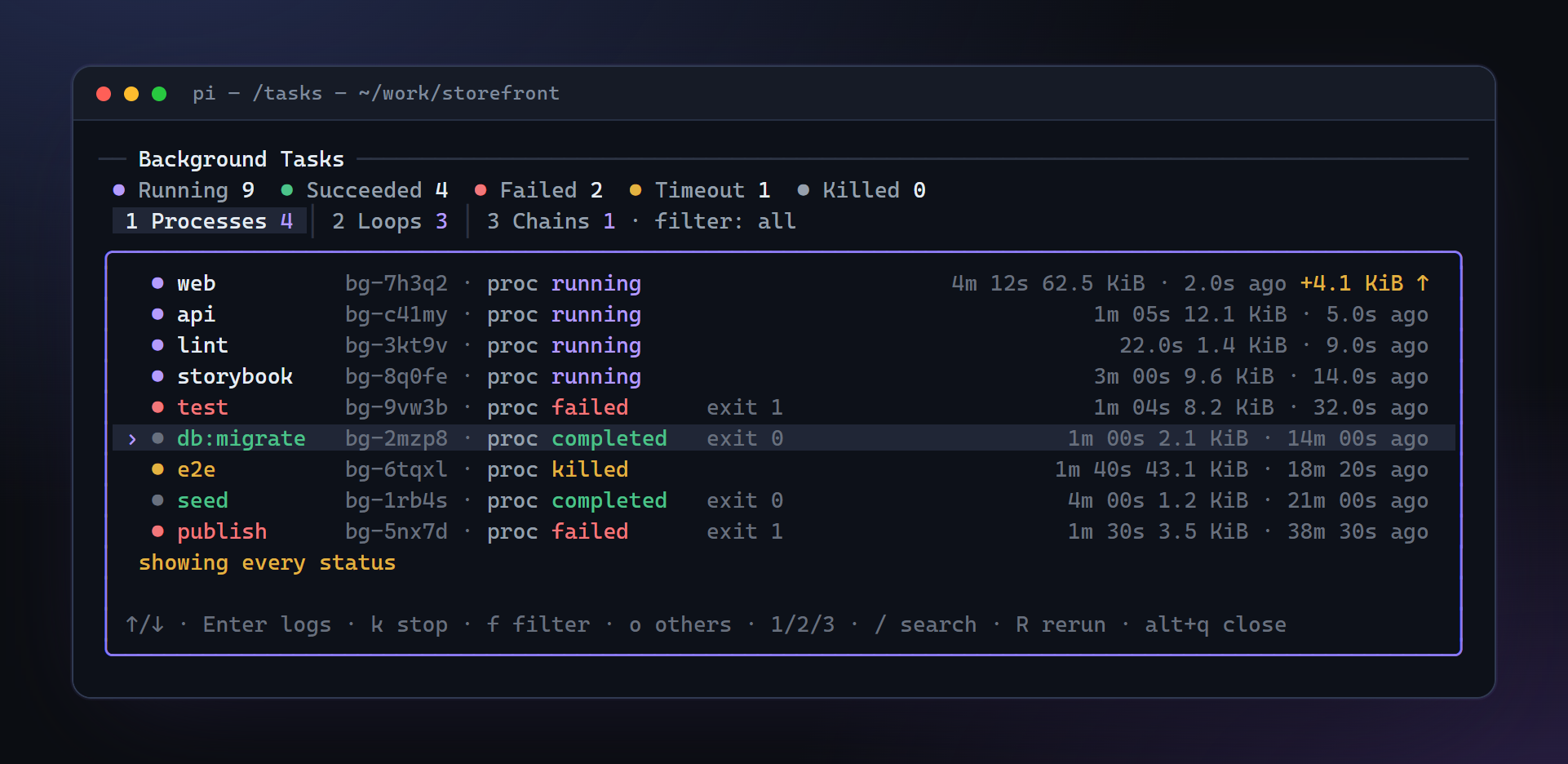
Every image on this page is a screenshot of the shipped panel, not a mock-up: npm run preview renders them from TasksPanel itself, so a change in src/ui/panel/ shows up in the next run instead of drifting away from the picture.
Use it
pretty_task_bg_run    command: "npm run build", name: "build"
pretty_task_bg_status id: "bg-4xq81"
pretty_task_bg_logs   id: "bg-4xq81", follow: true
pretty_task_bg_grep   id: "bg-4xq81", pattern: "error"
pretty_task_bg_wait   id: "bg-4xq81", timeoutSeconds: 120
pretty_task_bg_kill   id: "bg-4xq81"

pretty_task_loop_create schedule: "10m", prompt: "Check the deploy and report drift."
pretty_task_loop_create schedule: "0 9 * * 1-5", command: "npm run nightly"
pretty_task_loop_update id: "lp-9f3kd", action: "pause"
pretty_task_loop_update id: "lp-9f3kd", prompt: "Check the deploy, and report only drift."
pretty_task_loop_list   id: "lp-9f3kd"
Stopping means the whole tree: SIGTERM, a grace period, SIGKILL, then a poll until the process group is really gone — grandchildren included. On Windows that is taskkill /PID <n> /T.
A command in front can be let go
A long build is already running in front of you — the first frames of the animation above are this exact move. With PI_PRETTY_TASK_ADOPT_FOREGROUND=on, the built-in bash tool — and your own ! commands — run through this extension, so ctrl+shift+b moves the one command currently in front to the background instead of killing it. The call ends with the output it had captured and a ↪ moved to bg-… line, and the command keeps running as an ordinary task: pretty_task_bg_logs, pretty_task_bg_status, pretty_task_bg_kill all work on it.
PI_PRETTY_TASK_FOREGROUND_TIMEOUT does the same on a timer, for the terminal you have already walked away from; 0, the default, never moves anything. A call's own timeout still stops the tree — a timeout is a failure, not a move. The takeover is off by default because it re-registers pi's own shell tools; see ADR-0020.
Leave it running while you are away
A prompt loop is a clock: every fire delivers a message into the session and starts one turn. That is enough to keep a long job moving overnight, provided the work has somewhere to live and the loop knows when to stop.
- Keep the work in a progress file, one item per line with an acceptance check on each. "
npm run test:unitexits 0" can be finished; "improve the code" cannot. - Put a closing contract in the loop's prompt: tick the item that finished, and when nothing is left call
pretty_task_loop_update id=<id> action=complete. - Fine-tune the wording without touching the schedule: every fire reads the loop's prompt file (the path
pretty_task_loop_listprints, and the loop's page in/tasksshows along with its first three lines and when the file last changed), so an edit takes effect on the next fire and deleting the loop deletes the file. The same change goes throughpretty_task_loop_update id=<id> prompt="…"when the agent is the one refining the wording: the loop keeps its id, fire count and iteration history, the text given at create time stays the seed the file falls back to, and a write that cannot land leaves the old text in place and says so in the reply. - Always pass
maxFires. It is the only stop that does not depend on the model's own judgement.
The bundled pretty-task-unattended skill carries the whole recipe — the file shape, the exact contract text, and what to read the next morning. Ask for it in plain words ("run this unattended overnight") and it fills in the calls.
Tools
| Tool | What it answers |
|---|---|
pretty_task_bg_run | Start a command; also starts a chain step with after, or a named template with template |
pretty_task_bg_status | Status, elapsed time, working directory, kill reason |
pretty_task_bg_logs | The output tail, or follow for only what arrived since the last read |
pretty_task_bg_grep | Matching lines of the whole output file |
pretty_task_bg_wait | Wait for a task to end, up to 600 seconds |
pretty_task_bg_kill | Stop the task and every process it started |
pretty_task_loop_create / _list / _update / _delete | A schedule, its fires, and its recorded iterations |
Configuration
Every key is read once at load; a value it cannot use fails the extension with the key name instead of silently falling back.
| Key | Default | Meaning |
|---|---|---|
PI_PRETTY_TASK_OUTPUT_CAP_BYTES | 20971520 (20 MiB) | Output file cap; crossing it kills the tree with reason output_cap |
PI_PRETTY_TASK_MAX_RUNNING_TASKS | 20 | Running process records per session, children and steps included |
PI_PRETTY_TASK_NOTIFY | on | Write an OSC 9 notification to the terminal when a task ends |
PI_PRETTY_TASK_RETENTION_DAYS | 7 | Session directories older than this are pruned at startup |
PI_PRETTY_TASK_SHELL / _SHELL_PATH | bash | Windows shell (cmd, bash) and its absolute path; bash.exe comes from Git for Windows — the one pi was started from, then the git on PATH, the registry, the usual install dirs, then PATH |
PI_PRETTY_TASK_POSIX_SHELL / _POSIX_SHELL_PATH | bash | POSIX shell (inherit, bash, sh) and its path |
PI_PRETTY_TASK_ADOPT_FOREGROUND | off | Run pi's bash tool and ! commands through this extension, so the command in front can be moved to a task; the powershell tool it registers has no such move |
PI_PRETTY_TASK_FOREGROUND_TIMEOUT | 0 | Seconds before the command in front is moved to the background by itself; 0 never moves |
Command templates live in <project>/.pi/pretty-task.json and ~/.pi/agent/pretty-task.json, project first, and are read once at load — a file edited mid-session applies after /reload. Adding or changing one is covered by the bundled pretty-task-templates skill.
Full detail, including the shell rules, decoding order and per-call cwd/env: docs/configuration.md.
Documentation
Start at AGENTS.md for the product model and rules, and GLOSSARY.md for the vocabulary. Scope and decisions live in docs/ — docs/scope-v1.md and the ADRs under docs/adr/ — and the index for all of it is the wiki page .llm-wiki/wiki/syntheses/pi-pretty-task-文档索引.md.
Development
npm install
npm run verify    # check + lint + test
npm run build     # emit dist/
npm run preview   # build, then re-render docs/preview*.{png,gif}
npm run check typechecks without emit, npm run lint is Biome, npm run test runs vitest over both projects, npm run test:unit the pure half in seconds. Style is machine-enforced by .editorconfig + Biome; dist/ is build output and is never committed. AGENTS.md has the full verification list.
npm run preview drives the built panel with scripted keystrokes in a headless browser and writes the images on this page; it needs a Chrome or Edge on the machine (PREVIEW_BROWSER points at another one). docs/previews.md covers the frames and the colours.
Releasing
Published to npm by .github/workflows/publish.yml when a GitHub Release is published. Steps, token requirements and the traps: docs/releasing.md.
License
MIT