
Install
Install with PiG
pig install npm:pi-llama-infraInstall with Pi
pi install npm:pi-llama-infraPackages run code with your permissions and influence agent behavior. Catalog inclusion is not a security audit. Review the source before installing a third-party package.
Pi manifest JSON
The pi field of package.json.
{
  "image": "https://raw.githubusercontent.com/noguerol/llama-infra/main/docs/preview.jpeg",
  "extensions": [
    "./src/index.ts"
  ]
}
README
Written by the package's publisher, shown as published in version 1.9.0 (README.md). PiG does not review it.
llama-infra — Discovery, Metrics & Control for Local LLM Runtimes
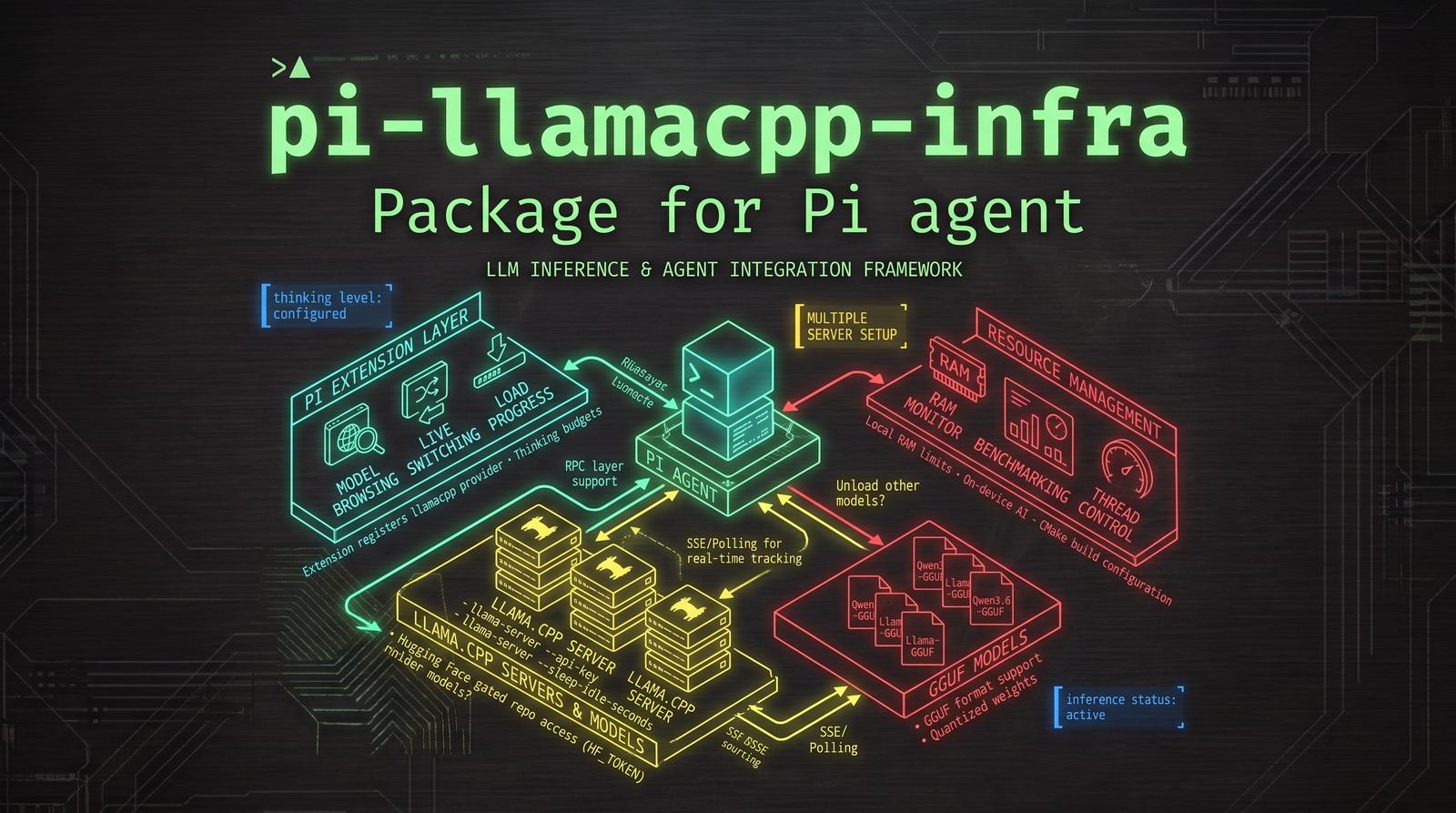
llama-infra turns pi into a first-class citizen of your local LLM infrastructure. It is built primarily around llama.cpp and its family (ZINC, DwarfStar/ds4, lucebox, LM Studio), and now also speaks the most popular OpenAI-compatible runtimes — vLLM / SGLang / TGI — and the halogen and gufo engines. It probes any number of machines — localhost, LAN or Tailscale — discovers every served model, registers them into pi's native /model list, and gives you live Prometheus metrics, per-model thinking budgets, vision detection and a full configuration UI — all without leaving the pi prompt.
Supported Servers
Every endpoint llama-infra talks to runs llama.cpp, a direct variant, or an OpenAI-compatible server (vLLM-family, halogen or gufo):
| Server | Detection | Notes |
|---|---|---|
| llama.cpp | GET /v1/models with meta.n_ctx | Single-model and router/multi-model modes |
| ZINC | owned_by: "zinc" | Payload workaround: empty model field + tool normalization |
| DwarfStar / ds4 | Opt-in ping to /v1/chat/completions | antirez's ds4-server for DeepSeek V4 (per-server probeDs4 flag) |
| lucebox | GET /props with server.name: "luce-*" | DeepSeek dflash server with rich metadata |
| LM Studio | GET /v1/models + optional /api/v1/models metadata | Local OpenAI-compatible server backed by llama.cpp; default port 1234 |
| vLLM / SGLang / TGI | owned_by: "vllm" in GET /v1/models | OpenAI-compatible runners; context from max_model_len; no /props, no /slots; thinking via thinking_token_budget |
| gufo | owned_by: "gufo" in GET /v1/models | llama.cpp fork with its own runtime; context from context_length, drafter from /slots[].speculative; /props is a placeholder (400 without ?model=), so no GGUF metadata and no LM Studio catalog probes; thinking on/off via chat_template_kwargs.enable_thinking (see gufo) |
| halogen | owned_by: "halogen" in GET /v1/models with no /props | OpenAI-compatible engine; context and vision read from GET /health (slot_ctx / context, vision.enabled); thinking on/off via chat_template_kwargs.enable_thinking; metrics served in the llamacpp: namespace (see halogen) |
Anything else (Ollama, cloud APIs…) is out of scope — use pi's built-in providers for those.
Features
- Multi-machine discovery — configurable list of servers (host, ports, API key, options); probes all of them at startup and on demand
- HTTPS servers — per-server
protocol(http/https) for machines proxied behind TLS (Tailscale serve, Caddy, …); discovery, metrics, warmup and chat requests all follow the configured scheme. Only public CA-issued certificates are supported — self-signed certificates are not supported - Compact model ids — models appear as
Name (host:port)in pi's/modelpicker, like a native provider; the raw GGUF path/alias is sent to the server automatically on every request - Single-model & router modes — llama.cpp single-model mode (one GGUF per instance) and router mode (multiple models per server, with per-model status and args)
- Long local generations — discovered models are registered with up to 32,768 output tokens (bounded by the model/server context) and llama-infra OpenAI-compatible requests enforce a 20 minute timeout floor so slow local runs don't get cut early by pi defaults
- Per-model metadata badges — 👁️ vision (mmproj / modalities), 🚀 drafter (speculative decoding), 🗜️ quant tag from GGUF filename, 🧠 KV cache quantization (from server args or
/proc) - Live speed & metrics — a constantly updating footer reading of the active model's prefill (⚡, or its time-to-first-token when the prompt is too short/cached to measure a throughput) and generation (🔥) token speed, measured straight from the stream (~10 updates/s, same accounting as trimegisto's
↑prefill ↓decode); when pi is idle it also mirrors other clients the server's/metricsendpoint reports. Lives in the footer's status line, so no extra terminal row is taken. Works even without--metrics - Energy cost (💰) — local models report no per-token cost, so llama-infra estimates the electricity the inference consumed: configure each machine's power draw (kW) and tariff (per kWh) once, and every assistant message carries a realistic
usage.cost.total(kW × €/kWh × measured request time) — pi's native cost footer, session stats and any consumer reading usage (e.g. trimegisto agents) all show it. Currency selector: USD / EUR / GBP / CNY - Thinking budgets — llama.cpp accepts
thinking_budget_tokensper request; configure budgets per thinking level (minimal/low/medium/high/xhigh/max) per model; models with budgets are registered with reasoning enabled. llama.cpp-family models are registered with theqwen-chat-templatethinking format, so pi also sendschat_template_kwargs.enable_thinkingand the off level actually stops reasoning (required for halogen, which defaults toxhigh) - Header warmup — pre-caches the system prompt KV on llama.cpp-family servers so the first real request is faster
- LM Studio support — uses LM Studio's OpenAI-compatible
/v1API, enriches names/context/quant/vision from/api/v1/models(or legacy/api/v0/models), and avoids llama.cpp-only request fields - vLLM / SGLang / TGI support — auto-detects
owned_by: "vllm", reads the context window frommax_model_len, normalizes thevllm:metrics namespace, and uses vLLM's ownthinking_token_budgetfield (see vLLM / SGLang / TGI) - gufo support — auto-detects
owned_by: "gufo", reads the context window fromcontext_lengthand the 🚀 drafter from/slots[].speculative, keeps the llama.cpp thinking contract (thinking_budget_tokens+chat_template_kwargs.enable_thinking), keeps prompt warmup on (cache_promptreuse verified), skips the/propsand LM Studio probes gufo cannot answer, and reads gufo'sllamacpp:-namespace metrics for the speed footer and 🎯 spec-accept rate (see gufo) - halogen support — auto-detects
owned_by: "halogen"and reads both the real context window (/healthslot_ctx/context) and the vision capability (/health.vision.enabled), with an 8 s probe floor and a sticky per-machine context, so pi never compacts at the 32k fallback on a 262k model and vision-enabled models register with the 👁️ badge; thinking can be turned off/on throughchat_template_kwargs.enable_thinking(see halogen) - ZINC workaround — ZINC rejects non-empty model IDs; the payload hook rewrites the request and normalizes tool definitions automatically
- Vision detection — scans
/procfor local llama-server processes launched with--mmprojand marks those models as image-capable; also reads server-reportedmodalities/input_modalitiesand halogen's/health.vision.enabled - Native configuration UI — everything configurable through
/llama-infra config; the discovery settings panel uses pi's own/settingscomponent (SettingsList): one row per option with its value, a help line under the list explaining the highlighted option, Enter/Space to change, fuzzy search; no config file editing required - Legacy migration — auto-migrates an existing
~/.pi/agent/local-models.jsonon first run
Install
llama-infra is a pi package: a small entrypoint (src/index.ts) backed by several focused modules. Heavier pieces (UI, scan engine, metrics, header warmup) are loaded lazily on first use so the extension stays light at startup. The package is declared in package.json.
# From GitHub
pi install git:github.com/noguerol/llama-infra

# Pin a tag/commit
pi install git:github.com/noguerol/llama-infra@v1.2.0

# From npm
pi install npm:pi-llama-infra

# Local checkout (development)
pi install /path/to/llama-infra

# Try it for one run only
pi -e git:github.com/noguerol/llama-infra
pi list                         # show installed packages
pi remove npm:pi-llama-infra
Security: pi packages run with full system access. Install only packages you trust and review the source.
Requirements: a working pi installation and at least one supported server running somewhere accessible (localhost, LAN or Tailscale): a llama.cpp-family server, an OpenAI-compatible vLLM/SGLang/TGI endpoint, a halogen server, or a gufo server. LM Studio works when its local server is started (Developer tab or lms server start, usually on http://localhost:1234/v1).
Quick Start
/llama-infra config      # open the config menu → add your first server (LM Studio: port 1234)
/llama-infra scan        # discover models now
/llama-infra list        # see what was found
That's it. On the next pi startup, llama-infra probes your servers automatically and registers every model into /model. Switch models with /model as usual.
LM Studio quick setup
LM Studio exposes an OpenAI-compatible API on /v1 (default http://localhost:1234/v1) and a richer local REST API for model metadata on /api/v1/models (older LM Studio versions used /api/v0/models). llama-infra probes /v1/models as the source of usable model IDs and, when available, enriches them with LM Studio's context length, display name, quantization and vision capability.
# Start LM Studio's local server (or use the Developer tab in the GUI)
lms server start

# In pi: add/select host 127.0.0.1 with port 1234, then scan
/llama-infra config
/llama-infra scan
No special payload workaround is required: LM Studio accepts standard OpenAI chat-completions requests. llama-infra deliberately does not send llama.cpp-only fields such as cache_prompt or thinking_budget_tokens to LM Studio.
vLLM / SGLang / TGI
OpenAI-compatible servers that advertise owned_by: "vllm" in GET /v1/models are detected automatically — no extra flags. vLLM/ROCm is the reference case (example-vllm-model on 127.0.0.1:8081); SGLang/TGI reuse the same code path.
Discovery & context — the server kind comes from owned_by: "vllm" and the context window from max_model_len (e.g. 262144 for example-vllm-model). vLLM has no /props and no /slots, so llama-infra skips both probes entirely (llama.cpp still uses them). The built-in default servers already probe port 8081:
curl -s http://127.0.0.1:8081/v1/models | jq -r '.data[0] | "\(.id) owned_by=\(.owned_by) ctx=\(.max_model_len)"'
# example-vllm-model owned_by=vllm ctx=262144
Thinking budgets — vLLM's Qwen chat template exposes chat_template_kwargs.enable_thinking (verified: false → 0 reasoning tokens, true → reasoning is produced). The budget field is vLLM's own thinking_token_budget — not llama.cpp's thinking_budget_tokens — and it caps reasoning tokens while thinking is on (verified: 64 → 63, 128 → 127; 512 had no effect because the model stopped on its own). Configure per-level budgets under modelOptions as usual; for vLLM models the extension injects thinking_token_budget. Because vLLM silently ignores llama.cpp's thinking_budget_tokens, llama-infra also renames that field to the engine's field on the way out (so pi's native level budget works even when the server kind is not detected). If detection fails entirely (renamed wrapper, remote SGLang/TGI), force the field per model with modelOptions[id].thinkingBudgetField: "thinking_token_budget". preserve_thinking, reasoning_budget_tokens and chat_template_kwargs.reasoning_effort are accepted but ignored by this server.
Servers that reject the field — some OpenAI-compatible engines validate request fields strictly instead of ignoring unknown ones: a vLLM fork served by a custom native worker answers HTTP 400 not supported by the … native worker: thinking_token_budget. Two things happen then:
- Self-healing (automatic) — when a turn fails with that error before producing any content (pi-ai emits
startfirst, so llama-infra buffers until the error or the first real content event), or with a bare400 status code (no body)while a budget field was actually sent, llama-infra retries the request once without any budget field. If the retry succeeds it remembers the opt-out —modelOptions[id].thinkingBudgetField: falseis written to the config, so neither the current session nor later scans ever send the field again. If the retry fails too (an unrelated 400, e.g. context overflow) the original error is surfaced untouched and nothing is persisted. - Manual opt-out — set
"thinkingBudgetField": falseper model (or typenone/offin 🧠 Thinking budgets → 🔤 Budget field). llama-infra then registers the model withcompat.thinkingTokenBudgetField: false(pi's documented "do not send it" value), stops renaming into the field and strips any leftoverthinking_budget_tokens/thinking_token_budgetfrom the outgoing payload.
{
  "modelOptions": {
    "Example-Model (gpu-host:8081)": { "thinkingBudgetField": false }
  }
}
Thinking levels and chat_template_kwargs keep working; only the token budget is not sent.
Metrics — Prometheus names are normalized from the vllm: namespace (just like llamacpp:), so the footer ⚡/🔥 and ▶n (other clients) readings work unchanged. Generation rate is read from vllm:generation_tokens_total.
Local vision detection & manual overrides — vLLM publishes neither vision modality nor drafter/spec-decode info over HTTP. For local engines (loopback host, with detectVision enabled) llama-infra now reads the engine's own process args from /proc and uses them as ground truth for vision:
--language-model-only, or--limit-mm-per-prompt '{"image":0}'→ text-only;--limit-mm-per-prompt '{"image":N}'withN > 0→ vision.
Wrappers whose process is not literally named vllm are still recognized by their flag surface — an OpenAI-style launcher that carries --served-model-name together with --max-model-len, --tensor-parallel-size or --gpu-memory-utilization — so a line such as python3 /usr/local/bin/custom-serve serve … --served-model-name my-model --max-model-len 32768 is covered too.
The manual modelOptions[id].vision override remains the final word: it wins over both server-reported data and the process-arg ground truth, and it is still required for remote/non-loopback vLLM servers, which expose no /proc. Set vision/drafter explicitly per model under modelOptions. The key may be the raw server id (/v1/models → id) or the registered name shown by /model, which appends the (host:port) suffix:
{
  "modelOptions": {
    "Example-27B (gpu-host:8000)": { "vision": true },
    "example-vllm-model": { "vision": false, "drafter": "DFlash2 15/7" }
  }
}
The resolver accepts both forms (raw id, registered display id, and the legacy host:port/<raw id> key) at scan and registration time, so the override survives rescans and does not depend on the compact-id cache being warm. Overrides always win over server-reported data, so vision: false also disables a wrongly detected tower.
models.json fallback (published npm build) — if you cannot edit the extension, force the input modality from pi's own ~/.pi/agent/models.json. Use the provider id llama-infra (not llamacpp-infra) and modelOverrides, which merges onto the extension-provided model instead of replacing it (a providers.*.models entry would replace the model and drop its contextWindow, reasoning and headers):
{
  "providers": {
    "llama-infra": {
      "modelOverrides": {
        "Example-27B (gpu-host:8000)": { "input": ["text", "image"] }
      }
    }
  }
}
Known limitations
- vLLM does not report
modalitiesover HTTP. For local loopback engines withdetectVisionenabled, vision is inferred from the process args (--language-model-only/--limit-mm-per-prompt '{"image":0}'→ text-only;--limit-mm-per-prompt '{"image":N>0}'→ vision), including non-vllm-named wrappers detected by their flag surface. Remote servers keep HTTP-only detection, so force vision there withmodelOptions[id].vision = true(raw server id or registered name with the(host:port)suffix); the manual override always wins. - Drafter/spec-decode gets no name badge unless set via
modelOptions[id].drafter; when vLLM exposesvllm:spec_decode_*, the footer shows the drafter acceptance ratio (🎯). cacheK/cacheVKV-quant badges stay empty (GGUF/llama.cpp-specific).- No
/slots, so server-side idle stats come fromvllm:num_requests_running, plus the spec-decode acceptance ratio (🎯) and prefix-cache hit ratio (♻️) derived from thevllm:counters. - vLLM serves one model per process; the server
modestayssingle. - The server enforces a hard limit and returns HTTP 400 when prompt +
max_tokensexceedsmax_model_len; a correctcontextWindowkeeps pi's compaction predictable. Since no client-side estimate is tokenizer-exact for tool-heavy prompts, the provider stream also self-heals that 400 by retrying with themax_tokensthe server's own prompt count allows (see Tools-aware request clamp + overflow self-healing). When only one model needs a lower generation cap, setmodelOptions[id].maxTokens(see Per-model output cap) instead of lowering the globalsettings.maxOutputTokens. - This particular server does not validate types (e.g.
enable_thinking: "false"is accepted); pi always sends proper booleans.
Tools-aware request clamp + overflow self-healing — llama-infra recomputes max_tokens on every provider request: in a before_provider_request hook for normal turns, and in an onPayload wrapper for nested ctx.modelRegistry.streamSimple() calls (which bypass the plugin hook). It estimates the full payload — messages plus tool schemas, counting images at a fixed cost and skipping base64 data — using conservative divisors (chars/3.5 for text, chars/3 for tool JSON; pi's own estimateContextTokens() uses chars/3.5 and is blind to tool schemas) and reserves headroom of max(4096, 10% of the estimate): a flat reserve is eaten whole by the estimator's own bias on a long tool-heavy prompt (measured: 71221 estimated vs 75318 counted by the server, +5.8%), leaving prompt + max_tokens = context + 1 — the exact 400 the clamp exists to prevent. The headroom therefore grows with the prompt it is protecting. The per-model modelOptions[id].maxTokens remains the ceiling for normal turns: the clamp only lowers max_tokens when the estimated prompt requires the headroom, and never raises it above the configured cap. Compaction checkpoints are the exception. pi sizes a summary with model.maxTokens, and for servers that announce no limit of their own that is llama-infra's generation policy (settings.maxOutputTokens, 32768 by default). A cumulative summary grows past that policy, gets cut mid-sentence, and pi discards the partial checkpoint — Summarization failed: generation hit the token cap and the summary is incomplete — leaving the session unable to compact. Summarization requests (recognised by pi's own summarization system prompt, no tool schemas) are therefore sized to the room the window actually has, which may be above the configured cap, still under the same prompt + max_tokens + reserve <= contextWindow rule — and bounded by a checkpoint ceiling: a summary is a distillation of the transcript it summarizes, so the request never asks for more output tokens than the estimated transcript (summarizationOutputCeiling() in src/runtime.ts). Without that ceiling a checkpoint grows to the last free token of the window: on a 262144-token window that was 215045 output tokens, which left only 47100 for a prompt the estimator had under-counted at ~42800, and vLLM answered 400.
No heuristic is exact, so when a strict engine still answers HTTP 400 (This model's maximum context length is 200000 tokens … your prompt contains at least 167233 input tokens), the provider stream parses the prompt size the server counted, buffers the failed turn (a 400 produces no content), and retries with max_tokens = contextWindow - reported prompt - reserve. That count is a lower bound — vLLM says at least N input tokens — so treating it as exact was how a retry could overflow again; the retry keeps a quarter of the remaining room free (OVERFLOW_LOWER_BOUND_SHARE) and may repeat up to OVERFLOW_MAX_RETRIES times, each attempt reading the newer report with a larger reserve, so the request converges instead of surfacing the 400 after one try. A prompt that already exceeds the window on its own is not retried at all (shrinking the answer cannot help). Errors that are not context overflows are never retried.
Ready-to-paste ~/.pi/agent/llama-infra.json
{
  "servers": [
    { "id": "local", "host": "127.0.0.1", "label": "Local",
      "ports": [8080, 8081, 8082], "enabled": true,
      "costProfile": { "kW": 0.095, "ratePerKwh": 0.15 } },
    { "id": "tower", "host": "gpu-host", "label": "gpu-host",
      "ports": [8080], "enabled": true }
  ],
  "settings": {
    "discoveryTimeoutMs": 2000,
    "prefixModelIds": true,
    "showBadgesInNames": true,
    "detectVision": true,
    "metricsEnabled": true,
    "maxOutputTokens": 32768
  },
  "modelOptions": {
    "example-vllm-model": { "vision": false }
  }
}
Per-level thinking budget for the registered vLLM model (injected as thinking_token_budget); add thinkingBudgetField only when the server kind cannot be detected — vLLM models are otherwise detected automatically:
{
  "modelOptions": {
    "example-vllm-model (127.0.0.1:8081)": {
      "thinkingBudgets": { "minimal": 256, "low": 1024, "medium": 4096, "high": 16384 }
    },
    "my-hidden-vllm": {
      "thinkingBudgetField": "thinking_token_budget",
      "thinkingBudgets": { "minimal": 256, "low": 1024, "medium": 4096, "high": 16384 }
    },
    "strict-worker-vllm-fork": {
      "thinkingBudgetField": false
    }
  }
}
"thinkingBudgetField": false disables the field entirely (servers that reject unknown request fields, e.g. a vLLM fork with a strict native worker). The same opt-out can be typed as none/off in the 🔤 Budget field prompt, and llama-infra writes it on its own when such a server rejects a request.
halogen
halogen is a proprietary OpenAI-compatible engine. It answers GET /v1/models like everyone else, but publishes neither /props nor meta.n_ctx — the context window lives only in GET /health. Without reading it, the registration chain falls back to 32,768 and pi compacts at ~33k on a model serving 262,144.
Detection — a model with owned_by: "halogen", no /props answer, and a reachable /health is picked up automatically, with no extra flags. halogen servers are registered into the llama.cpp family:
curl -s http://127.0.0.1:8081/v1/models | jq -r '.data[0] | "\(.id) owned_by=\(.owned_by)"'
# halogen-example-model owned_by=halogen

curl -s http://127.0.0.1:8081/health | jq '{context, slot_ctx, slots}'
# { "context": 262144, "slot_ctx": 262144, "slots": 3 }
Context grafting — once per scan, llama-infra probes /health at the server root and grafts slot_ctx (preferred) or context onto every model as meta.n_ctx and max_model_len, never overwriting a value the server did publish. The same probe reads vision.enabled and marks the model image-capable.
Slow-health guard (8 s floor) — /health pings the engine itself (engine.probe_s), so it can take seconds while a request is in flight or under memory pressure. The generic discoveryTimeoutMs (2 s by default) is too short for that: the health probe gets a floor of 8 s regardless, so a busy engine never looks like a missing one.
Sticky context — the last good context is remembered per host:port. If a later scan's /health probe stalls, llama-infra reuses the remembered value instead of regressing to the 32,768 fallback, so the registered contextWindow stays stable and pi's compaction stays predictable across scans.
What works out of the box — halogen models are registered as llama.cpp-family:
| Area | Behaviour |
|---|---|
| Context window | the real served context from /health (e.g. 262,144), not the fallback |
| Compaction | driven by that real context |
| Metrics | /metrics is served in the llamacpp: namespace → footer ⚡ prefill / 🔥 generation work unchanged |
| Long generations | 32k output cap and the 20 minute timeout floor, same as llama.cpp |
| Vision | auto-detected from /health.vision.enabled → the model registers as image-capable and shows the 👁️ badge |
| Thinking on/off | pi sends chat_template_kwargs.enable_thinking (level off → false, any thinking level → true, always with preserve_thinking: true) |
| Thinking budgets | injected under llama.cpp's field name thinking_budget_tokens (halogen lists it in /health.thinking_control_aliases) |
Thinking control — halogen boots with reasoning_effort="xhigh" (/health.reasoning_effort_default), so without a request-side switch every answer would spend its budget in reasoning and leave content empty. llama-infra registers halogen models with pi's qwen-chat-template thinking format, which makes pi send:
- level off →
chat_template_kwargs: { enable_thinking: false, preserve_thinking: true } - level minimal…max →
enable_thinking: trueplus the per-levelthinking_budget_tokens
The same format is applied to the whole llama.cpp family (their Qwen templates read the same kwargs; other templates ignore the extra variables).
Manual overrides — halogen reports drafters_available and drafter_default in /health, but llama-infra does not read the drafter yet. Set it per model:
{ "modelOptions": { "halogen-example-model": { "drafter": "mtp" } } }
Known limitations
- The 🚀 drafter badge stays empty unless set via
modelOptions[id].drafter. - A halogen server that has never answered
/healthregisters with the 32,768 fallback and no vision flag until the first successful probe (then the context sticks). - halogen takes images as
data:URLs or bare base64 and refuseshttp(s)image URLs — a server-side contract, not a llama-infra setting.
gufo
gufo is a llama.cpp fork with its own runtime. It answers GET /v1/models, /health, /ready, /slots, /metrics and the Chat/Responses endpoints, but GET /props is a placeholder: 400 missing_model without ?model=, and only {"template":"","model_info":{}} with it. That is why gufo gets its own server kind instead of being guessed from llama.cpp metadata.
curl -s http://127.0.0.1:8080/v1/models | jq '.data[0] | {id, owned_by, context_length, architecture}'
# { "id": "…", "owned_by": "gufo", "context_length": 262144,
#   "architecture": { "input_modalities": ["text", "image"] } }
Context window — read from context_length on the model entry (/slots[].n_ctx carries the same number). gufo publishes no max output length: its --max-tokens default is -1 (generate until EOS or the remaining context) and the configured value never reaches an HTTP response, so llama-infra registers its client cap min(context_length, settings.maxOutputTokens) — 32,768 by default. A gufo build that starts publishing max_tokens on /v1/models is honoured as-is, no change needed.
Thinking — gufo keeps llama.cpp's contract: reasoning arrives as reasoning_content, thinking is toggled with chat_template_kwargs.enable_thinking, and llama.cpp's top-level thinking_budget_tokens is accepted for existing clients (gufo's own spelling is reasoning_budget_tokens). Verified against a live gufo endpoint serving a reasoning model:
| request | reasoning output |
|---|---|
| baseline | produced (reasoning_content non-empty) |
chat_template_kwargs: { enable_thinking: false } | none |
reasoning_effort: "none" | none |
thinking: { type: "disabled" } | none |
thinking_budget_tokens: 32 / 128 | unchanged — budgets are not enforced |
reasoning_budget_tokens: 32 / 128 | unchanged — gufo's own spelling is ignored too |
gufo models are registered with pi's qwen-chat-template thinking format, so pi's off level maps to enable_thinking: false and genuinely stops reasoning. Per-level budgets are still sent under thinking_budget_tokens — deliberately: it costs nothing and goes live the moment a build honors a budget field, while switching the name to reasoning_budget_tokens would change nothing today. Where a build ignores them they are inert rather than harmful — use off when thinking must be gone.
Speculative decoding — gufo spells it --speculative mtp --mtp-model …, which llama.cpp's arg parser has never seen; its /props placeholder cannot carry draft_path or default_generation_settings.speculative; and a containerized gufo is invisible to the local /proc scan. /slots is the one route that survives every deployment shape, so a gufo slot with speculative: true is translated onto the plugin's existing drafter label: Example-Reasoner [👁️🚀]. speculative: false or a missing /slots route adds nothing, llama.cpp keeps reading /props as before, and modelOptions[id].drafter still overrides.
Prompt warmup — gufo accepts llama.cpp's cache_prompt: true and reuses what it cached: a repeated request reported usage.prompt_tokens_details.cached_tokens: 62, where cache_prompt: false and an omitted field both reported 0. So warmup stays enabled for gufo. Because gufo answers 200 to unknown request fields, a successful response is never proof a field was understood — every claim on this page is behavioral (reasoning length, cached_tokens, rendered badges), never a status code.
Metrics — gufo serves the llamacpp: Prometheus namespace (prompt_tokens_total, tokens_predicted_total, requests_processing, spec_decode_num_*) next to its own gufo_* counters, so the ⚡ prefill / 🔥 generation footer works unchanged, and spec_decode_num_accepted/draft_tokens_total give the 🎯 accept rate (70.8% on the live MTP endpoint).
Vision — architecture.input_modalities containing "image" registers the model as image-capable with the 👁️ badge and input: ["text", "image"].
Known limitations
- The configured
--max-tokensis not discoverable, so the registeredmaxTokensis llama-infra's cap rather than the server's setting (an upstreammax_tokenson/v1/modelswould close this). - GGUF metadata is unavailable:
/propsanswers with a placeholder, so quant and KV-cache badges stay empty. The drafter is recovered from/slotsinstead. /healthis only{"status":"ok"}(no context, no vision), so there is nothing to graft from it the way halogen needs.♻️prefix-cache hit rate never renders: gufo's/metricshas noprefix_cache_hits_total/prefix_cache_queries_total, only the token counterprompt_tokens_cached_total, which is not a ratio.- Per-token thinking budgets are advertised but unenforced by the builds tested so far, in both spellings, so the budget knob is a no-op on gufo; off is the control that works.
Commands
| Command | Description |
|---|---|
/llama-infra | Quick status (servers, discovered models, metrics) |
/llama-infra config | ⚙️ Interactive configuration menu |
/llama-infra scan | Rescan all servers now |
/llama-infra use <model> | Switch this session to a discovered model |
/llama-infra status | Detailed per-endpoint report |
/llama-infra list | List discovered models with metadata badges |
/llama-infra metrics | Toggle live speed & metrics in the footer |
/llama-infra help | Command help |
/llama-infra config
The main config menu branches into submenus:
- 🖥️ Servers — add/remove/edit servers; per-server settings (host, protocol http/https, ports, API key, probeDs4, label)
- 🔄 Scan — rescan all servers now
- 📋 Models — per-model options (thinking budgets, replace/remove)
- 🧪 Test — connectivity test of all configured servers
- 🧠 Thinking budgets — configure the per-model budget field (auto per engine, e.g.
thinking_token_budgeton vLLM, ornone/offto send none on servers that reject it) and per-level token budgets - 📈 Metrics — enable/disable footer metrics, server poll interval
- ⚙️ Settings — opens a native settings panel (the same UI as pi's own
/settings): one row per option with its current value, a help line under the list explaining the highlighted option, Enter/Space to change, fuzzy search, Esc to go back. Covers discovery timeout, poll interval/budget, background rescan, startup grace, fail limit, vision detection, prefix model IDs, name badges, unloaded router models, max output tokens, request timeout, header warmup - ♻️ Reset settings — restore all discovery settings to their defaults
- ℹ️ About — extension info
/llama-infra use <model>
Selects a discovered model for the running session (pi's own selection path, so the footer, /model and the session log all agree), instead of making you open /model after every swap:
/llama-infra use uncensored      # fragment of id, name or raw server id
/llama-infra use Example-27B (gpu-host:8080)
Matching is separator- and case-insensitive across the registered id, the display name and the raw served id, and it rescans first when nothing matches. An unloaded router model loses to an equally matching loaded one. Nothing is guessed: an ambiguous fragment lists the candidates and asks, and an unknown one lists the closest ids.
Swapping models without restarting pi. A model that disappears from a server while the session is using it is detected on the next discovery (background rescan, /llama-infra scan, or session start). If exactly one model replaced it on that endpoint, llama-infra switches the session onto it and announces it; with several, it tells you to run /llama-infra use. A request can never go out with a stale id that this extension issued and cannot map: it reports "<id>" is not served on <host:port> and points at the command instead of letting the server reject it.
Model flavor words (Uncensored, Instruct, Alpaca, Base, MoE, …) are kept in registered names — only quantization, file and version suffixes are stripped — so a fine-tune never registers under the name of the model it was tuned from.
/llama-infra list
Shows every discovered model with metadata badges:
📋 Discovered models (8)

 1. Example-27B-Instruct (local:8080)     👁️ 🗜️ Q4_K_M
 2. Example-Model (local:8081)            🗜️ Q4_K_M
 3. Meta-Llama-3.1-8B (myserver:8080)     🚀 draft-model   🗜️ Q4_K_M
 4. gemma-3-4b-it (myserver:8081)         👁️ 🗜️ Q4_K_M
The same compact id is what pi's /model picker shows, with the serving machine in parentheses.
/llama-infra status
Detailed per-endpoint report:
🖥️ Server status

 local (127.0.0.1)
   :8080  ✅ llama.cpp  b3421  2 models  👁️ vision
   :8081  ✅ lucebox    dflash 1 model

 myserver (192.168.1.20)
   :8080  ✅ llama.cpp  b3421  1 model   🚀 drafter
   :8081  ❌ timeout
Configuration
Everything is configurable through the UI, but the persisted file is ~/.pi/agent/llama-infra.json:
{
  "servers": [
    {
      "id": "local",
      "host": "127.0.0.1",
      "label": "Local",
      "ports": [8000, 8001, 8002, 8080, 8081, 8082, 1234],
      "enabled": true,
      "probeDs4": false,
      "costProfile": { "kW": 0.15, "ratePerKwh": 0.21, "label": "gpu-host 27B" }
    },
    {
      "id": "myserver",
      "host": "myserver",
      "label": "My Server",
      "ports": [8080, 8081],
      "enabled": true,
      "probeDs4": true,
      "apiKey": "optional-bearer-token",
      "protocol": "https"
    }
  ],
  "settings": {
    "discoveryTimeoutMs": 2000,
    "pollIntervalMs": 4000,
    "pollMaxMs": 90000,
    "startupGraceMs": 40000,
    "knownGoodFailLimit": 3,
    "detectVision": true,
    "prefixModelIds": true,
    "showBadgesInNames": true,
    "includeUnloadedRouterModels": false,
    "warmup": true,
    "metricsEnabled": true,
    "metricsPollMs": 5000,
    "currency": "eur",
    "costTracking": true
  },
  "modelOptions": {
    "Example-27B (myserver:8080)": {
      "thinkingBudgets": {
        "minimal": 256,
        "low": 1024,
        "medium": 4096,
        "high": 16384
      }
    }
  }
}
Server fields
| Field | Default | Description |
|---|---|---|
id | required | Unique short id (used in model IDs and logs) |
host | required | Hostname, tailnet name or IP |
label | host | Friendly name shown in menus |
ports | required | Array of ports to probe (1234 is LM Studio's usual local server port) |
enabled | true | Whether to probe this server |
probeDs4 | false | Opt-in: ping /v1/chat/completions for DwarfStar/ds4 servers |
apiKey | — | Optional bearer token sent on discovery and per-model requests |
protocol | http | URL scheme for this machine: http or https (servers proxied behind TLS). Only public CA-issued certificates are supported — self-signed certificates are not supported |
costProfile | — | { kW, ratePerKwh } energy-cost profile for this machine; enables 💰 estimation (see Energy Cost) |
Settings
| Setting | Default | Description |
|---|---|---|
discoveryTimeoutMs | 2000 | Per-request timeout when probing endpoints |
pollIntervalMs | 4000 | Background re-poll rate while servers load models |
pollMaxMs | 90000 | Max total polling time |
rescanIntervalMs | 30000 | Background re-scan of every enabled endpoint, so a model swapped on a running server is picked up without a manual scan; 0 turns it off |
startupGraceMs | 40000 | Keep trying at startup while nothing has answered |
knownGoodFailLimit | 3 | Consecutive failures before a live endpoint is dropped |
detectVision | true | Scan /proc for --mmproj + read server-reported modalities |
prefixModelIds | true | Append the machine tag (host:port) to model ids; OFF keeps bare names and only disambiguates collisions |
showBadgesInNames | true | Append 👁️🚀💤 badges to model display names |
includeUnloadedRouterModels | false | Router mode: list models that are not currently loaded |
maxOutputTokens | 32768 | Global fallback for every model's maxTokens. A server-reported max_tokens and the per-model modelOptions[id].maxTokens override take precedence, and the result is clamped to the model's contextWindow (see Per-model output cap) |
| request timeout | 1200000 | 20 minute timeout floor applied to llama-infra OpenAI-compatible streams |
warmup | true | Pre-cache system prompt KV on llama.cpp servers |
metricsEnabled | true | Show live speed & metrics in the footer for llama-infra models |
metricsPollMs | 5000 | How often /metrics is fetched |
currency | eur | Display currency for energy costs: usd / eur / gbp / cny |
costTracking | true | Accumulate 💰 energy cost and inject it into usage.cost.total |
Thinking budgets
llama.cpp accepts thinking_budget_tokens per request; vLLM instead accepts thinking_token_budget (the extension picks the right field per server kind, and renames a llama.cpp-shaped field to the engine field so vLLM does not silently drop it). Configure budgets per thinking level per model through the config menu (🧠 Thinking budgets → select model → set level), where 🔤 Budget field overrides the field name for models whose server kind cannot be detected (leave it on auto (per engine) normally). Models with any budget configured are registered with reasoning: true, and pi sends the budget automatically when the thinking level matches.
🔤 Budget field also accepts none / off (config: "thinkingBudgetField": false): the server then receives no budget field at all. Use it on engines that reject unknown request fields — a strict vLLM fork with a custom native worker answers HTTP 400 not supported by the … native worker: thinking_token_budget. llama-infra also detects that error on its own: it retries the request once without the field and, only if the retry succeeds, saves the opt-out for that model.
Levels: minimal, low, medium, high, xhigh, max.
Per-model output cap (maxTokens)
A model's output cap can be overridden per model with modelOptions[id].maxTokens — useful when one model needs a different (usually smaller) generation cap than the rest, without changing the setting for every other model. Configure it from /llama-infra config → 📏 Output caps (pick a model → set or clear the cap), or edit modelOptions directly.
Precedence — the effective maxTokens is resolved in this order, first match wins:
modelOptions[id].maxTokens— manual override.- the server-reported
max_tokens, when the server publishes one. settings.maxOutputTokens— global fallback (default32768).
The per-model override is then clamped to the model's contextWindow, so it can never register a cap larger than the served context (a server-reported max_tokens is used as-is).
Accepted keys — modelOptions entries resolve the same three key forms everywhere (raw id, registered display id, legacy key), so an override survives rescans:
- the raw server id (
/v1/models→id), e.g.example-vllm-model; - the registered display id shown by
/model, i.e.<raw id> (host:port), e.g.example-vllm-model (127.0.0.1:8081); - the legacy
host:port/<raw id>key, e.g.127.0.0.1:8081/example-vllm-model.
{
  "settings": { "maxOutputTokens": 32768 },
  "modelOptions": {
    "example-vllm-model (127.0.0.1:8081)": { "maxTokens": 16384 },
    "127.0.0.1:8081/other-model": { "maxTokens": 8192 }
  }
}
vLLM constraint — vLLM rejects a request with HTTP 400 when prompt +
max_tokensexceedsmax_model_len. Lower the per-modelmaxTokenscap instead of the globalsettings.maxOutputTokenswhen only one model needs the extra headroom; the global setting stays the fallback for all other models.
Model ID Format
Models are registered with compact display ids: ModelName (host:port), e.g. Example-27B-Instruct (myserver:8080) — the compact model name plus the machine serving it in parentheses, matching how pi shows native provider models. Localhost servers (127.0.0.1, localhost) use local:port in the tag.
pi sends the compact id to the extension's request hook, which transparently rewrites it to the raw server-side id (the GGUF path, alias or router id the server advertised in /v1/models) before the request leaves pi. Config keys under modelOptions use the compact id; legacy host:port/model keys are migrated automatically on the first scan.
With prefixModelIds: false the machine tag is omitted (ModelName); it is re-added automatically only when two models would otherwise collide.
Thinking budgets in the UI
llama.cpp-family models are registered as reasoning models, exactly like a native pi provider: the footer shows ModelName (host:port) • <level>, the thinking selector offers levels with token estimates, and pi sends the configured thinking_budget_tokens budget on each request. Per-model budgets configured in the extension override pi's global per-level budgets.
Live Speed & Metrics (footer)
When enabled, the speed reading appears in the footer's status line (no extra terminal row) whenever the active model is from llama-infra, updating constantly while tokens flow. Both entries are kept ultra-compact so they coexist with other extensions on pi's single status line (which truncates from the end):
🦙(12) ⚡… 🔥…       (before the first measurement)
🦙(12) ⚡ 420 t/s 🔥 38.1 t/s  (while streaming)
🦙(12) ⚡ 420 t/s 🔥 38.1 t/s  (just after the answer ends — last rates kept)
🦙(12) ⚡ 561ms   🔥 38.1 t/s  (short/cached prompt: TTFT instead of a fake rate)
🦙(12) ⚡ 420 t/s 🔥 38.1 t/s  (between turns — last rates persisted)
🦙(12) ▶2 ⚡ 150 t/s 🔥 18.0 t/s  (pi idle, server busy for other clients)
🦙(12) ⏸ 💰3.2c      (no rate measured yet; energy cost of this session)
(🦙(n) is the extension's model-count status; both live on the same footer line, so no extra row is consumed.)
The footer is persistent: llama-infra keeps the last measured prefill/generation rates on the status line instead of clearing them between requests or turns, so the footer stays stable during multi-step agent runs; it only shows the ⚡…/🔥… placeholders before the first measurement and the idle ⏸ when no rate has ever been measured and the server is idle.
Client measurement (always, no
--metricsneeded) — both numbers are whole-request averages, the same model trimegisto uses for↑prefill ↓decode:- ⚡ prefill = uncached prompt tokens (
usage.input + usage.cacheWrite, i.e. what the engine really processed) ÷ time-to-first-token. That division is only reported as a throughput when the sample is big enough for compute to dominate (TTFT ≥ 1 s and ≥ 500 prompt tokens); otherwise — a small prompt, or an engine answering from its prefix cache in ~0.5 s while still reporting the fullprompt_tokens— the footer shows the TTFT itself (⚡ 561ms). Without that guard a cached 80k-token prompt reports six figures (real case:142489 t/s). The rate is smoothed with an EMA (α = 0.35). - 🔥 generation = generated tokens ÷ time since the first token. Stream chunks are not tokens (one chunk can carry many tokens, and a tool-call fragment is a JSON slice), so live samples use the streamed characters converted with a tokens-per-character ratio learned from the provider's real
usage.output(default 0.35 tok/char, calibrated after each request); the finished request always uses the authoritative token count. Samples shorter than 400 ms are ignored.
Updated ~every 100 ms while a stream is live (throttled, and unchanged text is skipped, so the footer never churns).
- ⚡ prefill = uncached prompt tokens (
Server supplement (only when pi is idle) — the poller fetches the server's Prometheus
/metricsendpoint (or JSON/stats) everymetricsPollMs(default 5 s). If the server reports other clients processing, their ⚡/🔥 rates are shown (▶n); when the server is idle the last measured client rates stay on the line, and the plain⏸reading is only used when no rate has ever been measured.
Energy Cost (💰)
Cloud providers report their own per-message cost, so pi's native cost footer is always right for them. Local llama.cpp-family servers report nothing — so llama-infra estimates the electricity the inference consumed and feeds it into the standard usage pipeline:
cost = (requestMs / 3_600_000) × kW × tariff
Every assistant message therefore carries a realistic usage.cost.total: pi's own cost display/session stats show it, and any consumer that reads usage (e.g. trimegisto sub-agents, which accumulate usage.cost.total per message into their dashboard) gets it for free — no per-tool cost logic needed anywhere else.
Setup
/llama-infra config  →  💰 Energy cost      (global: currency, master toggle)
/llama-infra config  →  🌐 Servers → machine → 💰 Energy cost   (per machine)
- Currency (global) — USD, EUR, GBP or CNY. It only changes the display unit; tariffs are stored per kWh in that currency.
- Per-server power draw & tariff — the power draw belongs to the machine, so each server gets its own profile inside its own config menu (
🌐 Servers→ select the machine →💰 Energy cost; adding a new server asks for it right away). SetkWduring inference (e.g.0.15for 150 W — GPU TDP + idle draw is a good approximation) and the electricity price per kWh. All models served by that machine inherit it.
Once set, each provider request is timed (before_provider_request → assistant message_end, partial/aborted requests included) and charged. The footer shows the session total as 💰 (e.g. 💰3.2c = 3.2 euro-cents; ¢/c/p/分 per currency); enable/disable anytime from the same menu.
Parallel agents & accuracy — when several clients hammer the same server in parallel, each client's wall time is the server time it actually consumed (decode is interleaved), so the session total approximates the machine's inference energy. Good for cost visibility; not a metering-grade measurement.
Config lives in ~/.pi/agent/llama-infra.json:
{
  "servers": [
    { "id": "local", "host": "127.0.0.1", "ports": [8000, 8080, 8081], "enabled": true,
      "costProfile": { "kW": 0.15, "ratePerKwh": 0.21, "label": "gpu-host 27B" } }
  ],
  "settings": { "currency": "eur", "costTracking": true }
}
Architecture
llama-infra/
├── package.json         # pi package manifest (pi-package)
├── LICENSE              # MIT
├── README.md
└── src/
    ├── index.ts         # Entrypoint: hooks, command, lifecycle. Statically imports core + types.
    ├── core.ts          # Config persistence, shared state, id helpers, compat profile (loaded at startup).
    ├── types.ts         # Shared interfaces (type-only; erased at runtime).
    ├── scan.ts          # Discovery engine (lazy: HTTP probing, /props, halogen /health context graft, LM Studio catalog, /proc, kind detection).
    ├── registration.ts  # Scan → pi-model mapping + provider registration (lazy).
    ├── metrics.ts       # Server /metrics poller → ServerMetricsState (lazy; only if `metricsEnabled`).
    ├── speed.ts         # Client-side speed tracker + footer status line (lazy; only if `metricsEnabled`).
    ├── cost.ts          # Cost profiles, currency formatting, energy math (static import; tiny).
    ├── cost-tracker.ts  # Energy-cost tracker: times requests, accumulates, feeds usage.cost (static).
    ├── ui.ts            # /llama-infra subcommands, menus, status, help (lazy).
    └── prompt-warmup.ts # Header warmup: capture + cache system prompt KV (lazy; only if `warmup`).
Module load profile:
| Module | Loaded when | Approx. size |
|---|---|---|
index.ts + core.ts (+ types.ts) | Startup (static) | ~25 KB |
scan.ts + registration.ts | First discovery (dynamic) | ~27 KB |
prompt-warmup.ts | Primed at load if warmup enabled; not loaded when disabled | ~15 KB; skipped entirely when warmup is OFF |
metrics.ts + speed.ts | Primed at load if metricsEnabled; not loaded when disabled | ~18 KB; skipped entirely when metricsEnabled is OFF |
cost.ts + cost-tracker.ts | Static at load (tiny; needed in sub-agent processes too, which never fire session_start) | ~4 KB |
ui.ts | First /llama-infra … command (dynamic) | ~32 KB |
Zero external npm dependencies (only pi's bundled @earendil-works/pi-coding-agent + Node built-ins).
Subsystems:
- Discovery engine — multi-server probing with timeouts, retry budgets, and per-server kind detection (llama.cpp, gufo, ZINC, DwarfStar, lucebox, LM Studio, vLLM, halogen)
- Router support — single-model and multi-model llama.cpp modes with per-model status, args parsing and metadata extraction
- Speed & metrics subsystem — client-side speed measurement (uncached-prefill throughput or TTFT + whole-request generation rate, with a learned chars→tokens ratio), throttled footer status updates, and server
/metricspolling that supplements the footer while the client is idle - Thinking budgets — per-model per-level configuration with automatic
reasoningregistration - Config persistence —
~/.pi/agent/llama-infra.jsonwith one-time migration fromlocal-models.json - /proc scanner — local llama-server process detection for vision, KV cache quant, and drafter flags
Development
# every behavior test is a standalone script (node built-ins only, no install)
for f in test/*.test.ts; do node --experimental-strip-types "$f" || break; done
The artwork (docs/banner.jpeg, docs/preview.jpeg) is generated, not screenshotted: python3 docs/generate-artwork.py redraws both with system fonts (Pillow, offline, deterministic), so the copy — and the labels — can be reviewed in the diff instead of hiding inside a binary.
test/no-private-data.test.ts guards this PUBLIC repo (and runs in CI before any publish): it fails when a tracked file carries an absolute home path, a Tailscale hostname, an API key, a personal e-mail — or anything listed in sanitize-denylist.local.json, an optional git-ignored file where you list the hostnames and model names of your own machines ({ "forbid": ["myhost", "Example-27B-Private"] }). Keep fleet names there, never in the tree: the repo is public, so the guard's own denylist must stay local.
Migration from local-models
If you have an existing ~/.pi/agent/local-models.json, llama-infra migrates it automatically on first run — your servers and settings are preserved. The old local-models extension can be removed after migration.
License
MIT © llama-infra contributors