
Install
Install with PiG
pig install npm:pi-live-compactionInstall with Pi
pi install npm:pi-live-compactionPackages run code with your permissions and influence agent behavior. Catalog inclusion is not a security audit. Review the source before installing a third-party package.
Pi manifest JSON
The pi field of package.json.
{
  "image": "https://raw.githubusercontent.com/victor-software-house/pi-live-compaction/main/assets/thumbs/final/pi-live-compaction-og.png",
  "extensions": [
    "./dist/index.mjs"
  ],
  "description": "Live streaming compaction with preset routing, Liquid templates, 11 continuity sections, and a TUI settings panel."
}
README
Written by the package's publisher, shown as published in version 0.1.7 (README.md). PiG does not review it.
pi-live-compaction
Live streaming compaction for Pi — structured summaries with preset routing, Liquid templates, files-touched manifests, task-state continuity, and a full TUI settings panel.
Highlights
- 11 continuity sections instead of 5 — intent trail, dead ends, task state, file manifests, mandatory reading
- Live streaming — watch the summary form as it compacts; partial recovery if the stream breaks
- Preset routing — route compaction to any model with per-preset thinking levels and fallback chains
- Liquid templates — fully customizable prompts with layout inheritance, partials, frontmatter knobs
- Focus directive —
/compact <focus>preserves the exact operator goal through compaction - TUI settings panel — scope switching, preset editor, prompt editor, runtime status
Install
pi install npm:pi-live-compaction
Or try without installing:
pi -e npm:pi-live-compaction
How it works

The extension hooks into Pi's session:beforeCompact and session:beforeTree events:
- Resolves the summarizer — picks a model from presets, inherits the session model, or falls back to a configured default
- Renders the prompt — Liquid template engine composes the request from partials with all context blocks
- Streams the summary — calls the summarizer with live streaming, showing progress in the chat flow
- Recovers on failure — if the stream breaks mid-summary, recovers whatever was streamed
- Logs diagnostics — writes attempt entries with SHA-256 hashes, token counts, and transport info
What the summary preserves
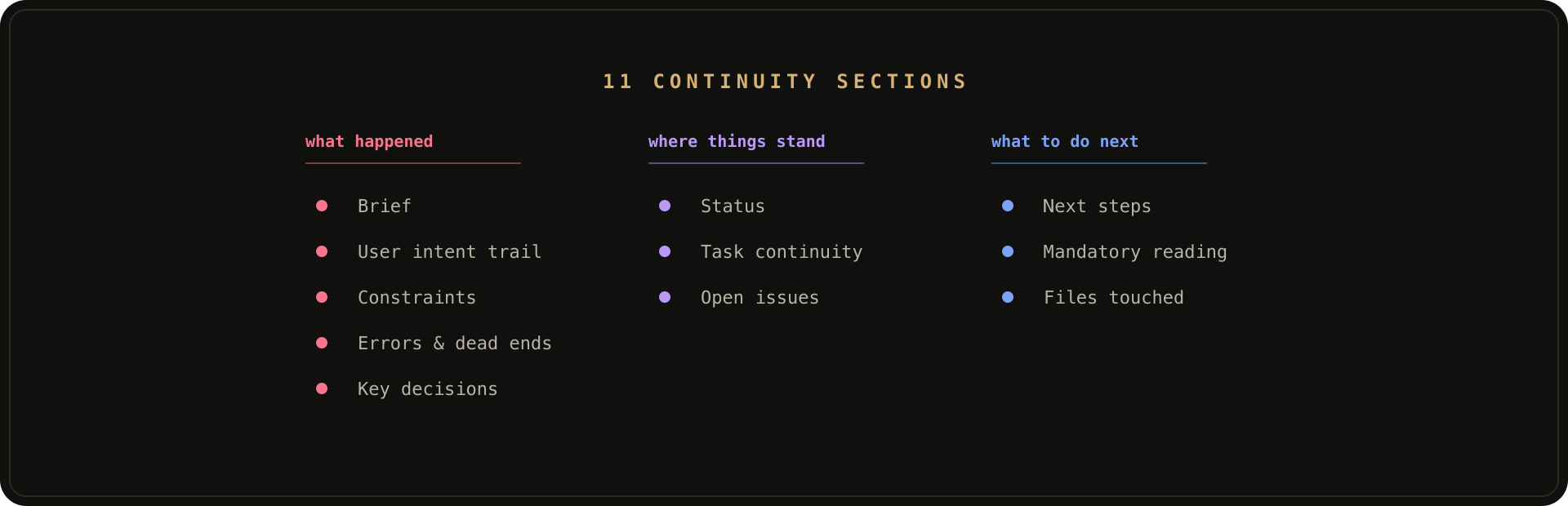
Every compaction summary captures what happened, where things stand, and what to do next — so the next agent (or the same session after compaction) opens the right files and doesn't repeat failed approaches.
Preset routing
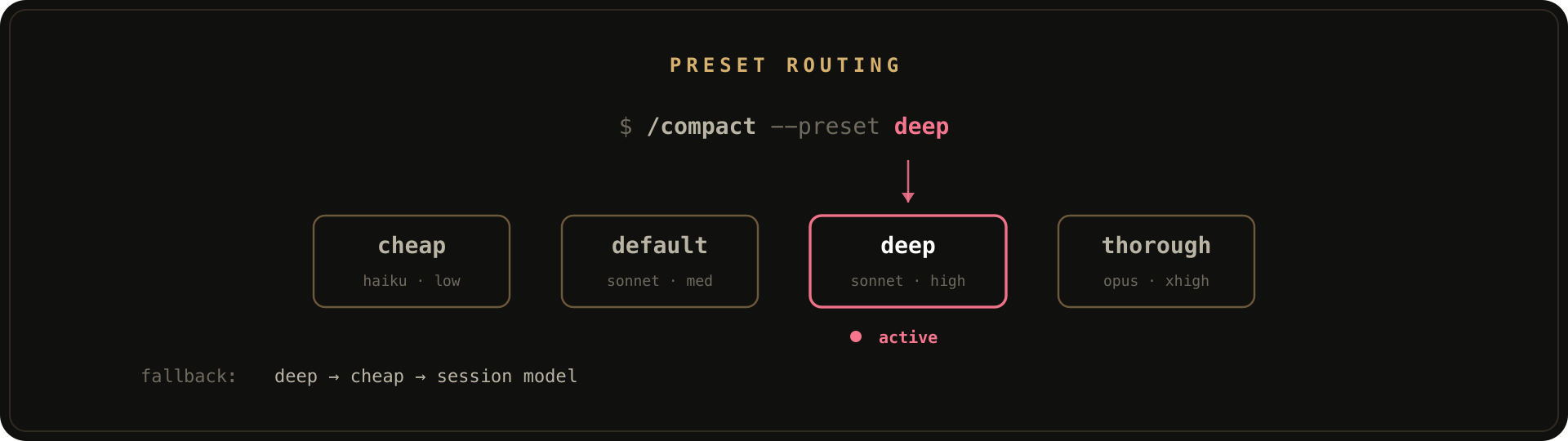
Route compaction to different models with different thinking levels. Use /compact --preset deep for thorough compaction or let the default kick in automatically. If the selected preset's model auth fails, the fallback chain tries cheaper models before falling back to the session model.
{
  "defaultPreset": "default",
  "fallbackPreset": "cheap",
  "presets": {
    "fast": { "model": "openai-codex/gpt-5.4-mini", "thinkingLevel": "medium" },
    "cheap": { "model": "anthropic/claude-haiku-4-5", "thinkingLevel": "low" },
    "default": { "model": "anthropic/claude-sonnet-4-6", "thinkingLevel": "medium" },
    "deep": { "model": "anthropic/claude-sonnet-4-6", "thinkingLevel": "high" },
    "thorough": { "model": "anthropic/claude-opus-4-8", "thinkingLevel": "xhigh" }
  }
}
Template engine
Prompts are LiquidJS templates powered by pi-template-kit:
- Layout inheritance —
{% layout '_base' %}+{% block content %} - Partials —
{% include '_blocks' %}from the siblingtemplates/directory - Frontmatter —
preset:,thinking_level:,model:,description:override runtime behavior per template - Custom filters —
present,quote,tokens,text,last_user_text - XML tags —
{% xml "tag-name" %}...{% endxml %}emits<tag-name>...</tag-name>or nothing when empty
Context blocks
| Variable | Content |
|---|---|
previous_summary | Prior compaction summary (if any) |
discarded | Serialized discarded conversation being replaced |
kept_tail | Serialized kept-tail messages that remain raw after compaction |
task_state | Live task-tracking snapshot at compaction time |
files_touched | Files-touched manifest with operation badges |
focus | Operator's /compact <focus> directive |
last_user_message | Most recent user message text |
Configuration
All configuration lives in config.json files. Prompts are Liquid templates (.md). Both support a two-level scope cascade:
| Scope | Path |
|---|---|
| Project | .pi/extensions/live-compaction/ |
| Global | ~/.pi/agent/extensions/live-compaction/ |
Resolution order: project → global → built-in defaults. Project overrides win. The TUI panel (/live-compaction) lets you switch between scopes when editing.
Each scope directory can contain:
config.json                  # preset routing, feature toggles
compaction-prompt.md         # main compaction template (Liquid)
branch-summary-prompt.md     # branch summary template (Liquid)
Custom templates
Drop a compaction-prompt.md or branch-summary-prompt.md in the project or global scope directory. Templates are LiquidJS with frontmatter knobs:
---
preset: deep
thinking_level: high
---
{% include '_blocks' %}
{%- if last_user_message | present %}
<latest-user-ask>
{{ last_user_message | truncate: 800 }}
</latest-user-ask>
{% endif %}
{% include '_contract' %}
Settings panel
Run /live-compaction to open the interactive settings panel:
- Switch between global and project scope
- Edit default preset and manage preset collection
- Edit compaction and branch-summary prompts
- Toggle session-model inheritance
- Toggle files-touched manifests
- Verify runtime status
Examples
The examples/ directory contains 9 declarative golden-file examples covering the full feature set:
| # | Example | What it demonstrates |
|---|---|---|
| 01 | minimal | Smallest possible composition |
| 02 | full-blocks | Every block populated with {% xml %} auto-omit |
| 03 | helpers-tour | All shipped filters/tags + Liquid built-ins |
| 04 | tool-calls | Tool-call/tool-result loop with sibling partial |
| 05 | pipeline-shaping | Declarative data shaping — where/slice/size/truncate |
| 06 | layout-inheritance | {% layout %} + {% block %} inheritance |
| 07 | files-touched-many | Multi-file manifest with every operation badge combo |
| 08 | no-kept-tail | Empty kept-tail edge case |
| 09 | task-continuity | Task-state snapshot and continuity guidance |
Run pnpm test to verify all examples render to their golden expected output. See examples/AGENTS.md for full details.
Built-in vs pi-live-compaction — full comparison
| (blank) | Pi Built-in | pi-live-compaction |
|---|---|---|
| Summary model | Session model only | Preset routing — any model, per-preset thinking level |
| Prompt | Hardcoded 5-section format | Liquid templates — fully customizable with layout inheritance and partials |
| Streaming | No streaming | Live streaming with partial recovery on stream failure |
| Output sections | 5 (Goal, Constraints, Progress, Decisions, Next Steps) | 11 (Brief, User intent trail, Constraints, Errors/dead ends, Key decisions, Status, Task continuity, Open issues, Next steps, Mandatory reading) |
| User intent | Not preserved | Full chronological trail with quote fidelity |
| Task state | Not included | <task-state> snapshot injected and reconciled |
| Files touched | Basic read/modified lists | Operation-badge manifest (R/W/E/M/D) with display paths |
| Focus directive | Not supported | /compact <focus> preserves exact operator goal |
| Branch summary | 5 fixed sections | 10 sections — verbatim user messages, reusable vs branch-local split, dead ends |
| Settings | None | Full TUI panel with scope switching, preset editor, prompt editor |
| Config | None | Global/project scope cascade with JSON config + prompt overrides |
Related packages
- pi-template-kit — shared LiquidJS template engine, filters, and
{% xml %}tag used by this package - pi-prompt-composer — build multi-option slash commands from plain prompts with variable expansion and interactive selectors
Development
pnpm install
pnpm run typecheck     # tsc --noEmit
pnpm test              # vitest (50 tests)
pnpm run preview       # render a compaction prompt to stdout
pnpm run examples:update  # regenerate golden expected files
Roadmap
- Per-preset fallback chains — each preset declares its own fallback model, enabling retry chains before falling back to the session model
- Per-preset prompt routing — map preset tiers to prompt template variants so stronger models get richer contracts
- Context-aware model selection — auto-select presets based on session length, available models, cost budget, and provider health
- Reusable TUI components — adopt shared
SettingsPanel/ editor components for the settings panel
Inspiration
The architecture was informed by pi-grounded-compaction — an early prototype that explored preset routing, template-driven prompts, and streaming compaction — and Pi's official custom-compaction.ts example for hooking into session:beforeCompact.
The compaction prompt contract, streaming engine, template system integration, TUI settings panel, files-touched manifest, task-state continuity, and branch-summary prompt are original work.
License
MIT