
Install
Install with PiG
pig install npm:pi-hide-providersInstall with Pi
pi install npm:pi-hide-providersPackages run code with your permissions and influence agent behavior. Catalog inclusion is not a security audit. Review the source before installing a third-party package.
Pi manifest JSON
The pi field of package.json.
{
  "extensions": [
    "./hide-providers.ts"
  ]
}
README
Written by the package's publisher, shown as published in version 0.1.27 (README.md). PiG does not review it.
🔇 pi-hide-providers
Hide providers and models from the selector in pi
Filter the model picker so you only see the models you care about.


The Problem
Pi's model selector shows every available model from every configured provider. If you have Ollama running with 20 local models, or an OpenRouter account with hundreds of options, the model list becomes noisy and slow to navigate. There's no built-in way to say "I never want to see these providers/models in the selector."
Pi has enabledModels in settings.json as an allowlist, but maintaining it manually is tedious — you have to list every model you do want, and clobber settings.json with hundreds of entries. What you really want is a blocklist: "hide everything from these providers, except the ones I explicitly use."
The Solution
pi-hide-providers gives you a blocklist that completely removes models from all lists — not an allowlist, not a scoped subset:
- Define hide rules in a config file (
~/.pi/agent/hide-providers.jsonor.pi/hide-providers.json) - On session start, the extension patches pi’s underlying
ModelRuntimeaccessors (with aModelRegistryfallback for older pi versions) to filter out hidden models - The
/modelselector,Ctrl+Pcycling,--list-models, and session restoration all see only visible models /hide-models resetremoves the runtime/registry patch — all models return immediately- Changes via
/hide-models addand/hide-models removetake effect immediately (no reload needed) - Interactive
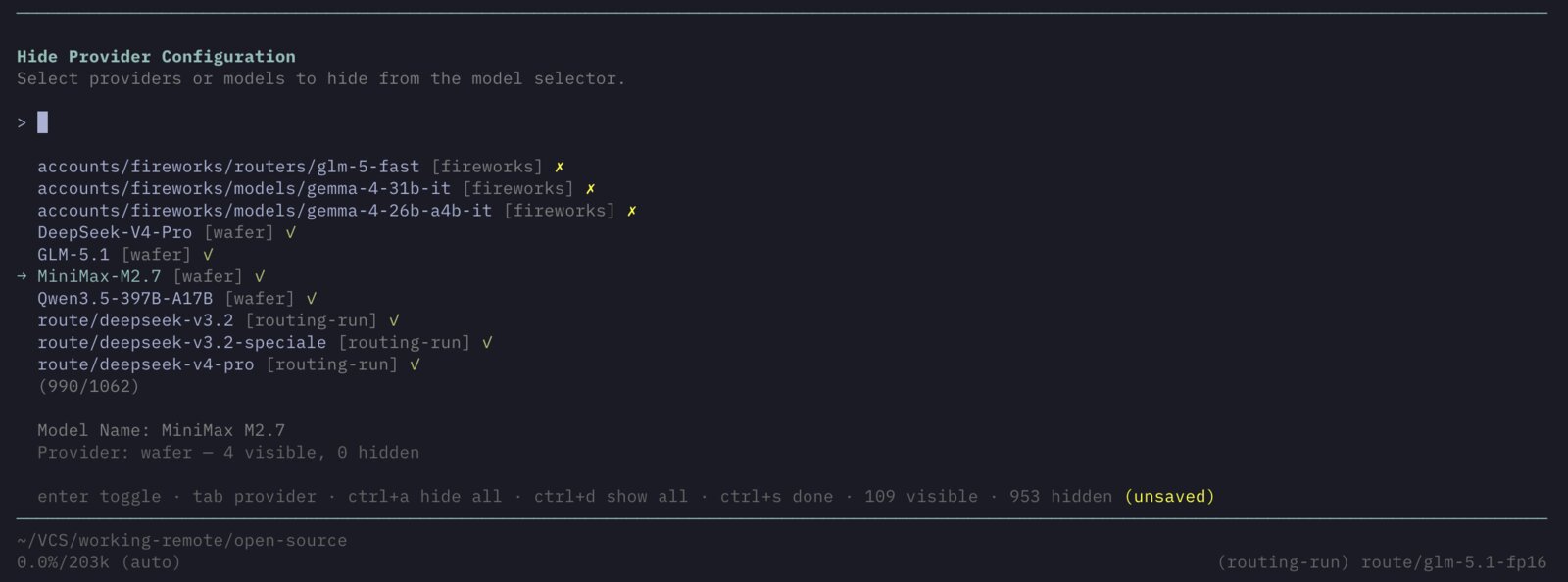
/hide-modelsTUI lists visible models first in user-toggle order, then hidden models in their original registry order, and keeps the cursor at the same index after each toggle — matching pi core's/scoped-modelsUX modelfields accept glob patterns —"gpt-3.5*"hides the whole family,"*preview*"hides every preview variant — so one rule can cover dated aliases and future models that follow the same naming convention/hide-modelssubcommands for adding, removing, and inspecting rules
No settings.json is modified. No 250+ entry explosion. No allowlist semantics.
Usage
Interactive Commands
| Command | What it does |
|---|---|
/hide-models | Open interactive TUI to select providers/models to hide |
/hide-models add ollama | Hide the entire ollama provider |
/hide-models add openrouter/cheap-model | Hide a specific model from openrouter |
/hide-models add openrouter/* | Hide the entire openrouter provider (explicit) |
/hide-models remove ollama | Remove the hide rule for ollama |
/hide-models status | Show current rules, patch status, and hidden model count |
/hide-models apply | Show current hide state (changes are already active) |
/hide-models reset | Unpatch registry — all models return immediately |
/hide-models help | Show usage reference |
Config File
Create ~/.pi/agent/hide-providers.json (global) or .pi/hide-providers.json (project-local):
{
  "hide": [
    { "provider": "ollama" },
    { "provider": "openrouter", "model": "cheap-model" },
    { "provider": "github-copilot", "model": "gpt-3.5-turbo" }
  ]
}
Rule formats:
| Rule | Effect |
|---|---|
{ "provider": "ollama" } | Hide all models from the ollama provider |
{ "provider": "ollama", "model": "*" } | Same — explicit wildcard |
{ "provider": "openrouter", "model": "cheap-model" } | Hide only openrouter/cheap-model |
Project config (.pi/hide-providers.json) takes priority over global config (~/.pi/agent/hide-providers.json).
Commands will not overwrite invalid config. Writers use a short-lived <config>.lock directory beside the actual config file. If a crash leaves it behind, remove the empty lock directory only after all writers have stopped.
Installation
With pi install (recommended):
pi install npm:pi-hide-providers
Or install from GitHub:
pi install https://github.com/monotykamary/pi-hide-providers
With npm:
npm install pi-hide-providers
Or in ~/.pi/agent/settings.json:
{
  "packages": [
    "https://github.com/monotykamary/pi-hide-providers"
  ]
}
Then /reload or restart pi.
For quick one-off tests:
pi -e ./hide-providers.ts
How It Works
Session starts
  → Extension reads hide-providers.json
  → Patches ModelRuntime (current pi) or ModelRegistry (older pi):
      available model reads → original result filtered by isHidden()
      all model reads       → original result filtered by isHidden()
      model lookup(p, m)    → returns undefined if isHidden(p, m)
  → All downstream consumers see only visible models:
      /model selector, Ctrl+P, --list-models, session restoration

/hide-models add or /hide-models remove:
  → Config updated on disk
  → currentRules updated in memory
  → Patched runtime/registry methods read latest rules via closure
  → Changes take effect immediately (no reload)

/hide-models reset:
  → Restores the original model accessors
  → All models return immediately
The SDK doesn't provide a mechanism to remove models from the registry — registerProvider({ models: [] }) is treated as "no models to register" (override-only), not "remove all models." Monkey-patching the accessor methods is the only way to completely remove models from all lists without touching settings.json.
The patches survive model catalog refreshes because they wrap the runtime accessors rather than a model snapshot. On reload, the extension detects an existing patch and updates its rules source.
Comparison with Alternatives
| Approach | Pros | Cons |
|---|---|---|
| pi-hide-providers (this) | Blocklist — completely removes models from all lists; no settings.json writes; changes take effect immediately; survives catalog refresh | Monkey-patches internal model accessors (not an official SDK mechanism) |
enabledModels in settings.json (manual) | Built-in, no extension needed | Allowlist — must list every model you want individually; no blocklist support; clobbers settings with hundreds of entries |
--models CLI flag | Per-session scoping | Must pass every time; no persistence |
pi.unregisterProvider() | Restores built-in models after override | Only works for providers registered via pi.registerProvider(); can't hide entire providers (empty models array is a no-op) |
pi-model-router scope shim | Dynamic scoping with routing | Heavyweight — full routing system just to filter the model list |
Development
npm install
npm test          # Vitest unit tests
npm run typecheck # TypeScript validation
npm run lint:dead # Dead code detection (knip)
Structure
.
├── hide-providers.ts   # Main extension
├── src/
│   └── index.ts        # Constants, types, and utilities
├── __tests__/
│   └── unit/
│       └── hide-providers.test.ts
├── package.json
├── tsconfig.json
├── vitest.config.ts
└── knip.json
License
MIT
Pi 1.0 compatibility (0.1.22)
Tested against Pi 1.3.0 with exact SDK development pins and wildcard host peers. Native ModelRuntime filtering, scoped fallbacks and selector restoration are verified in both host layouts.
Run bun run test:host for the offline real-host regression. Set PI1_HOST_PACKAGE to an installed Pi package directory and PI1_HOST_ENTRY=bundle to test its bundled CLI runtime.
Pi 0.99 compatibility (0.1.21)
Filters the actual 0.99 ModelRuntime and scoped-selector fallback entries. Auth/cancellation arguments are forwarded; filtering composes with model sorting and restores on shutdown. Custom screens propagate IME focus.
Tested with Pi 0.99.0. Host-provided Pi packages are wildcard peers, not bundled dependencies; development uses exact 0.99.0 versions.