
Install
Install with PiG
pig install npm:pi-herdr-subagents-liteInstall with Pi
pi install npm:pi-herdr-subagents-litePackages run code with your permissions and influence agent behavior. Catalog inclusion is not a security audit. Review the source before installing a third-party package.
Pi manifest JSON
The pi field of package.json.
{
  "extensions": [
    "./src/index.ts"
  ]
}
README
Written by the package's publisher, shown as published in version 0.11.2 (README.md). PiG does not review it.
pi-herdr-subagents-lite
English | 简体中文
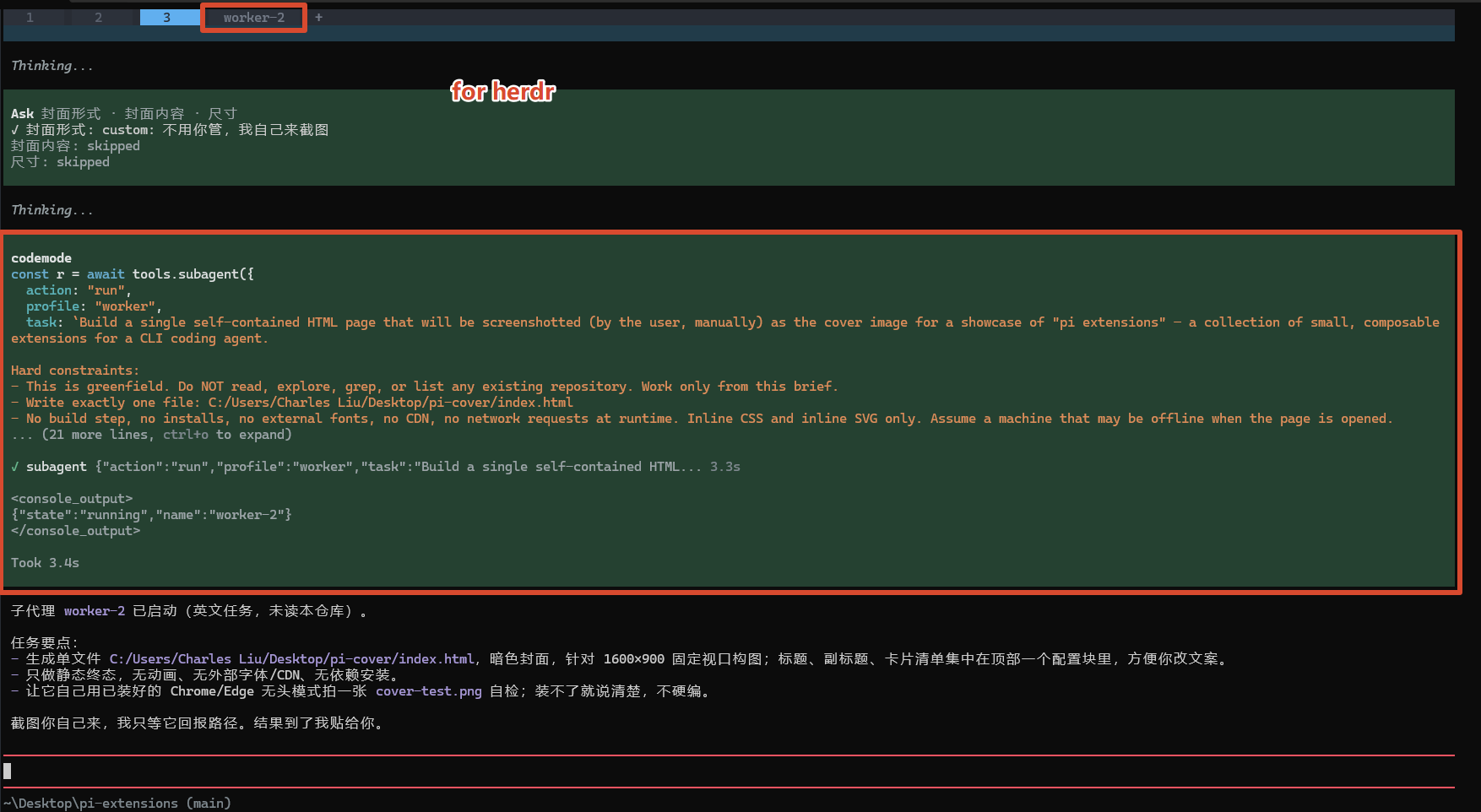
The extension runs each subagent as a separate pi process in its own herdr pane. The tool has two actions: run starts a subagent, send delivers a follow-up message. Results come back asynchronously. Behavior follows the v1 contract.
Features
- A subagent is a separate process, and a human can take over its pane. When the child cwd matches the parent cwd, it opens a tab in the same workspace. Otherwise it opens a new workspace.
- Profiles have two layers, global and per project, each a Markdown file with frontmatter.
runreturns at once. Each finished turn reports onesubagent_result. Results insideaggregateWindowMsmerge into one message, and an oversize result goes to an artifact file.- Questions stay with the human. A dialog in the child pane never reaches the parent, and the human answers there. Reporting
blockedto herdr belongs to the extension that opens the dialog (DEC-0070). - Nesting is off by default, and the extension is no sandbox. Unless the profile names this tool, a child tool set drops it.
Install
pi install npm:pi-herdr-subagents-lite              # npm
pi install /path/to/pi-herdr-subagents-lite         # local checkout
pi -e /path/to/pi-herdr-subagents-lite/src/index.ts # this process only
The old repository moved into this monorepo, so install from npm.
Do not pass -l. -l writes project settings only, so a child started in another workspace never loads the package. pi -e applies to the current process only.
Requires Node >= 22.19. Tested with herdr 0.9.5 and pi 1.4.0. The parent must run inside a herdr pane; otherwise calls fail with not_in_herdr.
Upgrade with pi update --extensions, remove with pi remove <source>.
Configuration
The extension reads one global file: <agent-dir>/pi-herdr-subagents-lite/config.json. <agent-dir> defaults to ~/.pi/agent and follows PI_CODING_AGENT_DIR. There is no project config.
Keys and their meaning: contract §1. Defaults and clamp bounds: src/config/index.ts and test/config/config.test.ts.
Minimal config
A missing file means all defaults. To change one value, write only that value:
{
  "maxConcurrent": 4
}
Full configuration
Every key follows, and each value is the default.
{
  // Default true. false = no subagent tool for the model.
  "enabled": true,
  // Default "subagent". Must match ^[a-z][a-z0-9_]{0,31}$. The name prefixes each guideline line.
  "toolName": "subagent",
  // Default "herdr". A plain name resolves from PATH; an absolute path pins a version.
  "herdrBin": "herdr",
  // Default 16, range 1 and up. At the limit run returns max_concurrent. Only a running turn holds a slot.
  "maxConcurrent": 16,
  // Default 16384, range 1024 to 1048576. A longer text goes to an artifact file. The message keeps a truncated head and the path.
  "maxResultChars": 16384,
  // Default 500, range 0 to 10000 milliseconds. 0 = deliver each result at once. A larger value merges more results.
  "aggregateWindowMs": 500,
  // Default ["quit", "reload"]. Values: new, resume, fork, quit, reload. A listed reason closes the child panes on parent shutdown.
  "closeChildrenOn": ["quit", "reload"],
  // Default false. true = close the pane after a failed or interrupted turn. false keeps it so send can resume.
  "closeOnFailure": false,
  // Default 250, range 50 to 5000 milliseconds. A larger value wakes less often and delivers later.
  "inboxPollMs": 250,
  // Default 15000, range 1000 to 300000 milliseconds. How often a running child is checked for liveness. Three absences in a row mark it lost.
  "livenessPollMs": 15000,
  // Default 2592000000 (30 days), range 0 to 31536000000 milliseconds. Run files older than this are deleted at session start. 0 = never.
  "runRetentionMs": 2592000000,
  // Tool text overrides. Each key defaults to unset, which keeps the built-in text shown below.
  "prompts": {
    // Replaces the built-in description.
    "description": "Use run when a task is self-contained and long-running. Use send to pass information to a subagent.",
    // The one-line entry in Available tools. Empty = keep the tool out of that list.
    "snippet": "",
    // Replaces the built-in guideline lines. Keep {{profiles}} to list the profiles.
    "guidelines": [
      "run only starts; it does not wait. The result arrives later as a message.",
      "send only delivers; no state tracking.",
      "Available profiles:\n{{profiles}}"
    ]
  }
}
The file must be strict JSON, and the extension reads it once at load. Delete the comments and restart pi after a change.
An unknown key, a wrong type or an unknown enum value stops the extension at load: pi prints invalid config <path>: <field>: unknown key and exits. A number outside its range clamps to the boundary without an error.
Usage
- Start
piin a herdr pane. - Write a profile (see the next section).
runtakes the profile frontmattername. - Ask the model to call the tool:
{"action":"run","profile":"explore","task":"Read README.md and answer with its first heading."}
The call returns {"state":"running",...}. The subagent runs in its own tab, and a [subagent explore-1] done message arrives later. Do not wait for it in the same turn. Deliver a follow-up with:
{"action":"send","name":"explore-1","message":"Also check the Windows branch."}
Profile
Global profiles live in <agent-dir>/pi-herdr-subagents-lite/profiles/*.md. Project profiles live in .pi/pi-herdr-subagents-lite/profiles/*.md and load once the project is trusted. A project profile wins over a global profile with the same name.
---
# Key run takes; the file name is not used
name: explore
description: "Read-only research: read code, answer questions, change nothing"

# Omit to inherit from the parent
# model: provider/model
thinking: low

# Plain names = strict allowlist. +name / -name adjusts the default set. Never mix both
# Omitted = pi defaults minus this tool (nesting off); "" = empty allowlist
tools: read, bash

# Omitted = pi discovery; "" = no skills; a list = only those
skills: ""

# append / replace: body is appended to or replaces the system prompt
# task: body is the task text, no identity file
system-prompt: append

# Close the pane after this run's done turn. Leave it false to keep the child resumable with send
auto-exit: true

# true = hidden from the guidelines; an explicit run still works
disable-model-invocation: false
---

You are a read-only explorer. Answer with file paths and line numbers.
Error codes: contract section 2. Defaults: src/profile/frontmatter.ts and test/profile/.
A profile stays out of the list when it has no name, an invalid or unknown field, or a duplicate name in its layer. run on it returns profile_invalid with the file, the field and the reason.
The extension ships one example, with file name and name both worker. Loading reads profiles/*.md only, and on every load it makes profiles/examples/ match the bundled example: it rewrites the bundled files and deletes extra ones. So copy the example one level up:
cd <agent-dir>/pi-herdr-subagents-lite/profiles && cp examples/worker.md worker.md
Credits
| Project | Borrowed |
|---|---|
| earendil-works/pi | Extension API, package layout, official examples |
| fyang93/pi-herdr-subagents | Profile field shapes; integration tests on an isolated herdr session |
| modem-dev/pi-herdr-subagents | herdr launch and lifecycle; derived end states |
| purboo/pi-durable-subagents | Async delivery, idempotency, report-once results |
This extension builds on these projects. Thanks to their authors.
Docs
| Document | Content |
|---|---|
| ARCHITECTURE | Module boundaries, dependency direction, test seams |
| GLOSSARY | The only source for terms |
| Modules | Usage and trade-offs per module |
| Decisions | One file per decision |
| Spec | The v1 contract |
| Research | Measurements of herdr and pi |
| CHANGELOG.md | Release notes |
License
MIT, see LICENSE.