
Install
Install with PiG
pig install npm:pi-firecodeInstall with Pi
pi install npm:pi-firecodePackages run code with your permissions and influence agent behavior. Catalog inclusion is not a security audit. Review the source before installing a third-party package.
Video
Declared by the package manifest. Open the file ↗
Pi manifest JSON
The pi field of package.json.
{
  "image": "https://raw.githubusercontent.com/Suge8/firecode/main/design/promo/og-1280x640.png",
  "video": "https://raw.githubusercontent.com/Suge8/firecode/main/design/promo/hero.mp4",
  "extensions": [
    "./dist/index.js"
  ]
}
README
Written by the package's publisher, shown as published in version 1.16.0 (README.md). PiG does not review it.



Install one extension. Uninstall the rest.
Parallel sub-agents, multi-model code review and a cleaner terminal for Pi. One install, works out of the box.



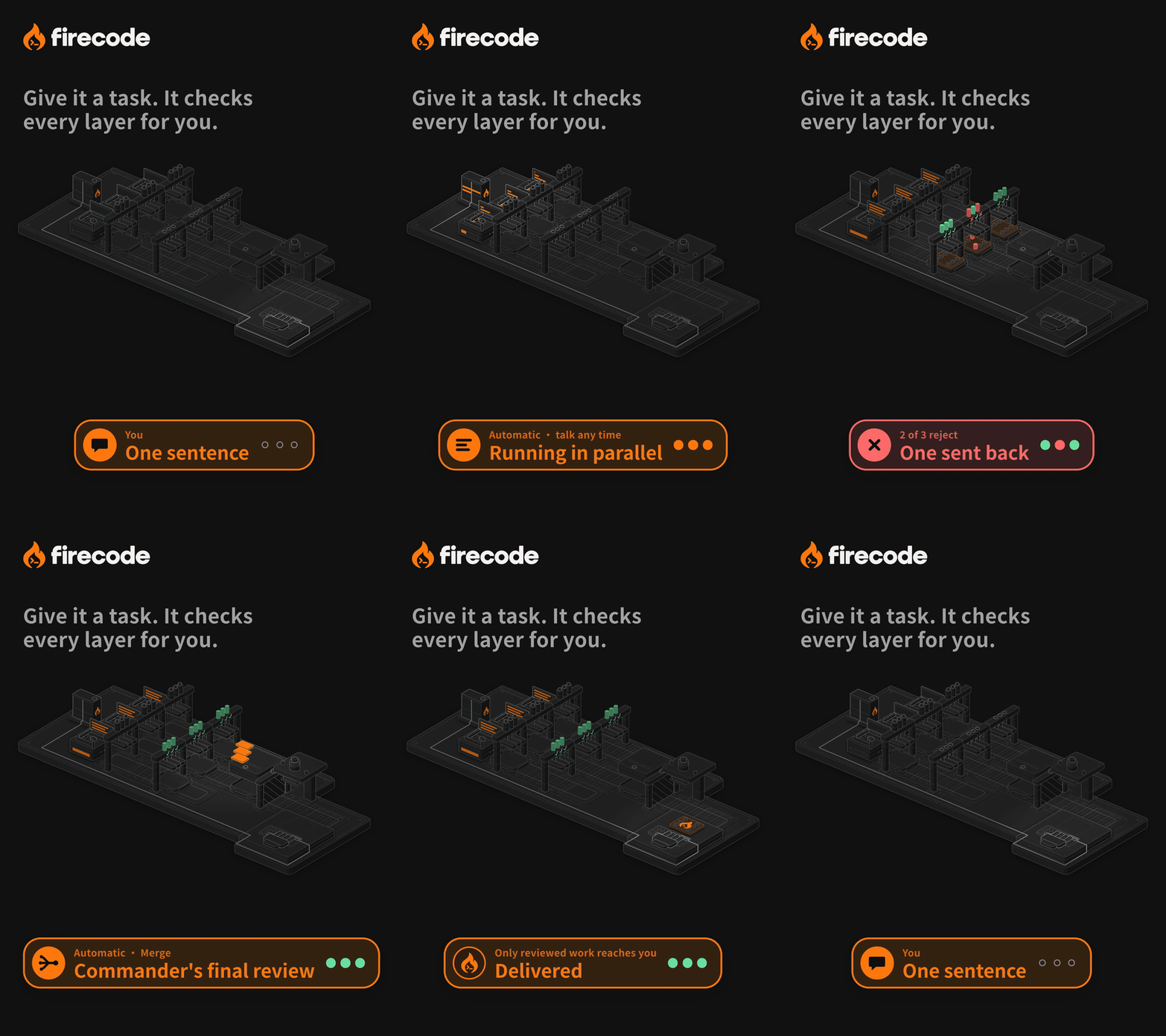
Why FireCode
- Works out of the box. The recommended config is written on first launch; swap in the models you are logged in to. The UI and the prompts follow your system language.
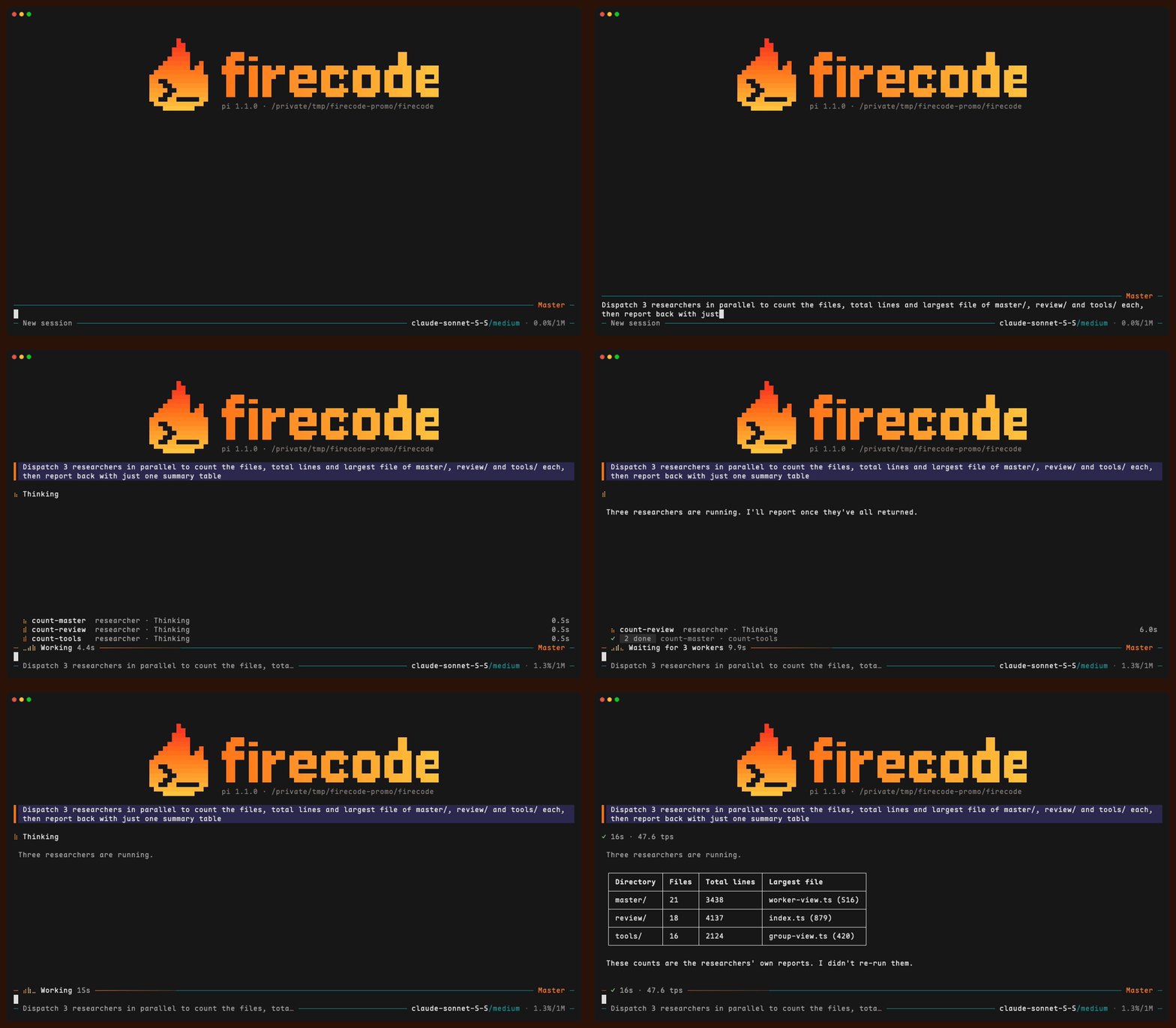
- Sub-agents under control. Run them in parallel, give each role an ordered model chain, switch automatically on failure, step in any time.
- Hands-off review. One command starts a review; what is worth fixing is sent back and reviewed again until it passes. You see how each review ended.
- An ultra-light core. Built the Pi way: minimal, so your context stays lean.
- Low visual load. Focus on the results that matter. Everything in between folds away until you open it.
Fully automatic review and delivery
Run /fire-review after a change. The commander sends high-risk changes (persistence, concurrency, migrations, auth) to review itself, without you asking. Up to five models you choose look for problems and score how often each one would bite and how bad it would be; the ones worth fixing go back to be fixed, the rest are listed for you, and the fix is reviewed again. It stops when the review passes, an advisor model calls it after repeated failures, or the rounds run out.
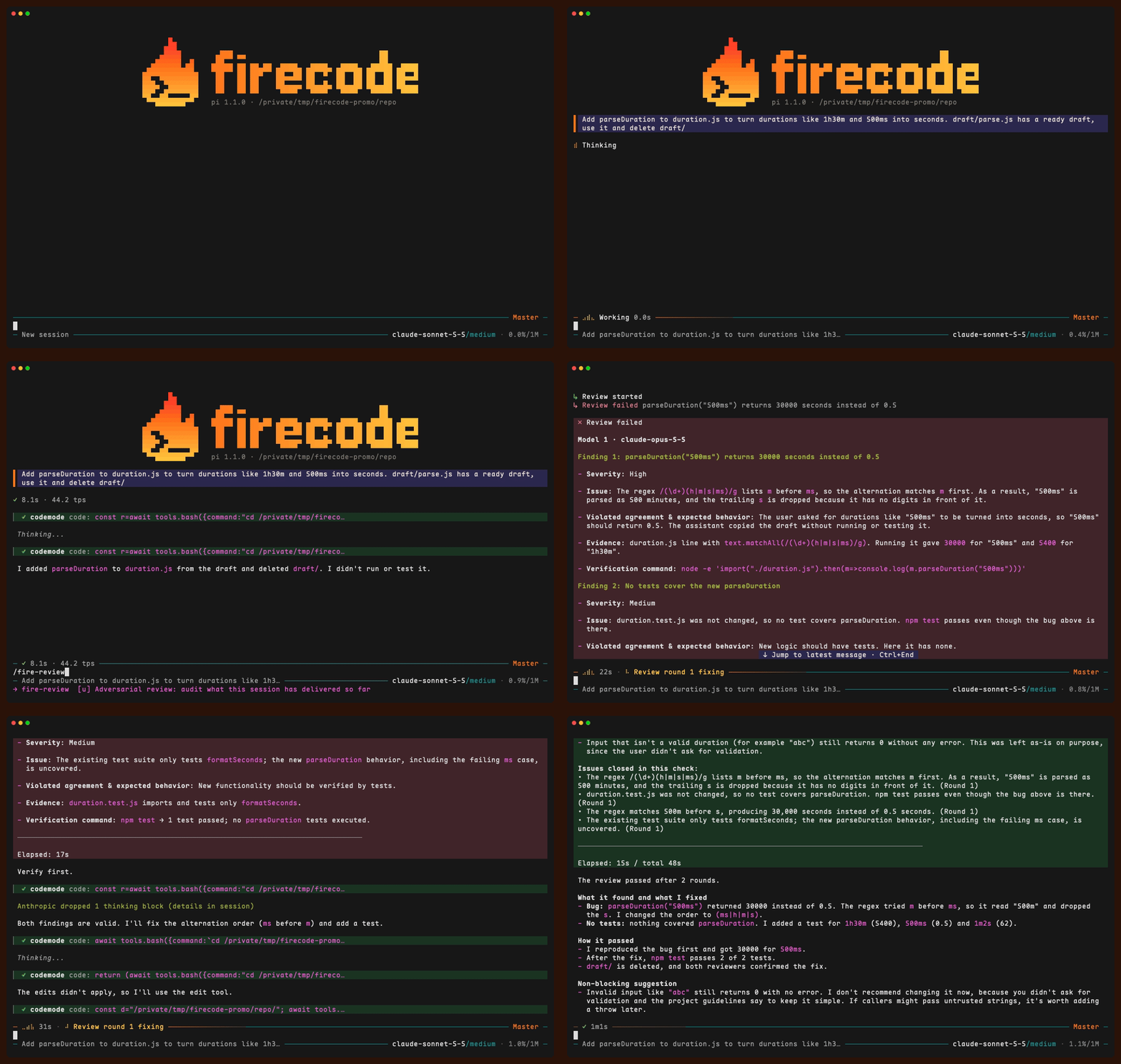
Other reviewers mostly hand you a list of problems. FireCode keeps fixing and re-reviewing:
| (blank) | Reviewers | What you get |
|---|---|---|
| FireCode | Up to five models, reviewing adversarially | Fixed code, re-reviewed |
Claude Code /code-review | One sub-agent of your session | A findings list; --fix applies it |
Codex /review | One reviewer on your session's model | A summary of the issues |
| Open Code Review (Alibaba) | One model, a sub-agent per file group | Line comments to fix yourself |
| Qodo | Specialist agents plus a judge | Ranked findings; can apply a fix |
| PR-Agent (open source) | One model call per tool | Comments and code suggestions |
| multi-model-review (Pi) | Several model families | One combined verdict |
Checked against each product's docs on 2026-10-12.
Clear sub-agent status
Every sub-agent sits above the input box. Click one to read its whole run and talk to it directly.
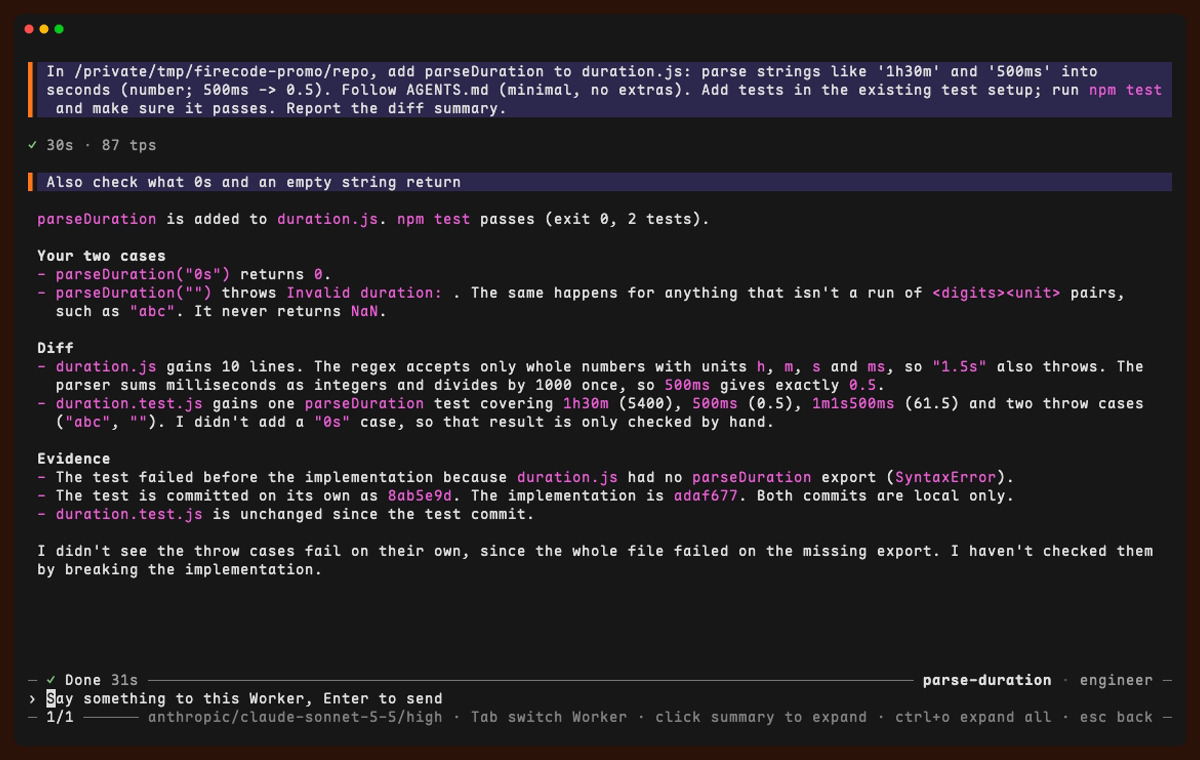
An ultra-light core
Built the Pi way: sub-agents add just two small tools, and review adds none. Here is what sub-agent tools cost on every request:
| (blank) | Sub-agent tools | Characters |
|---|---|---|
| FireCode | 2 | 1,715 |
| pi-subagents (0.77.0) | 2–3 | 1,561–4,918 |
| omp (18.10.1) | 2 | 3,369 |
| Codex CLI (0.162.1) | 5–6 | 5,045–9,641 |
Tool definitions sent to the model (name, description and parameters), default settings. FireCode measured 2026-10-31; others 2026-10-12.
Also in the box
/goal <objective> keeps the session working turn after turn until it is done, with the reviewers checking the result before it counts; Esc pauses · /quota and /tokens usage at a glance · Ctrl+R rename the session · Ctrl+Shift+S cycles OpenAI Fast / Ultrafast · Compaction summaries by a cheap background model, plus idle compaction before the prompt cache expires · Sessions named in the background from your first message · OpenAI native compaction · Works with Claude subscription login · Claude screenshots upload once instead of every turn
Install
pi install npm:pi-firecode
Restart Pi (1.5.0+) and it's ready. The config is created on first launch at ~/.pi/agent/extensions/firecode/config.jsonc: put in the models you use, and turn anything off with "features": { "<name>": false }.
- Using herdr? Run
herdr integration uninstall pifirst; FireCode reports the pane state itself. - Sub-agents and reviewers can run
bashwithout a sandbox. Run Pi in a container if you need isolation.
Contributing · Third-party notices · MIT © Suge8