
Install
Install with PiG
pig install npm:oh-my-tuiInstall with Pi
pi install npm:oh-my-tuiPackages run code with your permissions and influence agent behavior. Catalog inclusion is not a security audit. Review the source before installing a third-party package.
Pi manifest JSON
The pi field of package.json.
{
  "image": "https://raw.githubusercontent.com/minkhoaa/oh-my-tui/master/media/01-hero-signature.png",
  "extensions": [
    "./extensions/omt/index.ts"
  ]
}
README
Written by the package's publisher, shown as published in version 0.1.2 (README.md). PiG does not review it.
Oh My TUI
A new look for Pi. The same native agent underneath.




Install · Quick start · Showcase · Commands · Contribute
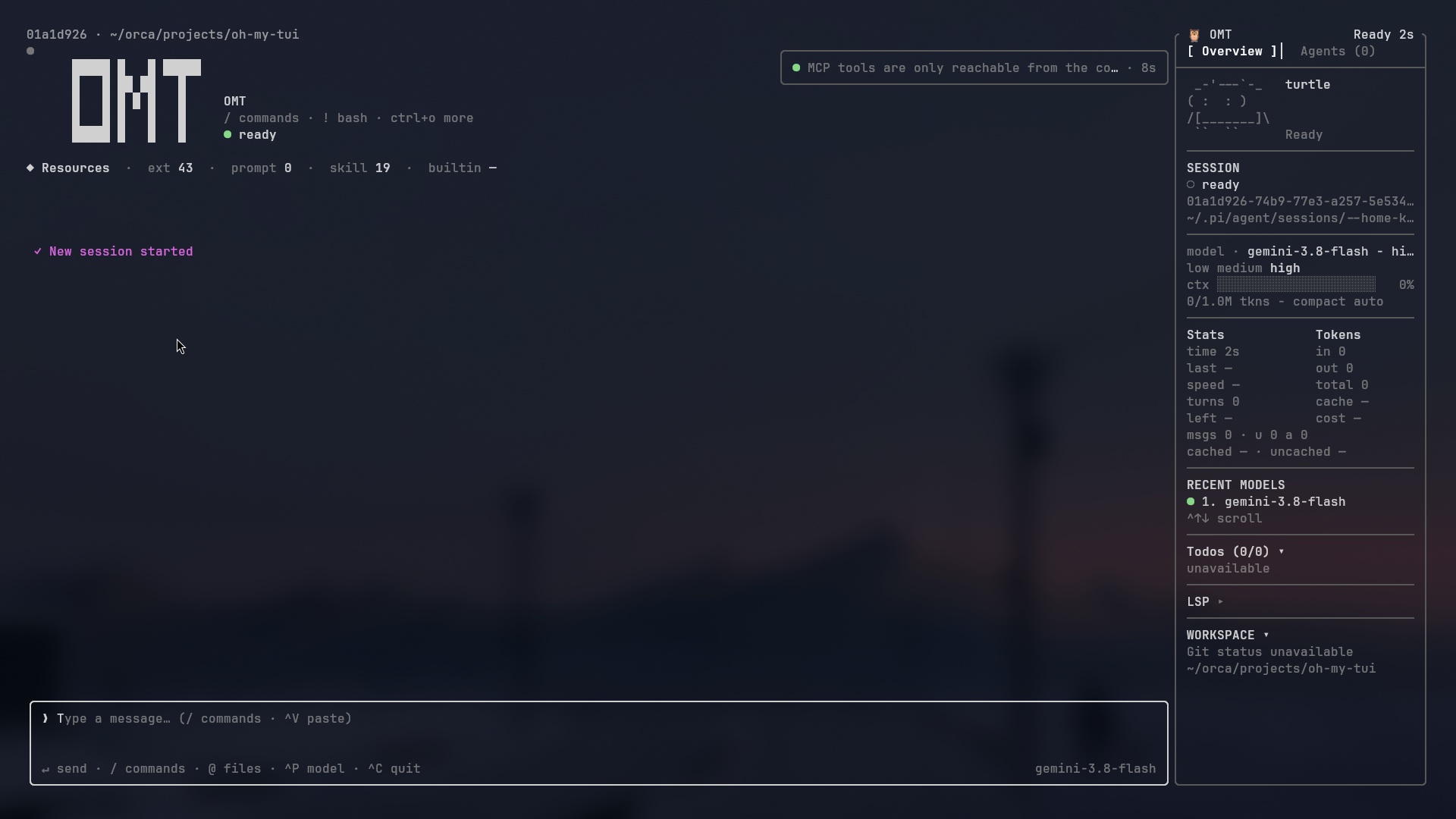
Oh My TUI (OMT) is a presentation-focused extension for Pi. It brings visual presets, a session dashboard, richer tool output, and interactive navigation to your terminal—without replacing Pi's agent runtime.
Features
- Make it yours. Choose from six presentation presets, color palettes, surface styles, and optional animated backgrounds.
- Keep your session in view. A right dock shows model details, token usage, workspace status, and an animated companion. Its Agents tab displays available subagent activity.
- Read less noise. Styled messages, folded tool cards, diff previews, and expandable reasoning make long sessions easier to scan.
- Find what you need. Open settings, search the command palette, inspect tool execution, browse Git changes, or navigate saved sessions and conversation branches.
- Stay native. Pi owns execution, model context, tools, sessions, and keybindings. OMT adds no model-facing prompts, tool definitions, or model requests.
Installation
Requirements
- Pi 1.5.0 or newer, installed separately.
- Node.js 22.19.0 or newer.
- An interactive terminal for OMT's visual interfaces. True-color support is recommended.
- Optional:
ffmpegonPATHfor importing custom backgrounds. Built-in scenes and bundled backgrounds do not require it.
From source
To try OMT from a local checkout:
git clone https://github.com/minkhoaa/oh-my-tui.git
cd oh-my-tui
npm ci --ignore-scripts
npm run pi:dev
pi:dev launches Pi with extensions/omt/index.ts loaded for that run. Do not load an installed copy of OMT alongside it.
From npm
The npm installation command will be available once the package is published:
pi install npm:oh-my-tui
To remove an npm-installed copy:
pi remove npm:oh-my-tui
Quick start
Inside Pi, start with:
/omt settings
Use the settings hub to explore themes, surfaces, and sidebar preferences. Then try:
/omt palette
/omt sidebar
/omt git
OMT starts with the Signature preset. To switch presets or try one without changing your saved default:
/omt theme clean
/omt theme ember --session
Saved configuration lives in omt.json inside Pi's agent directory. Preset commands save the selected preset by default; --session makes the change temporary. Use /omt save to persist current configuration overrides.
Showcase
Screenshots show a configured Pi environment. Installed extensions, model names, workspace data, and available integrations will vary with your setup.
Settings and live themes
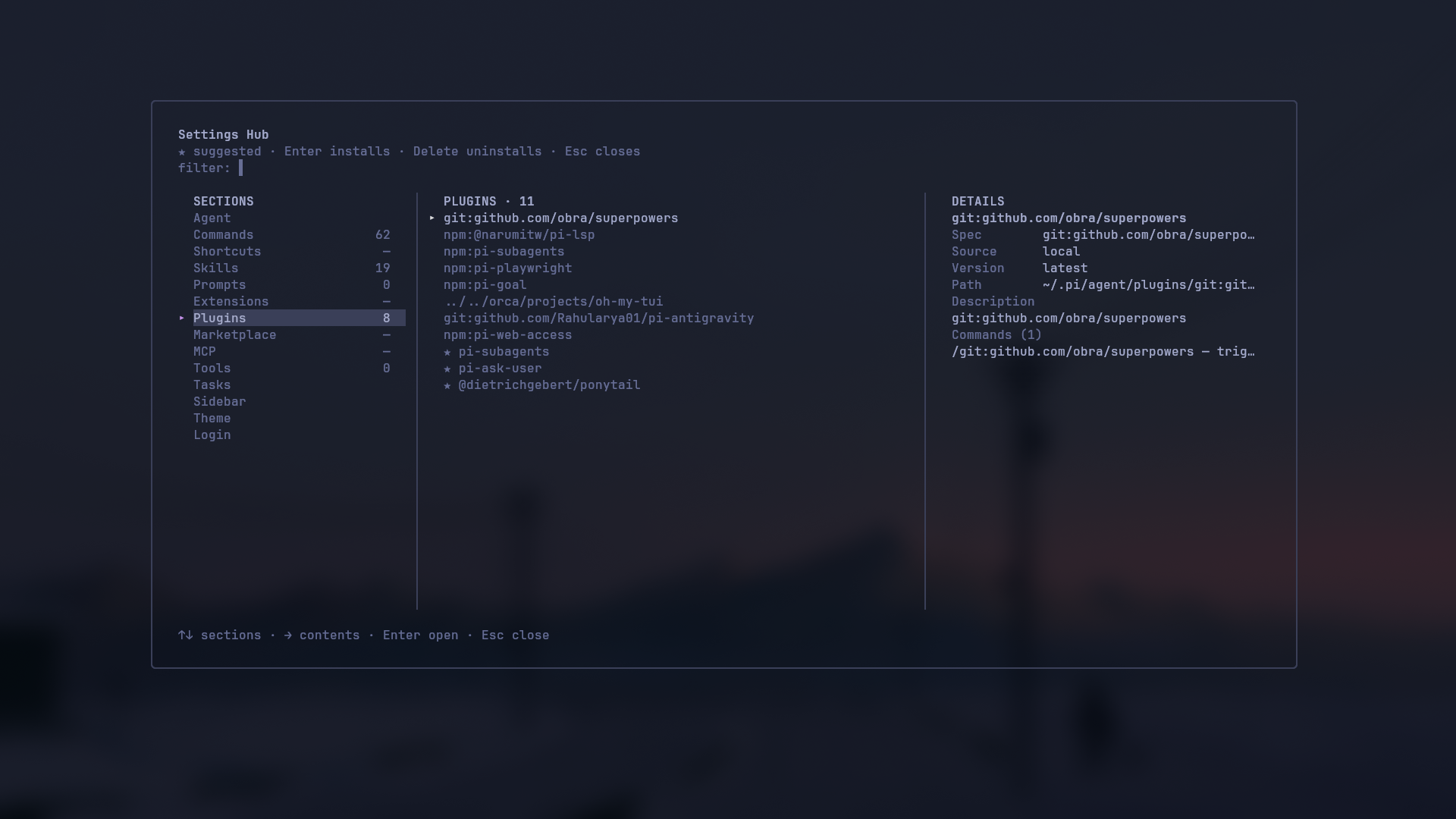
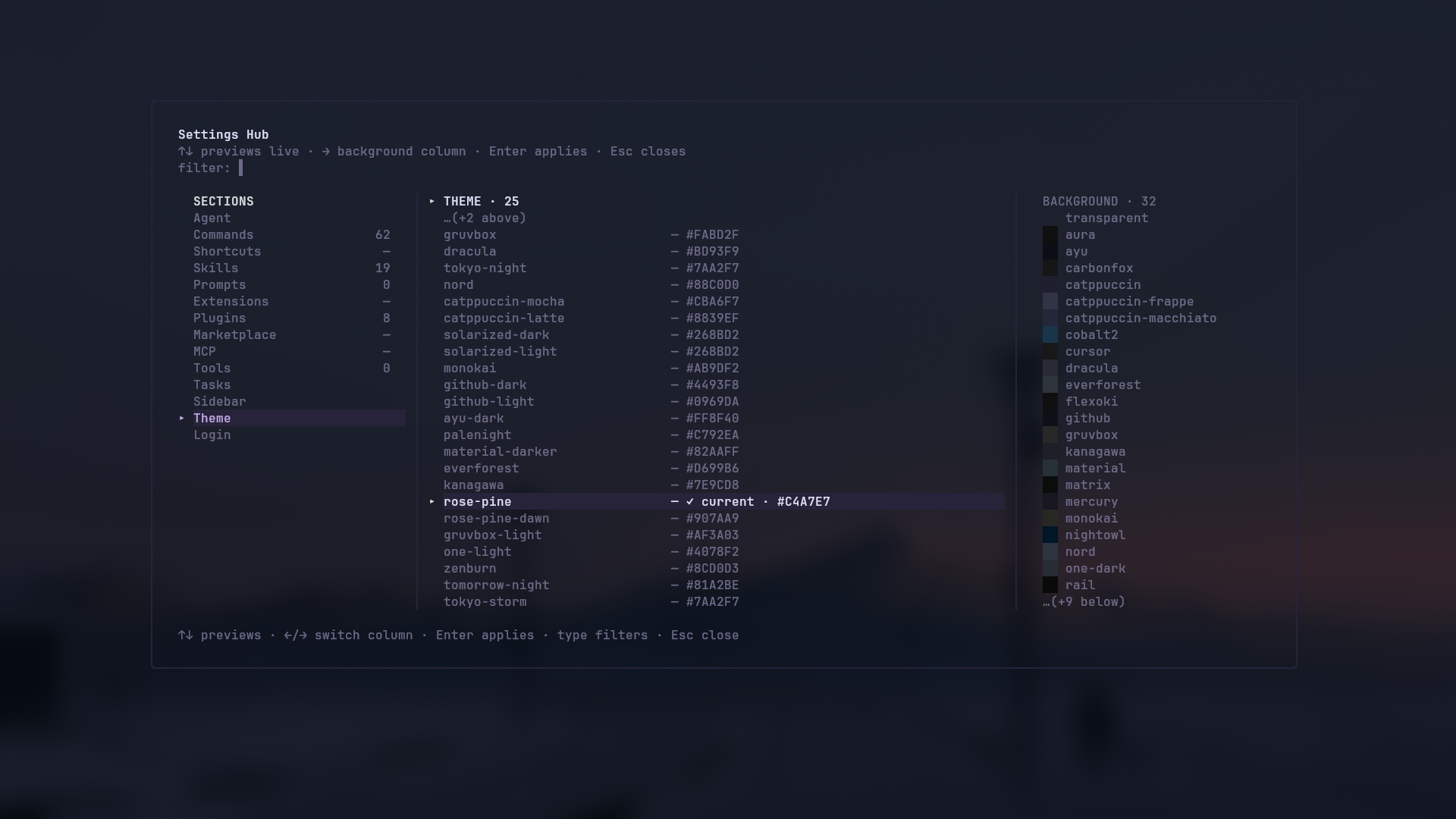
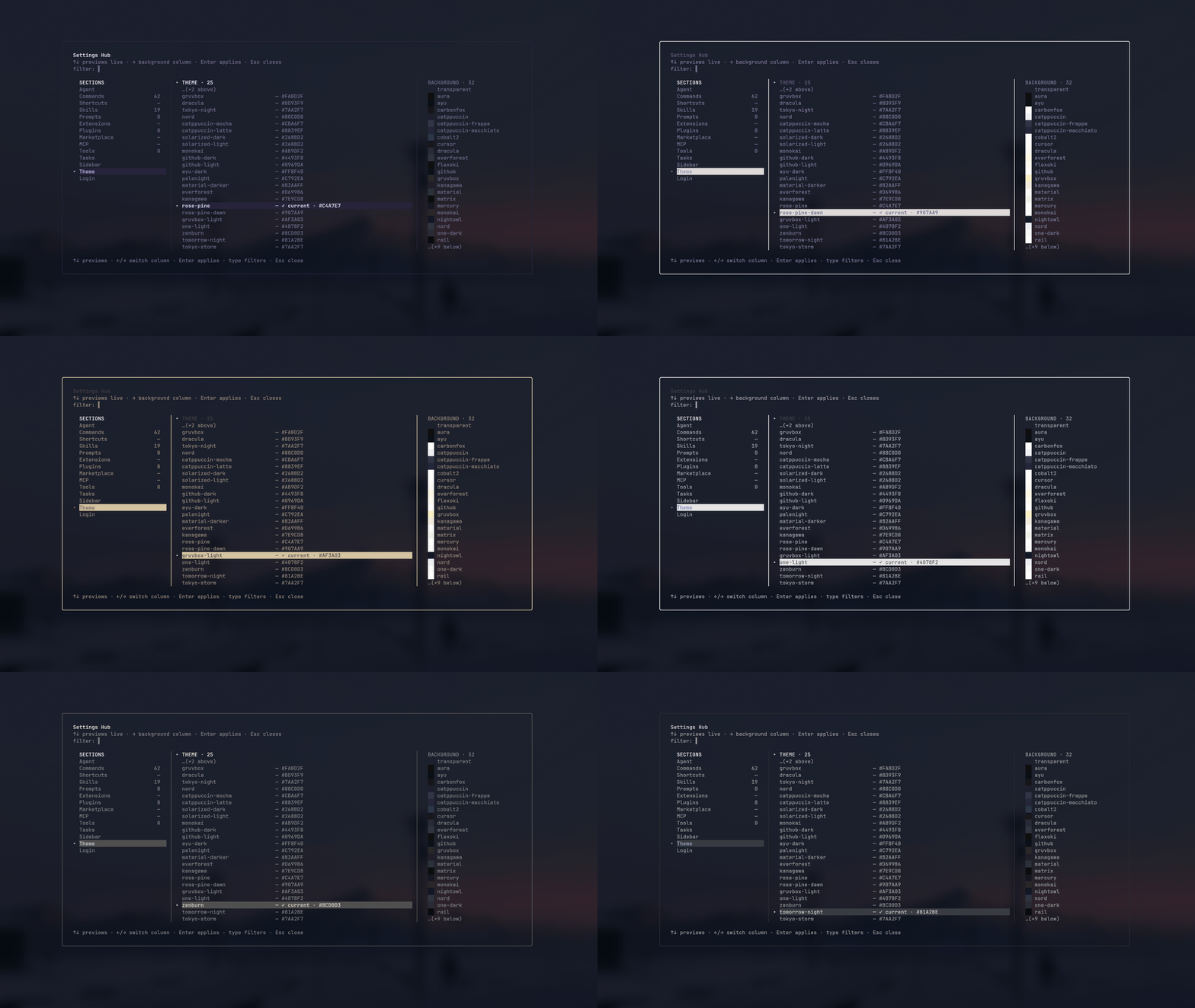
Open /omt settings to browse configuration and installed resources. The Theme section previews color palettes and background surfaces as you browse.
| Settings hub | Themes and surfaces |
|---|---|
 |  |
Watch live palette browsing
Dashboard and companions
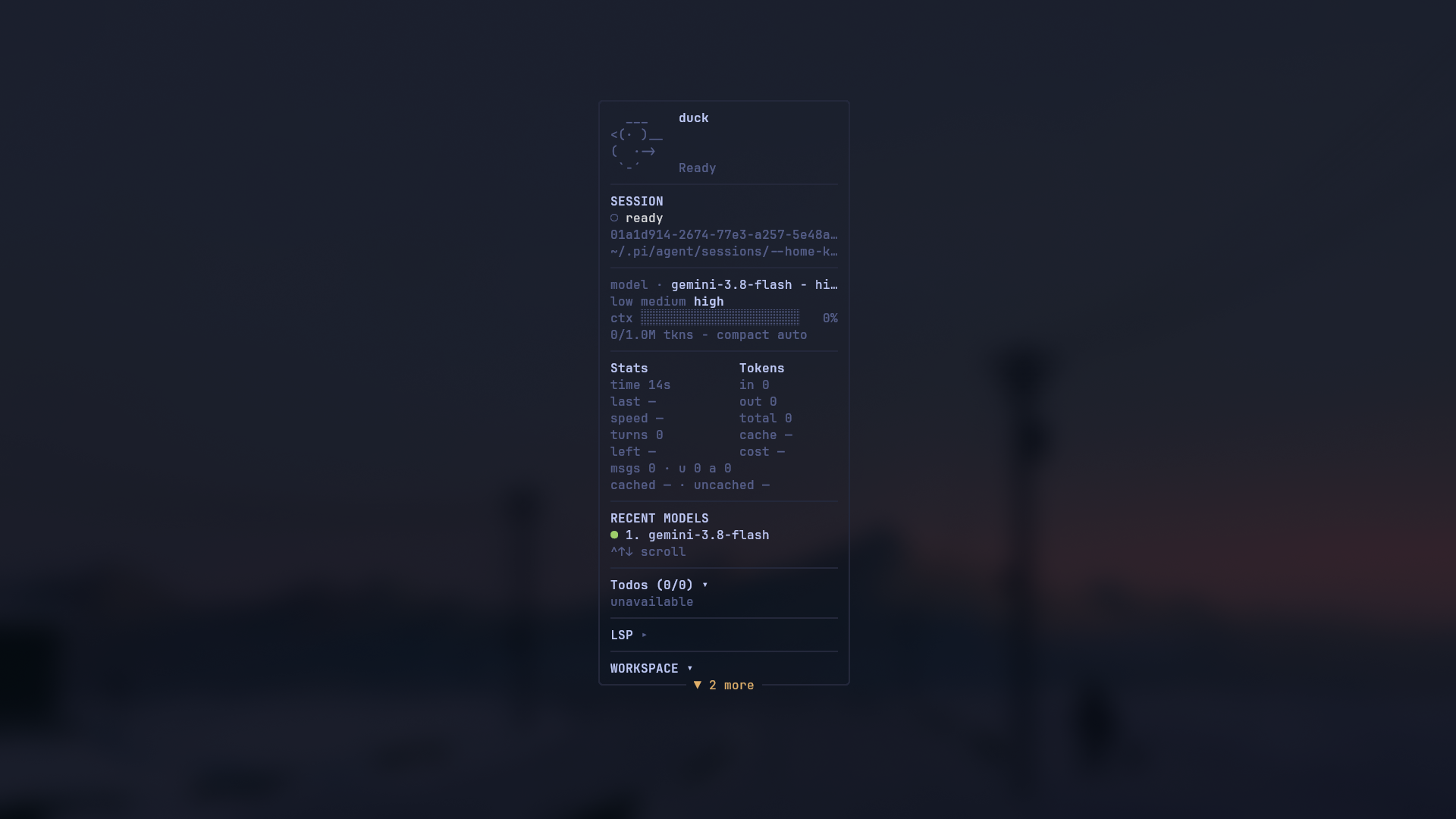
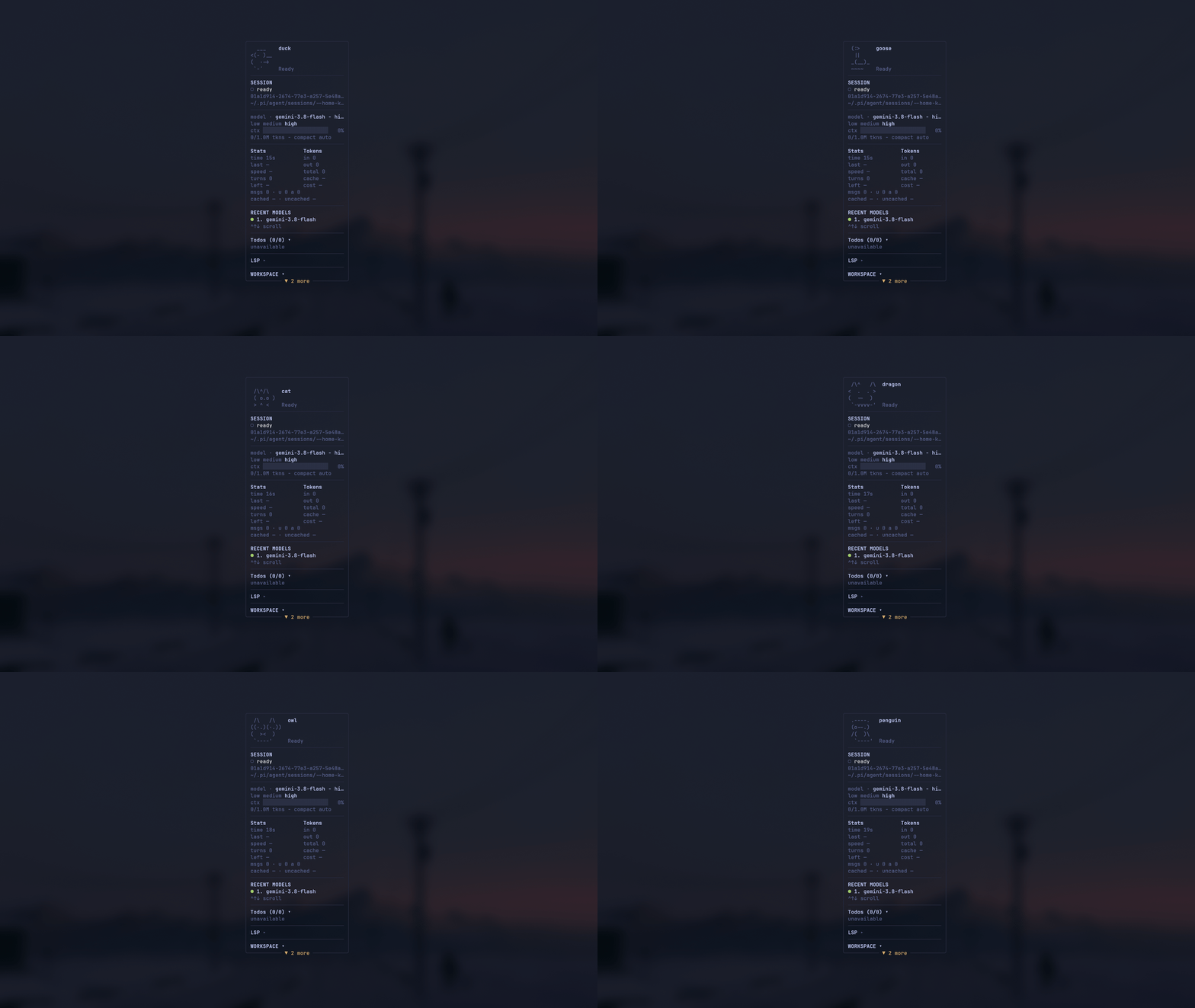
Open /omt sidebar for a scrollable session dashboard, or /omt sidebar on to enable the persistent companion view. Signature uses a right dock in supported fullscreen layouts and a compact companion otherwise.
Choose a companion with /omt pet, or press p in the dashboard to cycle pets.
| Session dashboard | Companion animation |
|---|---|
 |  |
Command palette and Git explorer
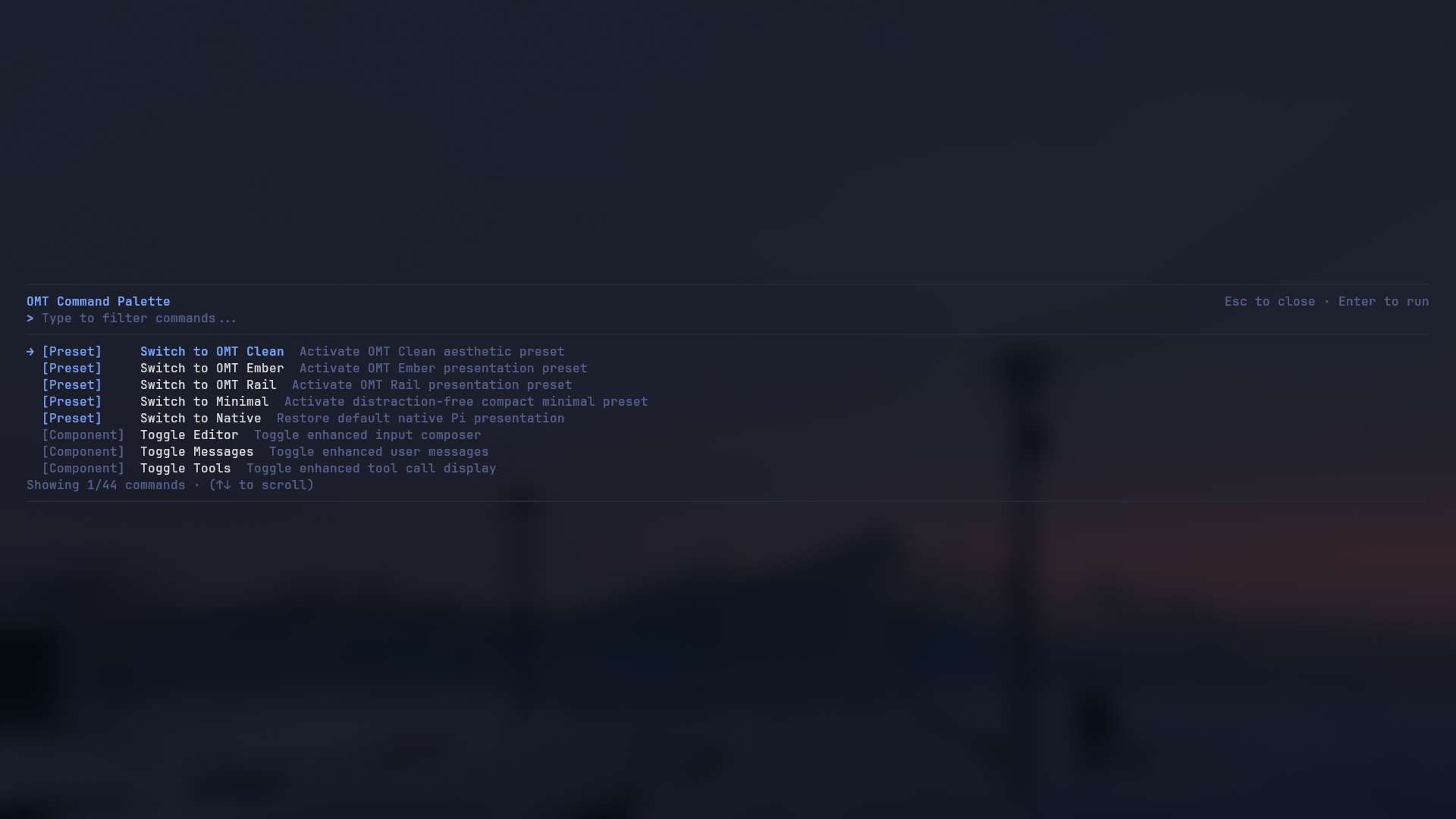
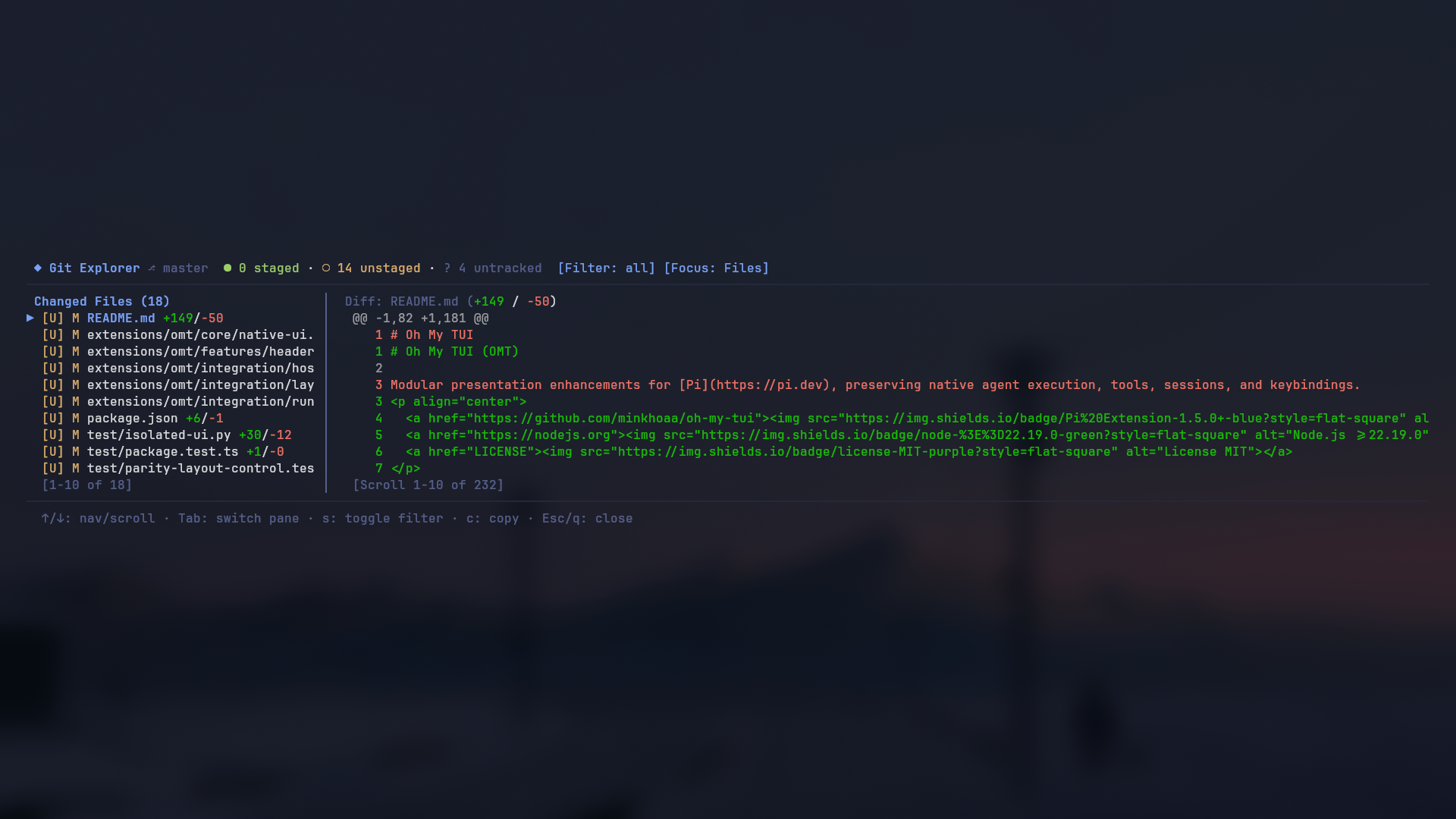
Use /omt palette to search OMT actions. Open /omt git to inspect working tree changes and unified diffs without leaving Pi.
| Command palette | Git explorer |
|---|---|
 |  |
Presets
Switch with /omt theme <name>. Short aliases such as clean, ember, and rail are also accepted.
| Preset | Style |
|---|---|
omt-signature | Default OMT presentation with a framed composer, dashboard dock, and companion. |
omt-obsidian | Obsidian Studio cockpit with left-rail architecture, solid chips, and fuel gauge telemetry. |
omt-clean | Clean, restrained styling. |
omt-ember | Warm, retro-inspired colors. |
omt-rail | Gutter rails and structured visual accents. |
minimal | Compact presentation with fewer visual elements. |
native | Restore native Pi presentation. |
Presets control the overall presentation; Signature palettes and surfaces customize its colors and background. Use /omt theme to open theme selection.
Commands
Enter these commands inside Pi, not your shell. Use /omt palette or command completion to discover more actions.
| Command | Action |
|---|---|
/omt settings | Open the settings hub. |
/omt palette | Search OMT actions. |
/omt theme [name] | Open theme selection or switch presets. |
/omt save | Save current configuration overrides as defaults. |
/omt on / /omt off | Enable or disable OMT presentation. |
/omt <component> on / /omt <component> off | Toggle editor, messages, tools, footer, or thinking. |
/omt sidebar | Open the scrollable dashboard. |
/omt sidebar on / /omt sidebar off | Show or hide the dock or compact companion. |
/omt pet | Choose a companion and its visual style. |
/omt inspect | Inspect session trajectory and tool execution. |
/omt git | Browse working tree changes and diffs. |
/omt session | Browse and search saved sessions. |
/omt tree | Navigate conversation branches. |
/omt model | Open the model picker using Pi's model registry. |
/omt queue | Open the prompt queue manager. |
/omt notifications | View session notification history. |
/omt shortcuts | Show shortcut help. |
/omt doctor | Inspect environment and compatibility diagnostics. |
/omt background off | Disable background effects. |
Native behavior and compatibility
OMT changes presentation, not the agent contract:
- Pi retains ownership of prompt construction, model streaming, tool schemas, complete tool output, context calculations, and session storage. Native editing, paste, autocomplete, attachments, and keybindings remain Pi's responsibility.
- Presentation does not rewrite history. Tool folding and reasoning previews affect display, not the content sent to the model or stored in sessions. Grouped tool cards can expand to show individual calls.
- Other extensions keep their surfaces. OMT avoids replacing an editor, footer, tool renderer, or layout owned by another extension. Cleanup restores only hooks OMT owns; callbacks become inert when ownership is lost.
- Layout support is detected at runtime. The Signature dock uses Pi's exported
HStackandsetLayoutRootAPIs, preserving the native root as its left child and reserving 34 columns on the right when supported and wide enough. Unsupported layouts fall back rather than replacing native rendering. - Integrations are optional. MCP, LSP, and subagent information reflects available host state and telemetry; OMT does not install or run those services. Floating notifications keep their history in
/omt notificationswithout shifting the conversation layout.
If a view is unavailable, run /omt doctor. For a simpler interface, try /omt theme minimal; use /omt theme native to return to Pi's presentation.
Development
npm ci --ignore-scripts
npm run verify
npm pack --dry-run
npm run verifyruns TypeScript checking and the test suite.npm pack --dry-runchecks the publishable package contents.npm run pi:devlaunches the local extension for interactive development.
Isolated terminal checks
For presentation changes, also run the offline PTY smoke workflow on a Unix-like system with Python 3 and Pi on PATH:
python3 test/isolated-ui.py --output /tmp/omt-ui-captures
The script uses temporary home, agent, and session directories with offline mode enabled. It exercises regular and fullscreen layouts, session transitions, dashboard scrolling, pets, resizing, preset switching, draft input, and shutdown without submitting model prompts. ANSI captures, plain text, and JSON summaries are written to the output directory.
Screenshot capture
npm run capture regenerates the showcase assets in media/. This is a desktop-specific helper, not a headless test: it requires a running Pi session in a remote-control-enabled Kitty terminal, Hyprland, grim, and ffmpeg.
The helper sends commands to the live session, changes presets, starts new sessions, switches workspace focus, and overwrites existing captures. Use a dedicated capture session and review scripts/capture-screens.mjs before running it. The target socket and workspaces can be configured through KITTY_SOCKET, TARGET_WORKSPACE, and RETURN_WORKSPACE.
Contributing
Bug reports, fixes, themes, and accessibility improvements are welcome.
- Open an issue to discuss larger changes before implementing them.
- Fork the repository and create a focused branch.
- Keep changes in the presentation layer. Do not modify Pi core, installed dependencies, native prompts, or session formats.
- Add or update tests, run the development checks above, and include isolated terminal evidence for UI changes.
- Open a pull request explaining the change, how it was tested, and any compatibility limitations. Include screenshots or a short recording for visible changes.
For bug reports, include your OMT, Pi, and Node.js versions; terminal and operating system; active preset; relevant extensions; reproduction steps; and /omt doctor output. Redact credentials, private paths, and conversation content before sharing captures.
See the changelog for release notes.
License and acknowledgments
MIT © Oh My TUI contributors.
Built for Pi. Portions are adapted from Pitago by cavaldos, also licensed under MIT. See NOTICE for attribution.