
Install
Install with PiG
pig install npm:harness-offloadInstall with Pi
pi install npm:harness-offloadPackages run code with your permissions and influence agent behavior. Catalog inclusion is not a security audit. Review the source before installing a third-party package.
Pi manifest JSON
The pi field of package.json.
{
  "extensions": [
    "./dist/pi.js"
  ]
}
README
Written by the package's publisher, shown as published in version 0.2.1 (README.md). PiG does not review it.
Harness Offload
Keep huge files, long logs and repo-wide searches out of your coding agent's context.
A small model on the plan you already pay for reads them and hands back the answer, with every line reference checked.


Claude Code · Codex · Gemini CLI · Copilot CLI · Cursor · OpenCode · Pi · Qwen Code · Crush · Kilo · Windsurf · any MCP client
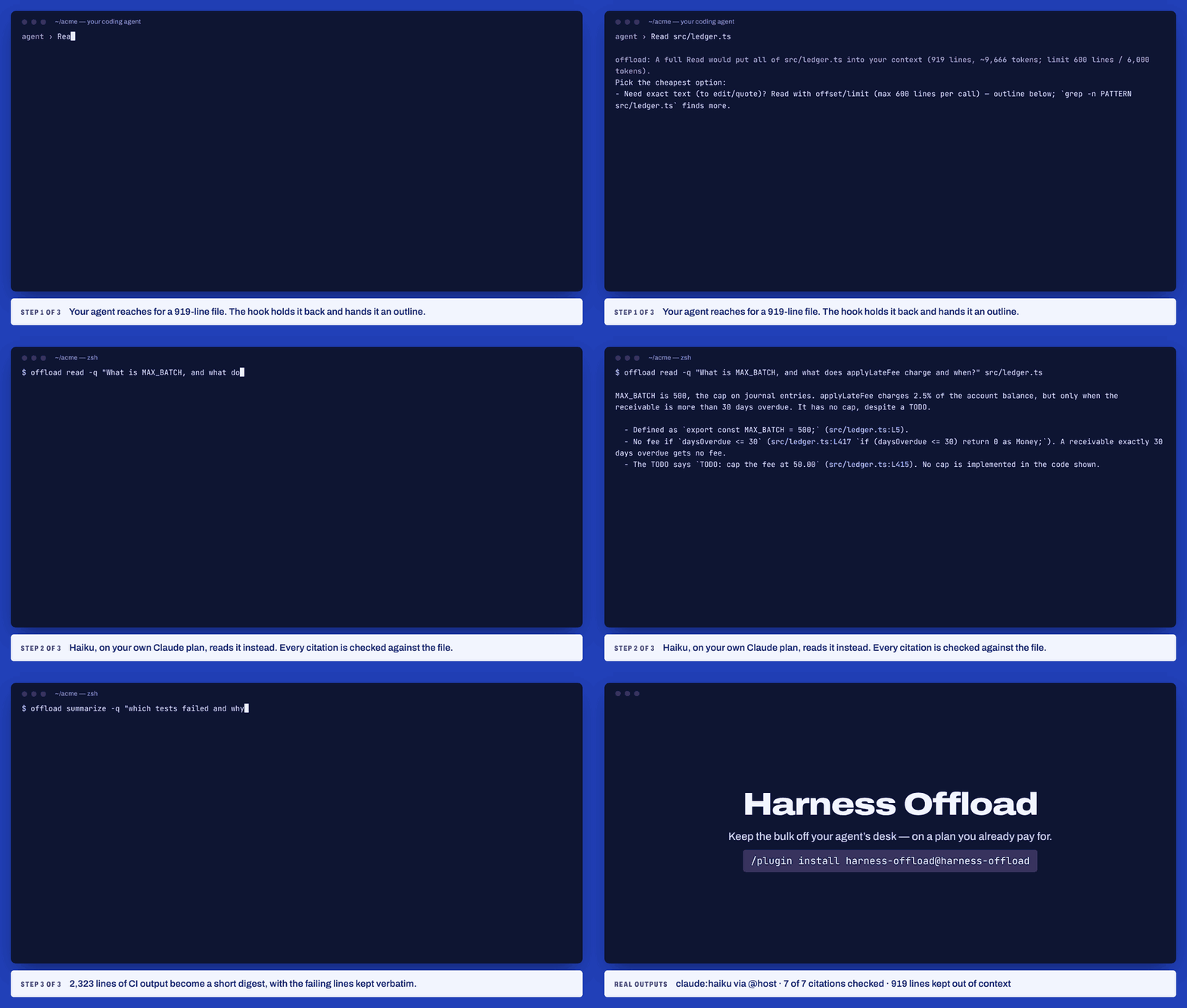
Real outputs, replayed: worker claude:haiku on a Claude plan.
Install
npx harness-offload@latest install
It asks which of your agents to set it up in (Claude Code, Codex, Cursor, Gemini CLI, Copilot CLI, Qwen Code, Crush, Pi, OpenCode, Kilo — the ones it finds are ticked) and whether for all your projects or just this one, shows exactly what will change, and installs only after you say yes. Each agent then reads with its own small model on the plan you already pay for: Claude Code → Haiku, Codex → gpt-6-luna, Gemini CLI → Flash-Lite…
Only Claude Code? claude plugin install harness-offload --marketplace levgiorg/harness-offload
What it changes, and where
| Agent | What happens | Where |
|---|---|---|
| Claude Code | claude plugin install … --scope user (or project) | managed by Claude Code (~/.claude, or the project's .claude/settings.json) |
| Codex · Copilot CLI · Qwen Code · Pi · Devin | their own plugin/extension command | managed by each agent |
| Gemini CLI | a new extension folder | ~/.gemini/extensions/harness-offload/ |
| Cursor | a copy of the plugin | ~/.cursor/plugins/local/harness-offload/ |
| OpenCode · Kilo | one one-line plugin file | ~/.config/opencode/plugins/, ~/.config/kilo/plugin/ |
| Crush | 2 hooks and a guide added to your settings (backup kept) | ~/.config/crush/crush.json |
| Offload itself | its own copy, so agents don't depend on the npx cache | ~/.local/share/harness-offload/ |
Nothing runs at npm install time; only install changes anything. Details per agent: docs/hosts.md.
- Check:
npx harness-offload doctor· Update: run the install command again (it saysupdated 0.2.0 → …) - Change who reads (another model, an API key, a local model):
npx harness-offload model …(18 providers + local), or/harness-offload:setupin Claude Code - No questions (scripts, CI, or from inside an agent):
npx harness-offload@latest install --yes [--agents claude,codex] [--scope project] - Remove:
npx harness-offload uninstall(asks; your settings stay unless you say so) · Claude Code alone:claude plugin uninstall harness-offload@harness-offload - Let your agent do it: paste "Run
npx harness-offload@latest install --dry-run, show me what it would change, then run it with--yes --agents <this agent>."
What it saves
| Your agent asked for | Would have read | Got back | Facts found |
|---|---|---|---|
| Questions about a 919-line module | 9,666 tokens | 402–412 | 4 / 4 |
| A 2,323-line CI log with two failures | 32,771 | 651–665 | 3 / 3 |
| Pytest file written from a reference test | 759 | 52 | 30 / 30 and 24 / 26 tests pass¹ |
Measured 2026-11-02 with Haiku as the worker, on both engines (a range = the two engines) —
docs/VALIDATION.md. ¹ The two failures were wrong expected values in the generated tests:
review what write produces.
How you use it
You mostly don't: hooks catch the expensive moves and steer the agent. When you or the agent want it directly:
offload read -q "how are late fees applied?" src/ledger.ts   # answer + checked path:line citations
offload explore "where is the retry policy configured?"      # read-only search across the repo
offload run -- npm test                                      # long output → digest + verbatim errors
offload task review-sql src/db/                             # your own task: your instructions, checked citations
offload dashboard --open                                     # what stayed out of your context
Your own tasks are a few lines of config — docs/commands.md.
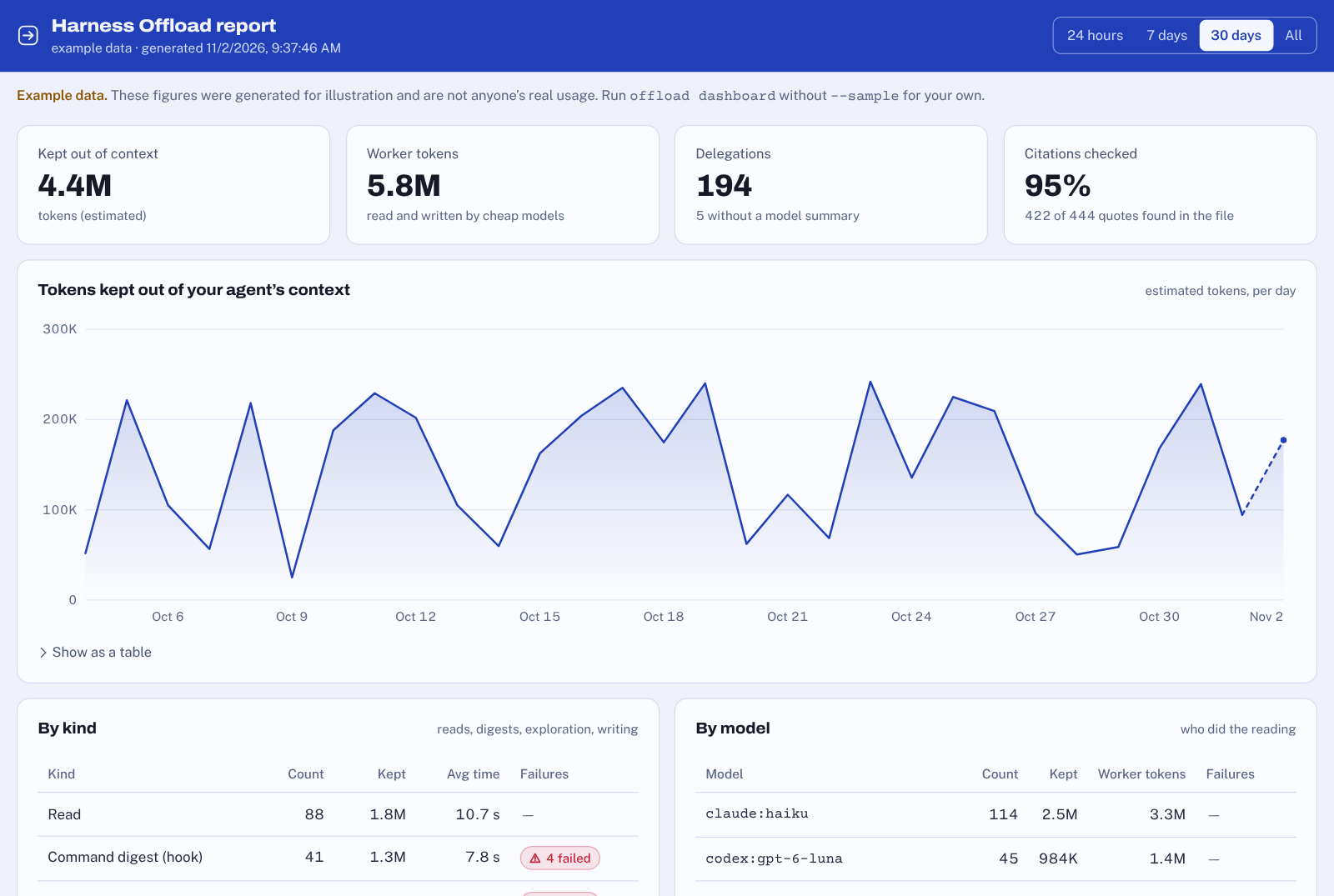
How it works
- A hook holds the big read back. A full read over 600 lines (or a
catof one) gets an outline and cheaper options instead. - A small model reads it.
offloadsends the file to the worker with deny-all permissions and secrets removed. - The answer is checked. Every
path:Lx-Lymust quote text that really is there, or it is flagged. - Noisy output becomes a digest. Verbatim error lines and the tail come from a script; the model only adds a summary.
Everything fails open: if no worker is available, your agent's tools work as before.
Docs
| (blank) | (blank) |
|---|---|
| Harnesses | what each integration does, install notes |
| Backends | @host, OpenCode, Codex, Gemini, Copilot, Qwen, Crush, Pi, API keys, local models, fallbacks |
| Commands | every command, exit codes, troubleshooting |
| Configuration | thresholds, guard modes, per-project settings, privacy |
| How it works | design, caveats, why the numbers are estimates |
| Compared | how it differs from RTK, squeez, context-mode, shunt and model routers |
| Performance | what the hooks cost per tool call, with and without offload (measured) |
| Security | trust model, worker lockdown, known limits |
| Development | tests, layout, releases |
Contributing
PRs welcome — CI runs both engines' conformance suites, the routing table, the TypeScript tests on three OSes and lint on every pull request. See CONTRIBUTING.md.
Acknowledgements
Harness Offload is original MIT-licensed code. Its ideas were shaped by Spotify's "shunt" plugin
(Apache-2.0, in spotify/portal-ai-plugins), which routes large reads to cheaper models through
coding-agent hooks; OpenCode's headless opencode run; the hook and plugin systems of Claude Code,
Codex, Cursor, Gemini CLI and Pi; Boris Cherny's notes on goal- and loop-driven agent workflows; and
community research on token savings (JetBrains' study of output compressors, the LogDx-CI benchmark).
No third-party source code is included.
The stats report embeds latin subsets of the Archivo, Public Sans and Courier Prime typefaces
(SIL Open Font License 1.1; notices in LICENSE-FONTS).