
Install
Install with PiG
pig install npm:avtc-pi-featyardInstall with Pi
pi install npm:avtc-pi-featyardPackages run code with your permissions and influence agent behavior. Catalog inclusion is not a security audit. Review the source before installing a third-party package.
Pi manifest JSON
The pi field of package.json.
{
  "image": "https://raw.githubusercontent.com/avtc/avtc-pi-featyard/main/assets/images/cover.png",
  "skills": [
    "skills"
  ],
  "extensions": [
    "./index.ts",
    "../avtc-pi-subagent/index.ts",
    "../avtc-pi-todo/index.ts",
    "../avtc-pi-parallel-work-guardrail/index.ts",
    "../avtc-pi-ui-components/index.ts",
    "../avtc-pi-subagent-ui-bridge/index.ts",
    "../avtc-pi-unstuck/index.ts"
  ],
  "allowedCodeDeps": [
    "avtc-pi-logger",
    "avtc-pi-settings-ui",
    "avtc-pi-ui-components"
  ]
}
README
Written by the package's publisher, shown as published in version 1.2.5 (README.md). PiG does not review it.
avtc-pi-featyard
Predictable, deterministic feature development for pi — deep upfront design, configurable comprehensive review and verification rigor, and auto-agents draining a backlog
Features
Featyard makes agentic development predictable and deterministic:
- Deep upfront design — subagents research every nuance during design; all open questions are asked upfront and answers are stored in the design-doc for later stages to build on.
- Configurable review and verification — set iteration counts per phase (design, plan, code review, verification) and per task; turn them down for simple features, up for complex ones.
- Two review modes — one general-reviewer subagent, or multiple specialized subagents (guidelines, quality, security, performance, requirements, testing) dispatched in parallel.
- Multi-model routing — assign different models per stage and per agent name (with glob patterns); optional round-robin rotation diversifies review findings.
- Todo-driven checklists — reviews and verification run against checklist-driven todo items so nothing is skipped or deferred.
- Automatic context compaction — configurable compaction triggers between tasks, phases, and review iterations keep long features viable without losing context.
- Auto-agents — once designs are approved, an auto-agent (started in a separate terminal) works through them sequentially: plan, implement, review each.
- Kanban board — browser UI tracking features across lanes with locks; auto-agents pull the next approved design off the board.
- Per-feature git worktrees — each feature gets an isolated branch workspace so parallel agents never collide.
Demo

Requirements
Pi 0.80.10 or later must be installed.
Git must be installed separately — needed for per-feature worktrees, review diffs, and TDD guardrails.
Installing via pi install npm:avtc-pi-featyard bundles these extensions automatically:
avtc-pi-subagent— a subagent tool supporting context compaction and nested subagentsavtc-pi-todo— a working-memory plan the agent manages through multi-stage workavtc-pi-parallel-work-guardrail— block or approve agent git operations that disrupt parallel workavtc-pi-ui-components— dialog coordinator preventing dialogs from rendering over each otheravtc-pi-subagent-ui-bridge— lets extensions' dialogs from nested subagents render in the root sessionavtc-pi-unstuck— auto-continue on empty model responses + configurable timeouts for bash and search tools
Optional (recommended):
avtc-pi-portrait— builds a behavioral portrait from your session corrections, injected into the system promptavtc-pi-ask-user-question— a question tool for the agent with subagent forwarding and attention alertsavtc-pi-user-decisions— captures decisions, re-injects into the system prompt after compaction and into subagentsavtc-pi-notification— bell and Telegram notifications, only fires when you're away
Installation
pi install npm:avtc-pi-featyard
Before you start
After installing, open /fy:settings and set:
- Design doc storage —
local(.featyard/, not committed) orcommitted(docs/featyard/, tracked). Defaultlocal. - Branch policy —
current-branch(pair-program in your repo) orworktree(autonomous, isolated worktree per feature).
Other defaults work out of the box; tune review-loop counts, verification, and model routing as you go.
Usage
Start a feature from the design phase. In a pi session, type the slash command for the design phase:
/skill:fy-design
(pi autocompletes slash commands — typing /design surfaces it.) The agent asks what you want to build, then:
- Researches the codebase to ground the design in current state.
- Asks clarification questions for each design section.
- Runs the design review autonomously (the
fy-design-reviewloop, driven by the extension). - Pauses for your review of the design document before moving on (interactive mode).
- Once you approve, the rest runs autonomously: plan → plan review → implementation → verification → code review.
- The feature lands in UAT for you to verify before it finishes.
You stay in control at the design gate; everything after is hands-off until UAT.
Tune the pipeline with /fy:settings — a multi-tab modal overlay for implement mode, review-loop counts, per-task review mode, inter-task context compaction, branch policy, and model routing per phase.
The Workflow Pipeline
design → plan → implement → verify → review → (UAT-after-review) → finish → (UAT-after-finish)
Start workflow via /skill:fy-design invoke. Next phase transitions happens automatically, but can be also switched with /skill:.
| Phase | Driver skill | What happens |
|---|---|---|
| design | /skill:fy-design | Explores intent + requirements, produces a design document ({design dir}/{slug}-design.md, per the design-doc storage setting) — interactive, you review before it advances |
| plan | /skill:fy-plan | Breaks the design into an fy-implementer-ready task plan (.featyard/task-plans/{slug}-task-plan.md) |
| implement | /skill:fy-implement | Works through the task plan in an isolated worktree |
| verify | /skill:fy-verify | Spawns the fy-feature-verifier subagent, then runs build / lint / tests |
| review | /skill:fy-review | Dispatches parallel specialized reviewers (or a single generalist) over the code; loops per maxFeatureReviewRounds setting |
| UAT | /fy:next | To transition to UAT phase in case no longer want to continue review-iterations, as UAT does not have skill to activate it via /skill: |
| finish | /skill:fy-finish | Presents merge / PR / keep / discard options and cleans up |
The widget in the TUI status bar shows live progress — workflow phases, auto-agent state, and feature ID + name. Task progress is shown by the separate avtc-pi-todo widget.

The implementation phase runs in one of three modes, set by the implementMode setting: current-session (the agent implements in the main session, checkpointed), subagent-driven (a fresh subagent implements each task), or subagent-driven-fork (a subagent forked from your session's context implements each task).
Design + plan review loops
The design and plan phases each self-review before advancing: the extension runs dedicated review passes (fy-design-review, fy-plan-review) and fixes the findings, repeating for the configured number of rounds. This catches gaps and inconsistencies before implementation begins, so the downstream phases start from a reviewed design and plan.
Kanban + Auto-Agents
The kanban board is optional. A single feature needs none of it — you run /skill:fy-design and the pipeline carries it to UAT. The kanban is for working on many features in parallel: you queue several designs, and auto-agents route them through the pipeline concurrently. An auto-designer runs design-reviews on queued designs (features land in the design-approval lane when ready), while each auto-worker takes one feature from the ready lane and drives it through task-plan, implementation, and code-review loops to UAT. Features live in lanes and move through them as work progresses.
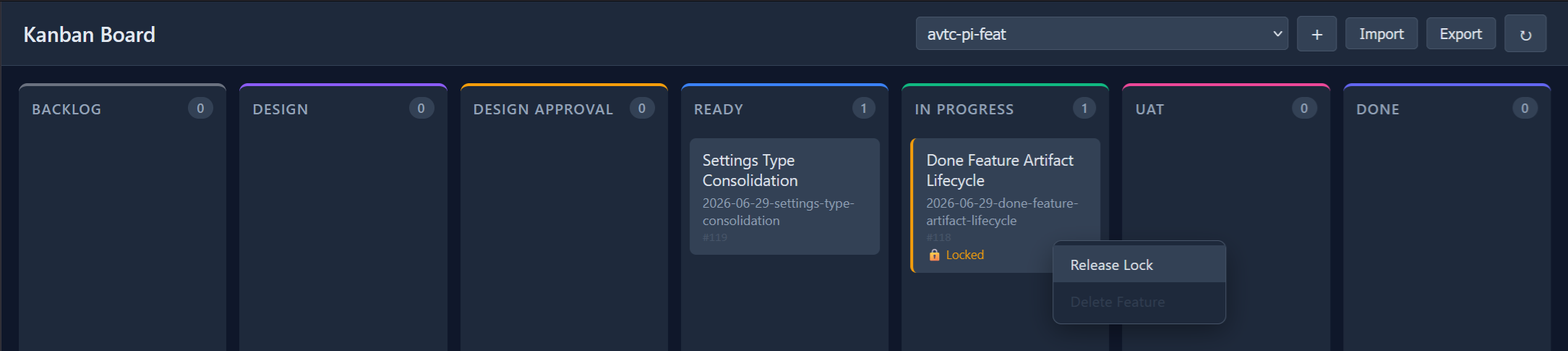
Status: worktree isolation is tested within a single repo; the auto-agent's switch to another feature when blocked by the user is not yet tested. Worktree mode targets one repo only — cross-repo changes (multiple repos, submodules, or sibling repos touched in one feature) are not supported. Single-session implementation remains the fully tested path.
| Command | What it does |
|---|---|
/fy:kanban | Open the kanban board in a browser (starts the HTTP server if needed) |
/fy:auto-agent | Start the autonomous loop — picks features from both design and ready lanes |
/fy:auto-worker | Autonomous loop, ready lane only |
/fy:auto-designer | Autonomous loop, design lane only |
/fy:auto-pause | Pause the auto-loop (keeps the current feature, heartbeat alive) |
/fy:auto-stop | Stop the auto-agent and resume interactive control (detaches the auto-agent, no re-dispatch) |
/fy:kanban-release | Release a feature lock so others can pick it up |
A queued backlog plus /fy:auto-agent lets the harness chew through features on its own, with verification and review gates still enforced.
Tools
| Tool | Description |
|---|---|
phase_ready | Signal phase completion + trigger the next-phase handoff |
task_ready_advance | Start a task, advance to the next, or finish implementation (per-task gate dispatch) |
add_to_backlog | Add a new feature to the kanban backlog |
Commands
| Command | Description |
|---|---|
/fy:next | Manual command to advance to next phase, expected to be used to advance from uat to finish, as other phases can be activated by invoking the skill related to phase |
/fy:reset | Turn-off the workflow |
/fy:resume | List active workflows and load the selected one into the current session |
/fy:settings | Open the settings UI |
/fy:continue [note] | Resume the workflow after a context compaction that waited for you to continue (manual /compact, or an automatic compaction at turn end). The prompt to run it appears as a notify. Optionally append a note that is sent with the resumed message |
/fy:archive-artifacts <days> | Archive old workflow artifacts (older than <days> days) out of your way; asks before moving anything |
/fy:archive-designs <days> | Archive old design docs (older than <days> days) from both .featyard/designs and docs/featyard/designs; asks before moving anything |
Skills
9 skills covering the pipeline phases, the design/plan review loops, and research:
- Phase drivers —
fy-design,fy-plan,fy-implement,fy-verify,fy-review,fy-finish - Review-iteration drivers —
fy-design-review,fy-plan-review(single-iteration passes re-dispatched per the configured loop count) - Research —
fy-research(deep code analysis for investigation tasks)
Invoke any with /skill:<name>.
Named Subagents
14 specialized agent profiles dispatched automatically by the review and verify skills (you don't invoke them directly):
- Reviewers —
fy-general-reviewer,fy-design-reviewer,fy-plan-reviewer,fy-guidelines-reviewer,fy-quality-reviewer,fy-security-reviewer,fy-performance-reviewer,fy-requirements-reviewer,fy-testing-reviewer - Verifiers —
fy-feature-verifier,fy-plan-verifier,fy-task-verifier - Utilities —
fy-researcher,fy-implementer
Dispatched via avtc-pi-subagent.
Artifacts
- Design docs —
docs/featyard/designs/or.featyard/designs/per thedesignDocStoragesetting. - Task plans, research, reviews — stored out-of-repo under a
.featyard/junction (see below)
The .featyard/ junction
Plans, research, and review artifacts are kept out of git (they're process artifacts, not source). Featyard creates a gitignored .featyard/ link at project init that points to a stable, project-keyed external location (~/.pi/featyard/<project>/). All worktrees of the project share that one store, so artifacts survive worktree removal.
Configuration
The /fy:settings command opens a tabbed modal covering every setting — workflow behavior, review-loop counts, branch policy, feature review mode, inter-task compaction, model overrides, and more:
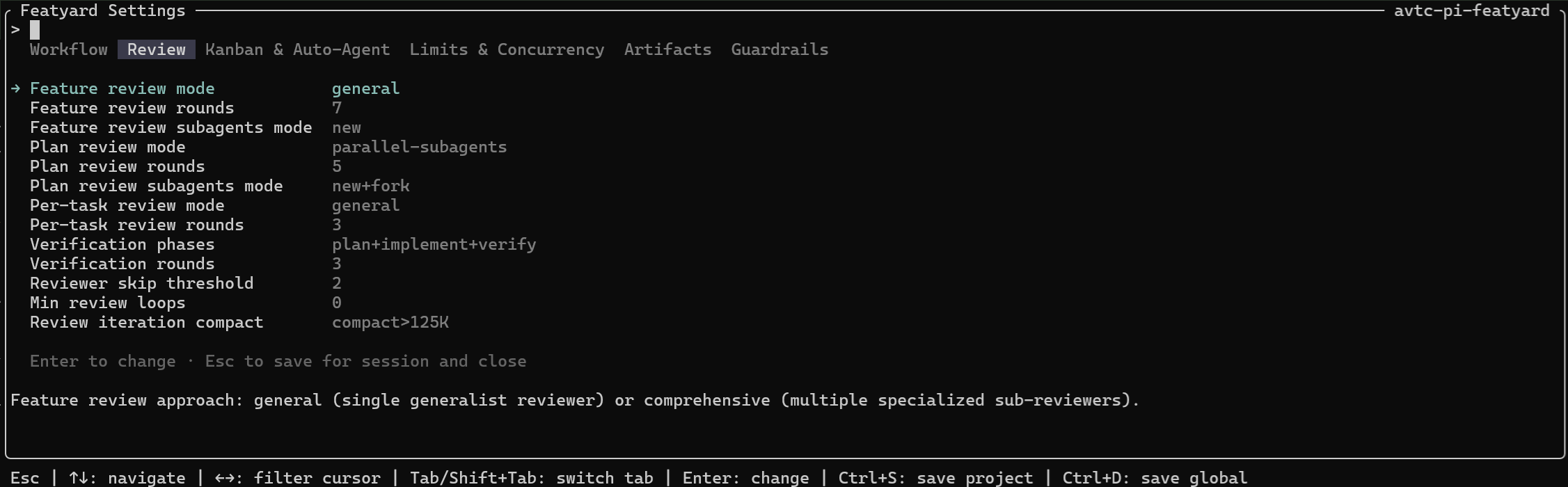
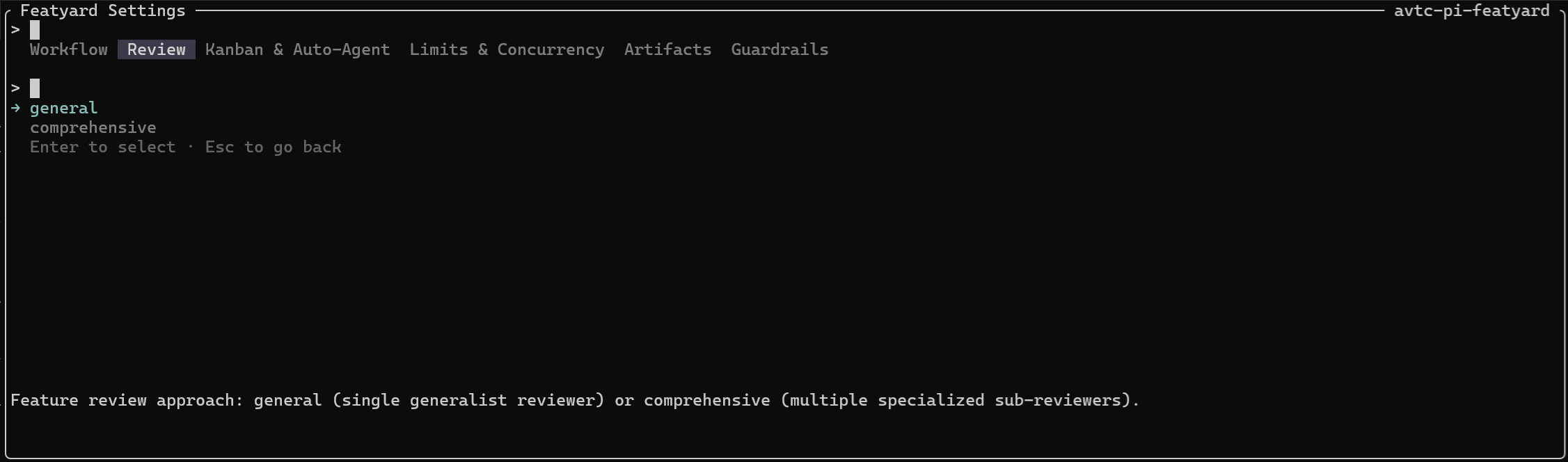
Workflow settings (workflow behavior, review-loop counts, branch policy, feature review mode, inter-task context compaction) live in avtc-pi-featyard-settings.json (~/.pi/agent/ global, <cwd>/.pi/ project overrides) and are edited via /fy:settings. Model routing per phase is configured separately in pi's shared ~/.pi/agent/settings.json under the "avtc-pi-featyard" key. See docs/CONFIGURATION.md for the full reference.
Full suite
Check out the full suite of related extensions, avtc-pi — deterministic feature development, subagent delegation, working-memory, behavioral learning, parallel-work guardrails, durable decisions, notifications, and more.
Developed with Z.ai — get 10% off your subscription via this referral link.
Attribution
Inspired by coctostan/pi-superpowers-plus and obra/superpowers (Jesse Vincent).
License
MIT