
Install
Install with PiG
pig install npm:@xoxoai/checkmateInstall with Pi
pi install npm:@xoxoai/checkmatePackages run code with your permissions and influence agent behavior. Catalog inclusion is not a security audit. Review the source before installing a third-party package.
Pi manifest JSON
The pi field of package.json.
{
  "skills": [
    "./plugin/pi/skills"
  ],
  "extensions": [
    "./plugin/pi/checkmate.mjs"
  ]
}
README
Written by the package's publisher, shown as published in version 0.8.4 (README.md). PiG does not review it.
□ □ ■ □
Checkmate
The QA system of record for an agent software factory.

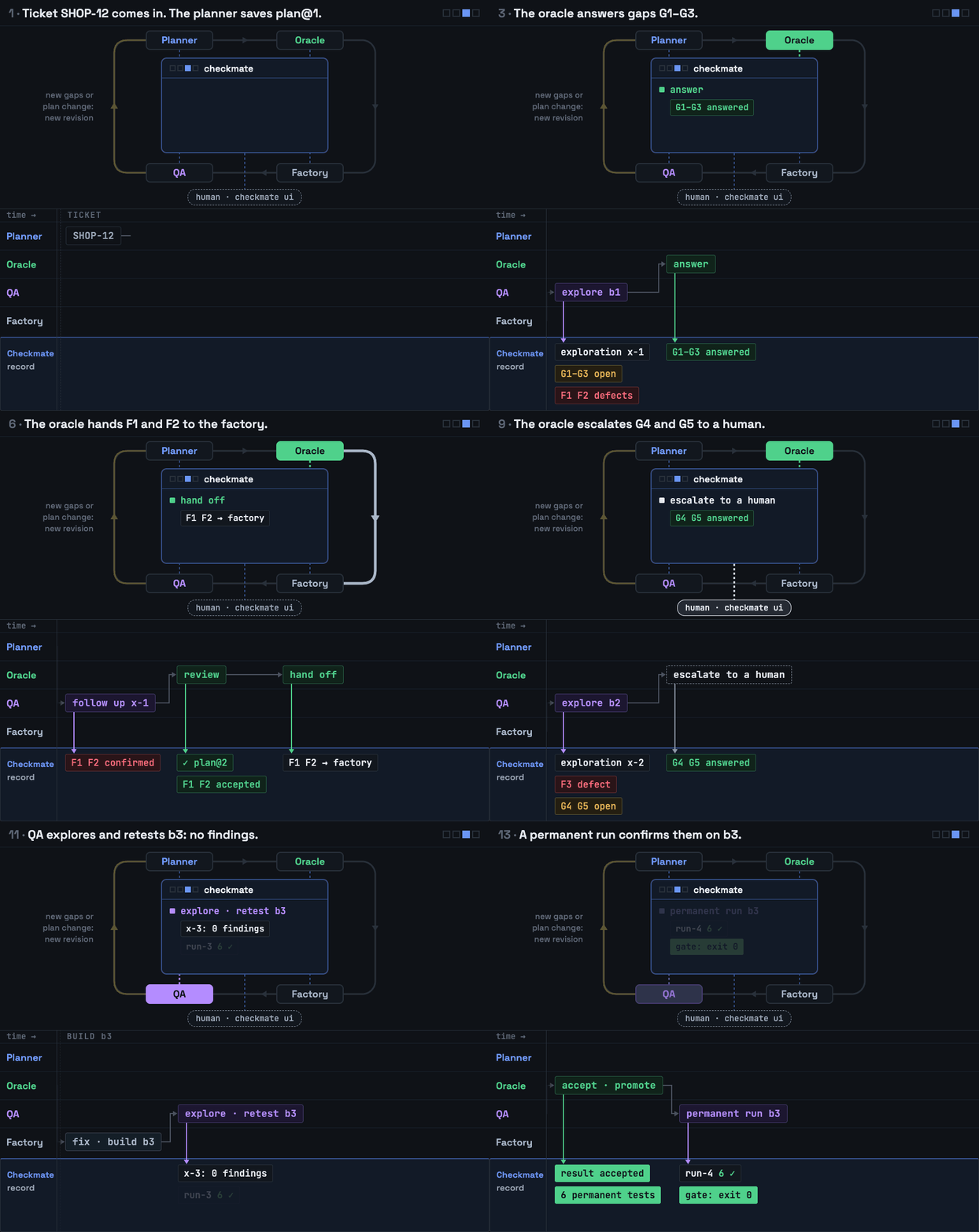
Checkmate turns a ticket into tests that an agent can run. It records the open questions, guides each test run, and keeps the evidence and every decision in one database. Agents and people read and write that record.
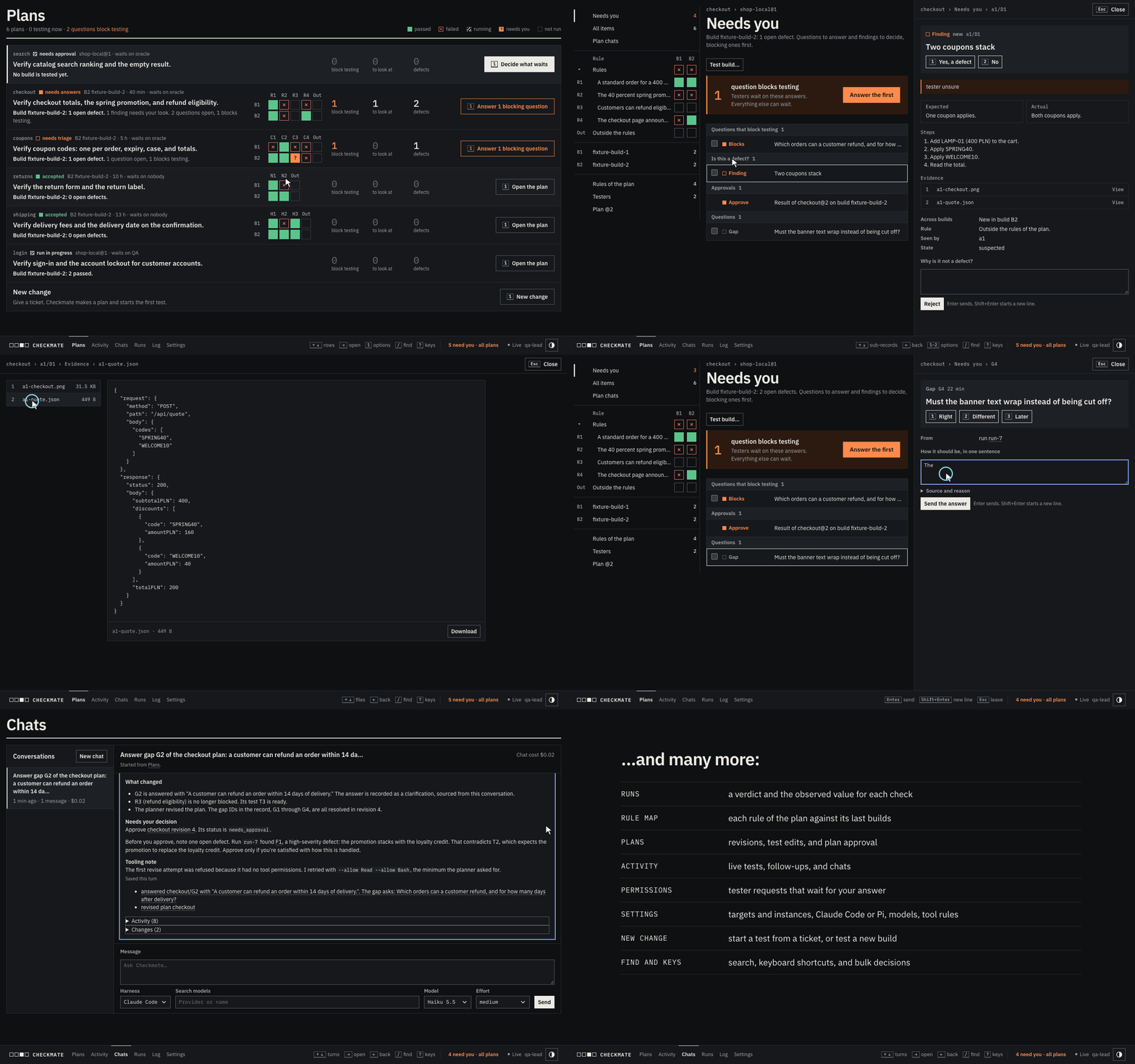
The Human review UI shows what waits for you: the evidence, findings and gaps. You can also chat with your harness directly.
In one minute
- The planner turns a ticket into rules, tests, and open gaps.
- The oracle answers gaps, approves plans, and accepts results. It is an agent or a person.
- QA tests each build. Code compares each check with its expected value.
- The factory builds the code and starts the app.
- Checkmate starts the planner and the testers through Claude Code or Pi. It does not change code or start the app.
- The QA record is kept in one SQLite file,
.checkmate/checkmate.db. Share project tool recipes in Git.
Core Idea
Traditional control systems might regulate temperature, aircraft altitude or motor speed. The Checkmate-enabled factory attempts to regulate something much more abstract: the alignment of software behavior with human intent.
QA sits at the center of the agentic dev lifecycle and indirectly drives each iteration through contracts, policies and a system of record, instead of being an afterthought at the end.
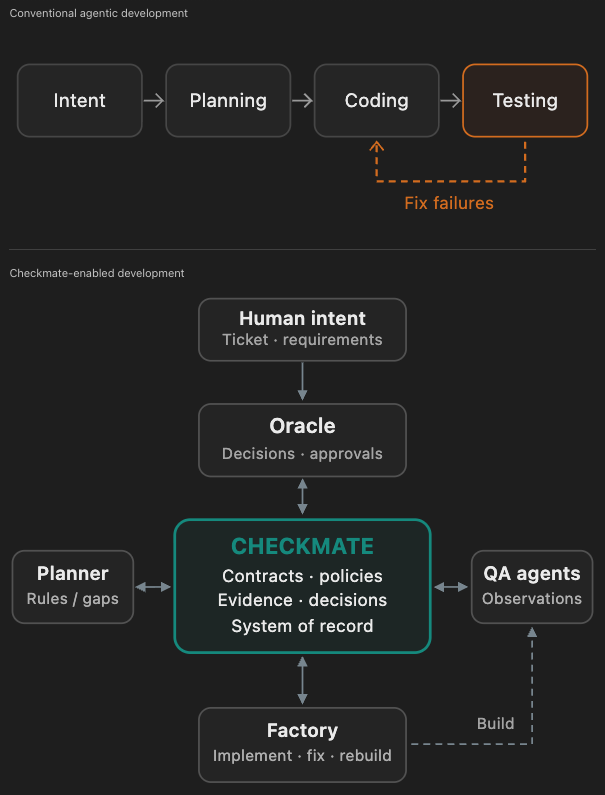
Early evidence shows that it helps the agentic loops to self-align better with true intent.
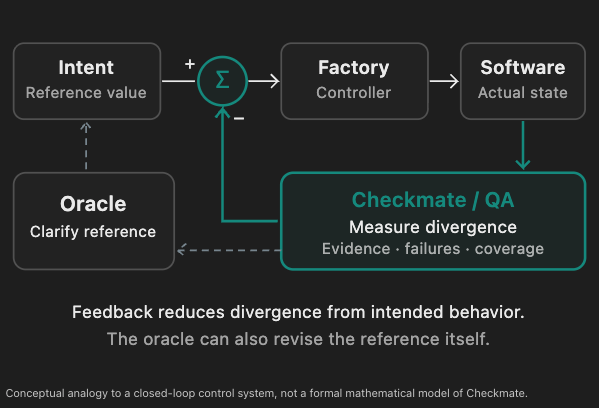
At core it is a double-loop system. It is inspired by TDD/BDD concepts applied with a twist specific to the agentic era.
A conventional control system usually attempts to minimize the difference between its output and a given reference value. But software development is different: often we discover that the reference value itself is wrong, and sometimes only after probing the system with tests and experiments. Chris Argyris and Donald Schön described a similar distinction in organizational learning. Single-loop learning corrects actions against existing objectives, whereas double-loop learning also questions the assumptions and objectives themselves.
Checkmate's distinction between defects and gaps maps onto this concept.
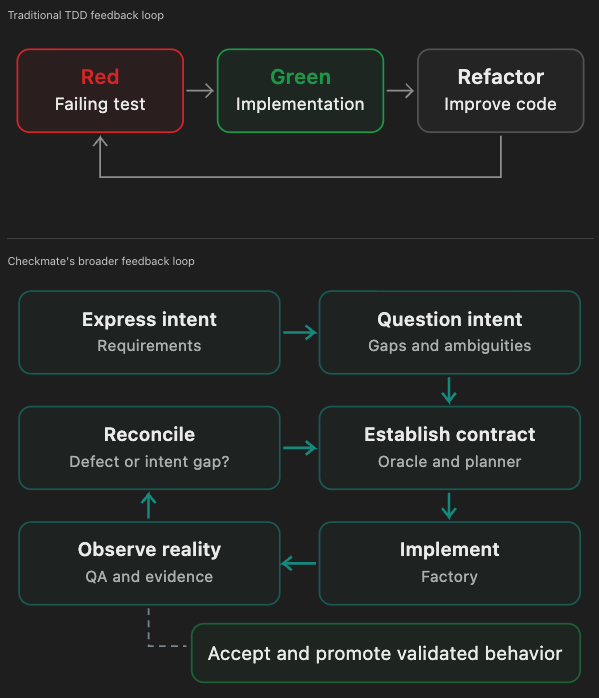
Front-loading QA like this has clear benefits:
- Catches gaps and ambiguities early: Defects and missing edge cases surface where agentic development is most critical, as the core idea becomes exponentially harder to adjust for agents with each commit.
- Sharpens requirements, reduces friction: Planned features often become simpler - or some even turn out to be redundant - keeping the intent that matters.
- Lowers delivery costs: Teams stay focused on real business needs and waste less time on late-stage or post-release fixes.
Limitations
- CLI runs with
--allowdon't inherit host tools: In the Claude Code plugin, testers inherit the tools of your host session, including its integrations (such as a Jira MCP server); only the clerk is limited toReadandWrite. In Pi, explorers use the tools and MCP servers configured in your host. In a CLI run that passes--allow, explorers only get the tools you explicitly pass and cannot ask for more. - Plan first, unless you accept the above limitations: Because of those tool limits, start by running the planner. It runs directly in your host environment, so it can read Jira tickets and other external sources before handing tasks off to explorers and testers.
Solo mode: Claude Code or Pi
Claude Code:
/plugin marketplace add dawiddiwad/checkmate
/plugin install checkmate@checkmate
/checkmate:test the change in JIRA-123 at http://127.0.0.1:4173
/checkmate:ui
Pi:
pi install npm:@xoxoai/checkmate -l
/checkmate test the change using checkmate in JIRA-123 at http://127.0.0.1:4173
/checkmate-ui
You are the oracle. The plugin and the extension ship the CLI. See Start Checkmate.
Team mode: the CLI in a factory or CI
npm i -g @xoxoai/checkmate
checkmate setup --url http://127.0.0.1:4173 --target shop \
  --data environment --policy "Each run gets fresh data."
checkmate plan open checkout --target shop@1 \
  --objective "Verify checkout totals." --source JIRA-123
checkmate delegate plan checkout --allow Read --allow Bash
checkmate status checkout
For pipelines, see Exit codes. Both modes need Node.js 24.12.0 or later, and Claude Code or Pi: Requirements.
Documentation
| Topic | Read |
|---|---|
| Install and a first test | Start Checkmate |
| Local QA as the oracle | Local QA with a human oracle |
| Factories and CI | Use Checkmate from a factory |
| Commands, states, records | CLI and record reference |
| Contributing | Develop Checkmate |