
Install
Install with PiG
pig install npm:@saifymatteo/pi-ttsInstall with Pi
pi install npm:@saifymatteo/pi-ttsPackages run code with your permissions and influence agent behavior. Catalog inclusion is not a security audit. Review the source before installing a third-party package.
Pi manifest JSON
The pi field of package.json.
{
  "image": "https://raw.githubusercontent.com/saifymatteo/pi-extensions/main/packages/pi-tts/screenshot.png",
  "extensions": [
    "./src/index.ts"
  ]
}
README
Written by the package's publisher, shown as published in version 0.3.0 (README.md). PiG does not review it.
@saifymatteo/pi-tts
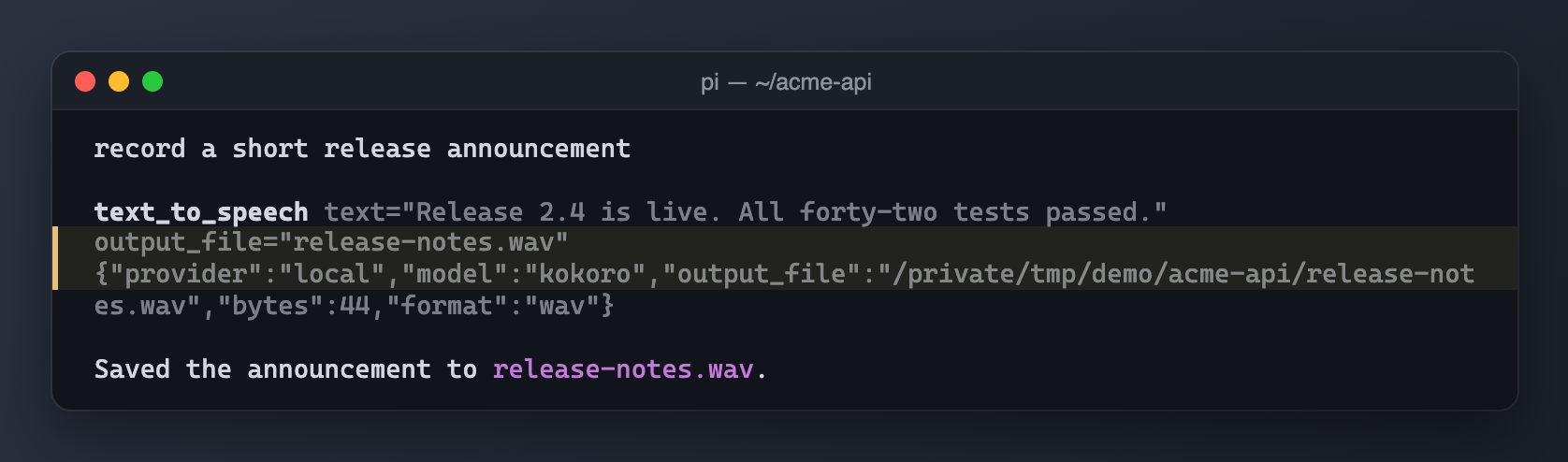
The agent calls text_to_speech, and the WAV file from the configured speech endpoint is saved into the project.
Purpose and registrations
Registers text_to_speech when the registry has a type: "tts" model; no slash commands or playback. Sends narration to a service and saves a new WAV, never overwriting an existing output. Uses standard fetch/streams and Pi tool registration; requires filesystem hard-link support for atomic publication.
Configuration and service
Reads the shared <agent-dir>/extensions/service-models.json registry and uses every model with type: "tts" and api: "openai-audio-speech". A missing registry is created once as $schema plus empty providers; with no TTS model the tool stays absent. A model may set default voice and language (requests can override them) and an optional one-line description, shown to the agent as a strength hint in the model parameter. Add providers from examples/service-models.example.json.
Editor validation: set "$schema": "https://raw.githubusercontent.com/saifymatteo/pi-extensions/main/packages/pi-tts/schemas/service-models.schema.json" at the top of the registry. pi-decisions and pi-tts ship identical copies of schemas/service-models.schema.json, so either installed package's URL works. The loader ignores $schema; the schema is editor help, not a runtime gate.
Requires an OpenAI-compatible speech server (POST audio/speech relative to the versioned base URL), not an installed CLI. Keys accept $ENV / ${ENV}; omission falls back to agent auth.json, explicit "" permits keyless TTS. Use environment references rather than embedded credentials.
Security and limits
All narration is transmitted to the selected service. Do not send secrets. 120s timeout, no retries/fallback, redirects rejected, 20000 characters/100 MiB maximum. Requires a new .wav path with an existing parent; writes private staging files beside output and hard-links atomically. Parent symlinks are not prohibited by the inherited implementation; only request trusted output paths. Output is local and never played automatically.
Tests
From the monorepo root with its existing test dependencies available:
node --test packages/pi-tts/test/*.test.mjs
Tests use the shared test-only TypeScript/VM loader, fixtures, and host/service stubs. They do not prove compatibility with a live host, CLI, or model service.
Running locally
From the monorepo root:
pi -e ./packages/pi-tts
Node >=24; host imports are peers, not bundled dependencies. Load only one copy: for an isolated session use --no-extensions with explicit -e paths so the original live extension is not also discovered. Set PI_CODING_AGENT_DIR to a disposable agent directory before launch; unset means the normal ~/.pi/agent fallback. Extension config continues to resolve there, never relative to this package.
Examples are manually authored, sanitized reference documents, not runtime defaults. Review and manually create only the needed files in the isolated agent directory; do not copy live credentials or endpoints. No example is automatically loaded or copied. Loading an extension grants Pi-process OS permissions. Licensed AGPL-3.0-only; see NOTICE.md.