
Install
Install with PiG
pig install npm:@saifymatteo/pi-9routerInstall with Pi
pi install npm:@saifymatteo/pi-9routerPackages run code with your permissions and influence agent behavior. Catalog inclusion is not a security audit. Review the source before installing a third-party package.
Pi manifest JSON
The pi field of package.json.
{
  "image": "https://raw.githubusercontent.com/saifymatteo/pi-extensions/main/packages/pi-9router/screenshot.png",
  "extensions": [
    "./src/index.ts"
  ]
}
README
Written by the package's publisher, shown as published in version 0.3.0 (README.md). PiG does not review it.
pi-9router
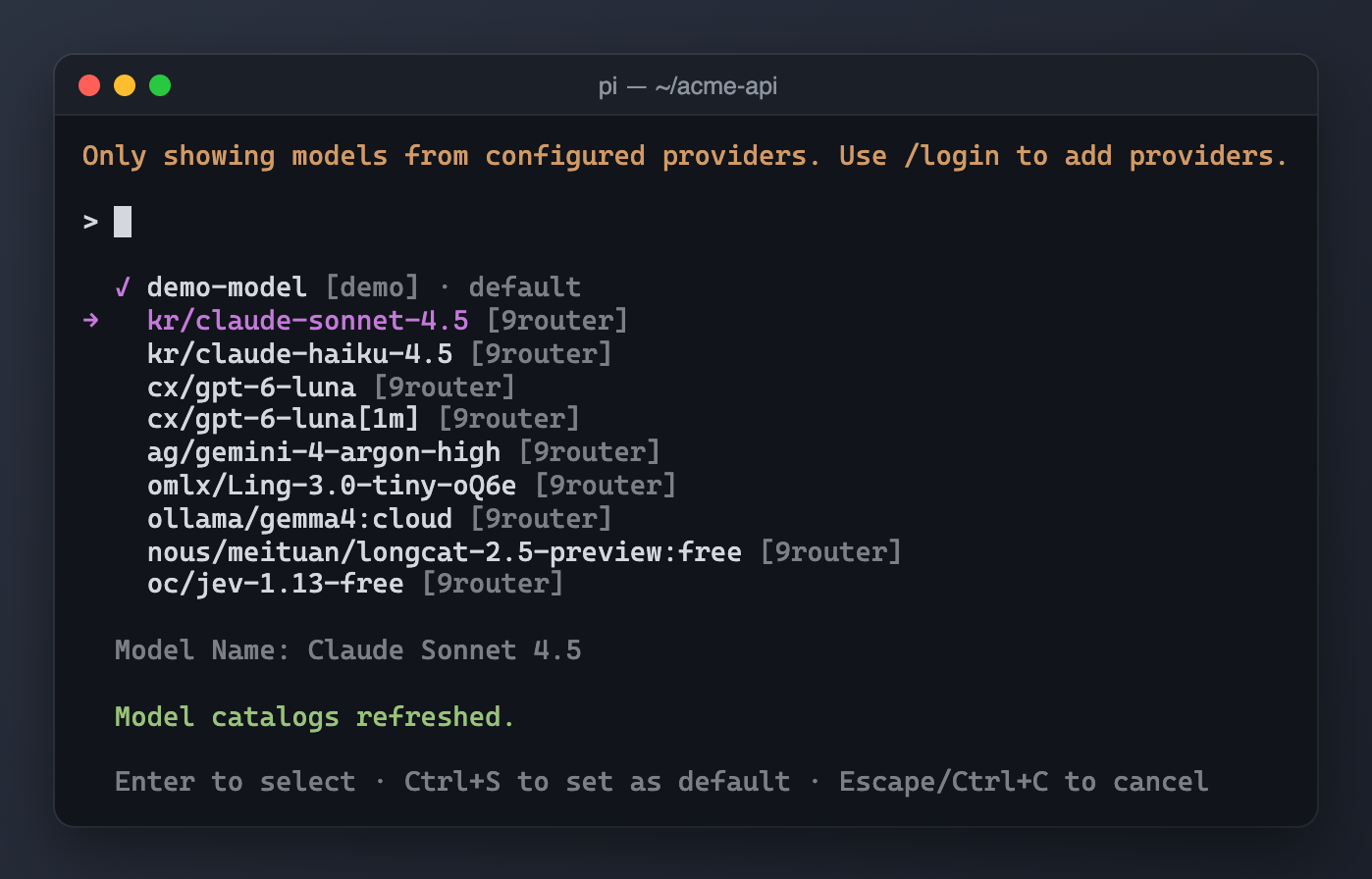
9Router model provider driven by the router's own /v1/models endpoint, plus fetch, search, and transcribe tools.
Model discovery uses only the router's models API: every model the router lists is registered from the capabilities it advertises itself (vision, reasoning, thinkingFormat, contextWindow, maxOutput) — no external catalogs (modelgrep, models.dev, opencode zen) are consulted, so a third-party outage can never break model discovery.
Based on @xynogen/pix-9router via the @haoyiyin/9router fork (both MIT); see NOTICE.md.
Install
pi install npm:@saifymatteo/pi-9router
Configure
There is no built-in default endpoint. Run /login, select 9Router, and enter the base URL and API key.
The two halves live in different files, both under <agent-dir> (PI_CODING_AGENT_DIR or ~/.pi/agent):
extensions/9router.json— the base URL and options (mode0600); no API key is stored here. This is the same directory other packages use for their settings (typically a symlink into your dotfiles), so it can be versioned safely.auth.json— the API key, stored by pi as the standard9routerlogin credential; chat authentication reads it from there, and so do the bundled tools.
/9router settings edits the base URL, combo reasoning on/off and the tool switches. A missing extensions/9router.json is created once with $schema, comboReasoning and the tool switches; baseUrl is left out so ROUTER_API_BASE still applies.
ROUTER_API_BASE / ROUTER_API_KEY environment variables override the config file and the credential respectively.
Migrating from @haoyiyin/9router: on first launch the extension reads the old haoyiyin/9router.json (or the intermediate saifymatteo/9router.json from 0.1.0 dev builds), writes the new secret-free config, and moves the key into the auth.json credential. The old file is then removed (and the haoyiyin/ directory, once empty), so the move happens once.
For editor completion, the config's first line is:
"$schema": "https://raw.githubusercontent.com/saifymatteo/pi-extensions/main/packages/pi-9router/schemas/9router.schema.json"
/login adds it when the key is absent and keeps any other $schema you set; the loader ignores it.
Model discovery
The provider refreshes <router-base-url>/models every 30 minutes (cached at ~/.cache/pi/9router.json). Startup never waits on the router: it registers the cached models at once, whatever their age, and refreshes in the background. The provider maps each model to pi's registry from the router's own capabilities:
| Router capability | Registered as |
|---|---|
capabilities.vision | model input (["text", "image"] or ["text"]) |
capabilities.reasoning | reasoning |
capabilities.thinkingFormat / thinkingCanDisable | compat.thinkingFormat + thinkingLevelMap |
capabilities.contextWindow (or context_window / context_length) | contextWindow |
capabilities.maxOutput (or max_tokens / max_completion_tokens) | maxTokens |
Cost is registered as zero for every model (the router meters usage). Display names are derived from the model id (e.g. kr/claude-sonnet-4.5 → Claude Sonnet 4.5) since the router does not advertise names. A failed refresh falls back to the stale cache; an unavailable router registers no models until it answers again.
Combo models (owned_by: "combo") advertise no capabilities, so their reasoning is decided by comboReasoning in the config file. It defaults to on (assumes combo routes hit thinking-capable upstreams) with the full off..max range. Opt out per machine with:
{
  "comboReasoning": false
}
To override that default range, pass a custom thinkingLevelMap (keys: off, minimal, low, medium, high, xhigh, max; values: what gets sent to the router, null hides the level). For example, to cap combo models at high:
{
  "comboReasoning": { "thinkingLevelMap": { "xhigh": null, "max": null } }
}
Tools
fetch / search / transcribe behave the same as in pix-9router; collapse config still lives in ~/.pi/agent/pix.json. They register only when a base URL and a credential are both available at load time (logging in mid-session enables them on the next launch). Disable any of them individually via the tools section of the config file — every tool is on by default:
{
  "tools": { "transcribe": false }
}
License
AGPL-3.0-only — see LICENSE. The vendored fetch/search/transcribe/http/render sources remain MIT (see NOTICE.md).