
Install
Install with PiG
pig install npm:@nidvue/teamworkInstall with Pi
pi install npm:@nidvue/teamworkPackages run code with your permissions and influence agent behavior. Catalog inclusion is not a security audit. Review the source before installing a third-party package.
Pi manifest JSON
The pi field of package.json.
{
  "image": "https://raw.githubusercontent.com/Nidvue/Teamwork/main/assets/social-preview.png",
  "skills": [
    "./skills"
  ],
  "prompts": [
    "./prompts"
  ],
  "extensions": [
    "./extensions"
  ]
}
README
Written by the package's publisher, shown as published in version 1.7.0 (README.md). PiG does not review it.
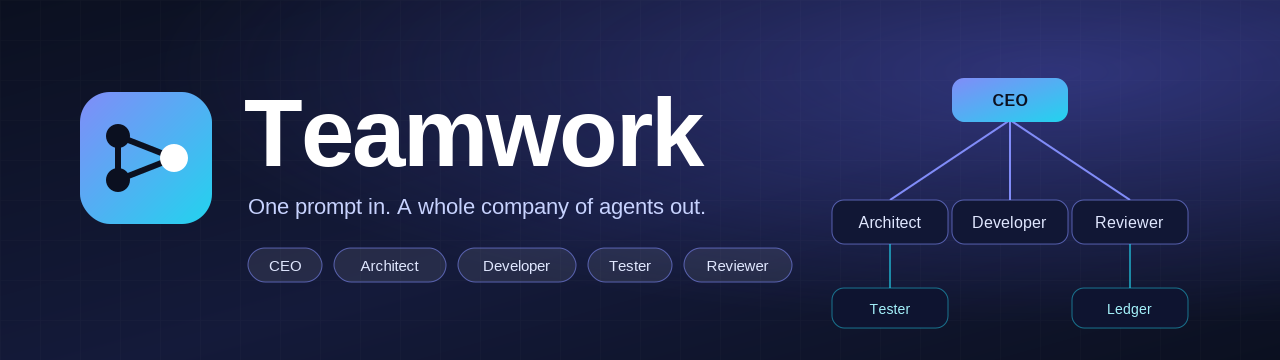

Nidvue Teamwork
One prompt in. A whole company of agents out.
Nidvue Teamwork is **a skill for your coding agent** - not a standalone application. Install it like any other skill (one clone, no package manager), then ask your agent for the team:






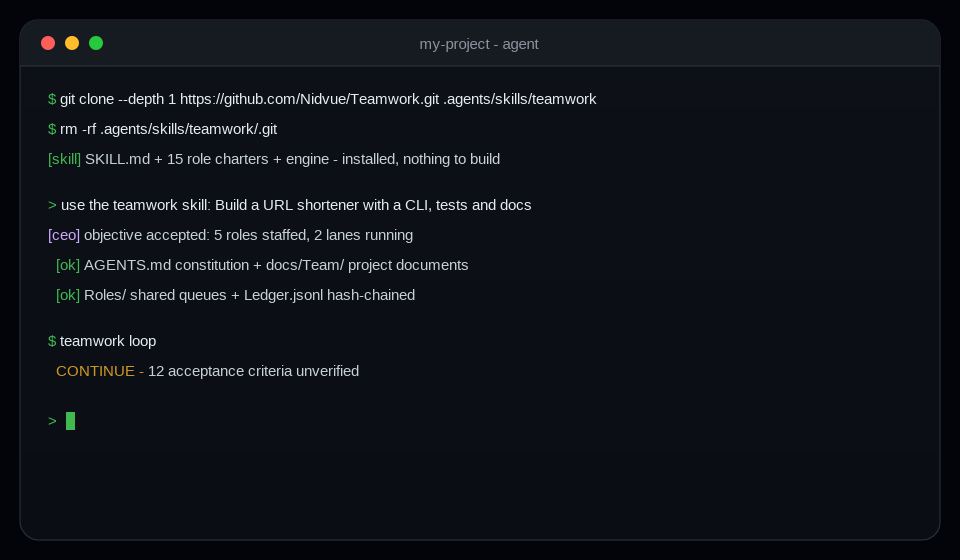
Nidvue Teamwork is a skill for your coding agent - not a standalone application. Install it like any other skill (one clone, no package manager), then ask your agent for the team:
> use the tw skill: Build a URL shortener with a CLI, tests and docs
That prompt becomes a team of AI agents that plans, builds, tests and
independently reviews its own work until every acceptance criterion has
executed evidence. The agent host supplies the LLM API, and every agent's model
is configured independently (teamwork model set <agent>): a strong model for
the Reviewer, a cheap one for the mechanical lanes. The engine (teamwork.py, stdlib only) ships inside the skill; installing it as a package is optional.
- Developed by AI agents, for AI agents. This repository is built by its own team: reviewed tasks in Archive, the learning loop in Evolution, and all but two commits (a merge and a dependabot bump) by a role mailbox.
- One prompt in, a whole company out. The 30-second quickstart is the whole install.
- It improves from its own failures. A failure becomes a lesson, a lesson becomes a skill, and a skill reaches the core only after two cuts; its own verdict is
confounded, because the first adoption changed the metrics and the classifier together (Evolution 9.2).
What makes it different
| Differentiator | What it is | Proof |
|---|---|---|
| Skill-first | One clone into the directory your agent scans; no package manager. | Installation |
| One parent, one board | One manager and one queue per role; any role scales. | How it works |
Evidence or UNVERIFIED | done needs a recorded command @revision -> result. | Operations |
| Reviewer-only merge | The author self-checks, a different role reviews, a pass lands. | How it works |
| Layered tests | Each role designs, builds and runs its own layer. | Features |
| Tamper-evident ledger | Every mutation is hash-chained and exportable. | Operations |
Five more ship inside the skill - engine commands, no plugin, no daemon:
| Capability | What you get | Command |
|---|---|---|
| Memory that persists | Captured at each lane exit, promoted to long-term, shared per role, verified against cited revisions. | teamwork memory |
| Live agent state | Every instance's state, task, time and progress, plus recent lanes; a stable --json feed the bundled widget renders. | teamwork status |
| Real parallel lanes | swarm run sizes the wave from the work, dispatches it and returns; each lane is detached. | teamwork swarm run |
| Agents that talk | A prioritised mailbox in the next packet; urgent preempts it and pauses its task. | teamwork message send |
| Token economy | A measured startup read against a 104 KiB cap, a memory index and read-by-id commands. | teamwork harness budget |
Install the skill
Clone the skill into the directory your agent host scans - no daemon, no hosted service, nothing to build:
# project-local: plain files in your repository, not a nested git repo
mkdir -p .agents/skills
git clone --depth 1 https://github.com/Nidvue/Teamwork.git .agents/skills/tw
rm -rf .agents/skills/tw/.git
Prefer a user-level install (~/.agents/skills/tw), a package manager
(npm install @nidvue/teamwork) or the optional engine wheel? Installation
compares all four channels, their commands and their requirements. Dropping the
nested .git is deliberate: the skill must be committed as plain files, not a
gitlink.
30-second quickstart
# 1. create the project and install the skill into it (one clone, nothing to
#    build; drop the nested .git so the skill is committed as plain files, not a
#    submodule)
$ mkdir my-project && cd my-project
$ mkdir -p .agents/skills && git clone --depth 1 https://github.com/Nidvue/Teamwork.git .agents/skills/tw && rm -rf .agents/skills/tw/.git

# 2. ask your agent for the team, from the project root
> use the tw skill: Build a URL shortener with a CLI, tests and docs
The CEO writes AGENTS.md, staffs the roster, freezes the interfaces, records
the acceptance criteria and opens the lanes. The hidden, gitignored workspace
appears at .pi/Teamwork/Teams/<Team>/; project output is committed. Read the full walkthrough in Quickstart.
What you get
- 16 role charters - the 15-role org plus a Team Leader per feature, each with its own memory and queue.
- A two-stage quality gate - author self-check, then independent review; only the Reviewer merges.
- Parallel lanes, no plugin -
swarm runsizes each wave from the work. - Built-in memory and a mailbox - role-shared memory, a
ctx://tree and a prioritised agent-to-agent queue. - Live state -
statusand its JSON feed, plus the bundled status widget. - Layered tests - one owner per layer, gaps shown by
tests plan. - Token-true budget -
harness budgetmeasures the startup read; trim it, never raise the cap. - Automatic model routing, off by default -
teamwork model autodetects the agent host and plans the strong model for the decision lanes and the economy one for the mechanical lanes. The model the user configured is kept until an explicit demand switches it:model auto --apply --allow-switch --reason '<who asked>'. - File ownership -
task add --files 'src/a.py,docs/Team/'declares paths a lane owns;preflightwarns on any other path. - Portable - CPython 3.11-3.13 on Linux, macOS and Windows; stdlib only.
Documentation
| Page | Read it for |
|---|---|
| Documentation home | The docs site index. |
| Installation | Install channels, requirements, uninstall. |
| Quickstart | Bootstrap a team and run the CEO loop. |
| For agents | The install-and-drive routine. |
| Usage patterns | The recurring jobs, as transcripts. |
| Operations | Slots, memory, live state, the mailbox, the ledger. |
| How it works | The loop, the gate, the workspace tree. |
| Features | Every capability, and what the gate refuses. |
| Architecture | Package layout, resource resolution, workspace format. |
| CLI reference | Every command and flag, in records, review, workflow and audit. |
| Alternatives | How this compares with others. |
| Roadmap | What is shipped, current, and not planned. |
| Releases | What a release publishes. |
| CI pipeline | Run the pipeline locally. |
Contributing, security and license
- Contributing - work on your own branch, run
pytest -qandruff check, open a PR; a Reviewer - never the author - merges it. Read CONTRIBUTING.md and the code of conduct. - Security - report privately via GitHub security advisories; see SECURITY.md.
- License - AGPL-3.0-or-later, copyright (C) 2026 Nidvue (NOTICE). The strong copyleft is deliberate: the audit guarantees should survive modification.
- No personal data, no local leakage -
scripts/privacy_scan.pyfails the build on names, emails, home paths, credentials or agent-host state.