
Install
Install with PiG
pig install npm:@maxiaochao/pi-herdr-subagentsInstall with Pi
pi install npm:@maxiaochao/pi-herdr-subagentsPackages run code with your permissions and influence agent behavior. Catalog inclusion is not a security audit. Review the source before installing a third-party package.
Pi manifest JSON
The pi field of package.json.
{
  "extensions": [
    "./extensions/herdr-subagents.ts"
  ]
}
README
Written by the package's publisher, shown as published in version 0.12.0 (README.md). PiG does not review it.
Herdr Subagents
Run focused Pi subagents in visible, focusable Herdr panes and collect exactly one terminal result per task.
The implementation is intentionally small: one task state machine, one derived run state, and one bounded worker pool. Herdr provides visible panes and navigation; the package only dispatches serial or read-only parallel work, waits for a report, and records the result. It does not add a second workflow engine around Pi.
Demo
https://github.com/user-attachments/assets/8ddf3ae6-a11a-492b-9cae-d9496ba65b67
The embedded video is the previously published walkthrough. The current release acceptance recording is retained in full as docs/demo.webm.
Requirements and install
Run Pi inside a Herdr workspace, then install the standalone package:
pi install npm:@maxiaochao/pi-herdr-subagents
Update it with pi update npm:@maxiaochao/pi-herdr-subagents. The full @maxiaochao/pi-toolkit package already bundles this extension, so install the toolkit or this standalone package, not both.
The tools and command are registered only when Pi is running inside Herdr with a workspace ID. If they are unavailable after entering Herdr, use /reload or restart Pi there.
Execution contract
herdr_subagents accepts an ordered, non-empty tasks array. Every task must explicitly set agent; there is no default Persona.
concurrency: 1runs tasks strictly in input order.concurrency: Nruns at most N read-only tasks at once.- A run containing a write-capable persona must use
concurrency: 1; unsafe parallel writes are rejected. - One task failing does not cancel siblings that are already running.
- The tool returns only after every task is
completed,failed, orcancelled. - There is no background queue, blocked/respond flow, automatic resume, or early failure detach.
- A hard task failure stops queued tasks from starting. Already-running siblings finish before the tool returns.
{
  "label": "review",
  "concurrency": 2,
  "tasks": [
    { "name": "api", "prompt": "Review the API boundary.", "agent": "reviewer" },
    { "name": "tests", "prompt": "Find missing test coverage.", "agent": "explorer" }
  ]
}
Each task starts a single-task interactive Pi process in its own Herdr pane. Herdr first confirms the interactive Pi is ready, then the prompt is delivered exactly once. Prompt acknowledgement never decides task completion. If delivery fails and the child never starts the attempt, the task fails with the Herdr error; it is not retried, because a retry could submit the text twice. Panes remain ordinary Herdr panes: they can be focused and inspected while work is running or after it settles. An early-finishing child stays at the Pi UI while sibling tasks continue. After the whole run settles, cleanup closes an unfocused run tab immediately or waits for the user to leave a focused run tab.
In Pi 1.4+ fullscreen mode, left-click a task row in the parent's Fleet widget to focus that task's exact Herdr pane. The title and empty rows are not clickable; a queued task with no pane has nowhere to jump. The click uses the last rendered row's task identity. Keyboard navigation remains available: with an empty editor, press Down to enter Fleet selection, use Up/Down to choose a task, then Enter to focus it (Escape leaves selection). /herdr-subagents focus <task-number> also works without mouse input. Clicking changes focus only; it does not submit a prompt or restart a task.
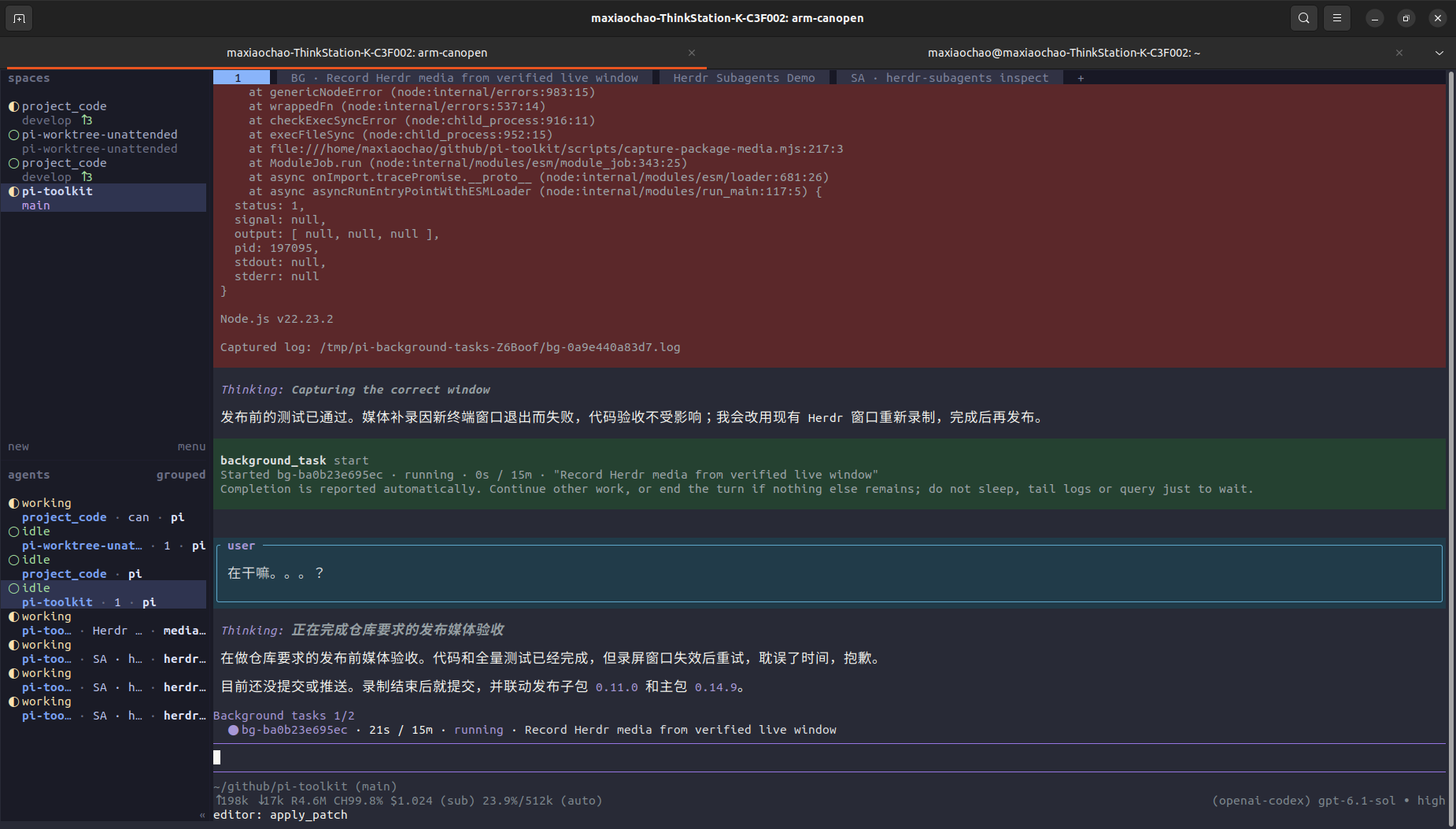
Use Alt+P or /parent in a child to focus its parent Agent pane. The shortcut has no persistent footer hint. Other extensions' status text, such as Codex Edit's editor: apply_patch, remains visible when those extensions are loaded and their editing tools are active. Changing Persona extensions does not change an already running child.
For a Persona whose tools includes edit, the child CLI also permits apply_patch so a trusted editing extension can switch protocols. This does not load an extension or enable both editors by itself. Personas without edit do not receive this permission, and a child without a patch extension keeps native edit.
Cleanup belongs to the Pi session that created the run. Starting a new Pi session never scans historical runs or closes their recorded Herdr tabs. If Pi terminates before shutdown cleanup runs, any surviving Subagent tab remains visible for explicit inspection or cleanup.
Result protocol
When the task finishes or cannot be completed, the child must call subagent_report once instead of ending with a normal text reply. The terminal status is:
completed: the requested work finished.failed: it cannot be completed; includeerror.
The complete result is stored on disk. The parent receives only the compact summary and document paths.
The child UI renders only the report status and saved size instead of echoing the complete result argument. The parent-facing tool result includes one complete-result path per task; additional consulted-document metadata remains in the durable report.
An atomically renamed attempt report is the authoritative completion signal. Herdr states such as idle, blocked, and done are wake-up hints only. A prompt transport error or Pi retry cannot fail a task while its child process remains alive. If the process exits without a valid report, the task fails explicitly.
A final Provider error does not publish a terminal report. The task remains running with runtime state waiting_interaction, the parent tool stays attached, and the child pane keeps its full session. Correct the Provider in the child and submit another prompt; the same attempt returns to working. Cancel the run explicitly if it should not continue.
Duplicate identical reports are idempotent. A conflicting report for the same task attempt is rejected. Terminal task records are immutable.
State model
The same small state machine is used for every task; there are no separate foreground, background, blocked, resumed, or retry lifecycles.
New task records use:
queued -> running -> completed | failed | cancelled
A run is running while any task is queued or running. Settled aggregate states are completed, failed, partial, or cancelled.
Older records containing starting or blocked remain readable for history and cleanup, but new runs never write those states.
Durable records
Records are stored under:
.pi/herdr-subagents/runs/<sortable-run-id>/
  run.json
  tasks/<order>-<task-id>/
    task.json
    session.jsonl
    system-prompt.md
    report.json
    reports/<attempt-id>.json
    attempt-results/<attempt-id>.md
    attempts/<attempt-id>.json
    attempts/<attempt-id>.reminded
The orchestrator is the only writer of run.json, task.json, and promoted report.json. The child writes attempt-scoped runtime state, reminder marker, result, and report files.
Tools and UI
herdr_subagents
Starts one ordered batch and waits until every task reaches a terminal state. Its parameters are:
| Field | Required | Default | Purpose |
|---|---|---|---|
tasks | Yes | — | Non-empty ordered task array. |
label | No | "batch" | Short Herdr run-tab label, at most 48 characters. |
concurrency | No | defaultConcurrency | Maximum number of simultaneously active read-only tasks. It is capped by maxConcurrency. |
tasks[].name | Yes | — | Short pane/task name, at most 48 characters. |
tasks[].prompt | Yes | — | Self-contained task instructions. |
tasks[].agent | Yes | — | Effective Persona name; use control list to inspect available Personas. |
tasks[].model | No | Persona/default model | Model override for this task. |
tasks[].thinking | No | Persona/default thinking | Thinking level override for this task; model support varies. |
model and thinking are independently optional. Omit them unless the user explicitly requests a task-specific override. A task override takes precedence over Persona settings and defaults. For example, when the user requests this model and thinking level:
{
  "tasks": [{
    "name": "review",
    "prompt": "Review the API boundary.",
    "agent": "reviewer",
    "model": "openai/gpt-5.2",
    "thinking": "high"
  }]
}
Omit either field to keep its existing resolution. Without configured thinking, the parent thinking level is inherited only when the model is inherited from the parent and the task does not specify model; otherwise child Pi selects its default. An explicit task thinking must be one of off, minimal, low, medium, high, xhigh, or max after trimming. Invalid task values are rejected before creating a run; child Pi still resolves model-specific compatibility.
A batch containing a write-capable Persona must explicitly or effectively use concurrency: 1; an unsafe parallel request is rejected.
herdr_subagents_control
| Action | runId | Purpose |
|---|---|---|
list | Not accepted | List Persona names and descriptions for task selection, plus configuration diagnostics when present. |
status | Required | Show one run and its task states. |
history | Not accepted | Page durable run metadata; default 10, maximum 50 via limit, newest first. |
cancel | Required | Cancel an active run. |
cleanup | Required | Remove one archived run. |
History accepts optional limit (1–50, default 10) and cursor (the previous page’s nextCursor). It returns runs, hasMore and, when needed, nextCursor; run entries contain only ID, label, status, timestamps, task count and a compact diagnostic for unreadable metadata. It does not expand task summaries, documents or session paths. Use status with a runId to read task summaries on demand.
herdr_subagents_control({action: "history", limit: 10})
herdr_subagents_control({action: "history", cursor: "<nextCursor>"})
herdr_subagents_control({action: "status", runId: "<selected-run-id>"})
Pages sort by start time and run ID, so adding a newer run between requests does not shift older pages. A cursor remains usable if its anchor run was removed. The index reads only run metadata, not every task/report. It still scans all small run records; a persistent index is deferred until that scan becomes a measured bottleneck. The index shows durable run status, not the task-corruption projection of detailed storage inspection.
Settled tasks are immutable. Follow-up work starts a new task or run; there is no resume/respond lifecycle.
The model-facing list text does not expand tools, skills, extensions, models, thinking levels, or configuration sources. Describe routing-relevant capabilities and constraints in each Persona's description. Use /herdr-subagents agents and /herdr-subagents settings for detailed configuration; full resolved data remains in the tool result's details metadata.
Slash command
/herdr-subagents supports:
| Command | Purpose |
|---|---|
active | Show the current run. This is also the default with no argument. |
history [cursor] | Show 10 run-index entries; use the returned cursor for the next page. |
focus <task-number> | Focus a running task pane. |
agents | Show effective Persona source, access, model, thinking, tools, skills, and extensions. |
models | List authenticated Pi models. |
settings | Show effective settings, their sources, and configuration diagnostics. |
Configuration and Personas
Settings and Persona definitions are separate:
| Scope | Settings file | Persona directory |
|---|---|---|
| Project | <project>/.pi/herdr-subagents.json | <project>/.pi/herdr-subagents/agents/*.md |
| Global | ~/.pi/agent/herdr-subagents.json | ~/.pi/agent/herdr-subagents/agents/*.md |
| Package | Built-in defaults | Installed package agents/*.md |
For JSON settings, project fields override global fields, which override built-in defaults. personas entries merge by Persona name and then by field; array values replace lower-precedence arrays rather than appending to them.
Persona Markdown uses whole-definition replacement instead of field merging. A same-name definition is selected in this order:
- project Persona
- global Persona
- package Persona
Complete settings reference
These are all supported top-level fields in herdr-subagents.json:
| Option | Accepted value | Built-in default | Purpose |
|---|---|---|---|
exposure | "model-only" or "direct" | Unset (inherit Pi; currently direct) | Controls whether the two tools may be called only by the top-level model or also by nested tools such as Codemode. |
defaultConcurrency | Positive integer | 1 | Concurrency used when a call omits concurrency; capped to maxConcurrency. |
maxConcurrency | Positive integer | 4 | Hard ceiling for requested/default read-only concurrency. It does not make write-capable batches safe. |
stalledWarningSeconds | Positive integer | 300 | Emit a warning after a child runs this long. This is not a timeout and does not stop it. |
abortGraceSeconds | Positive integer | 30 | After the user aborts a child with Esc, wait this long for a correction. If no new round starts, publish an unconfirmed child_aborted failure. |
defaultModel | Non-empty Pi model ID, normally provider/model | Unset | Fallback child model. If unset, the parent model is inherited. |
defaultThinking | Non-empty Pi thinking value | Unset | Fallback thinking level below Persona-specific settings. Typical Pi values are off, minimal, low, medium, high, xhigh, and max; model support varies. |
defaultExtensions | Array of non-empty Pi source strings | Unset (no optional extensions) | Fallback extension sources for Personas without an explicit extensions list. Project replaces global; [] clears inherited defaults. |
personas | Object keyed by an existing Persona name | {} | Per-Persona overrides. It cannot create a Persona without a matching Markdown definition. |
Each personas.<name> object supports:
| Option | Accepted value | Purpose |
|---|---|---|
model | Non-empty Pi model ID | Override the model from Persona Markdown and defaultModel. |
thinking | Non-empty Pi thinking value | Override Persona Markdown and defaultThinking. |
skills | Array of non-empty strings | Replace the lower-precedence explicit skill list. Use [] to clear it. |
extensions | Array of non-empty Pi source strings | Replace the lower-precedence extension-source list. Use [] to clear it. |
JSON overrides cannot change a Persona's name, description, access, tools, or system prompt; those belong in its Markdown definition.
Invalid known values are ignored and reported by /herdr-subagents settings or the control tool's list action. If defaultConcurrency exceeds maxConcurrency, the effective default is reduced to the maximum. Model IDs, thinking compatibility, skills, and extension sources are ultimately resolved by child Pi.
Exposure
Use the restrictive mode when only direct model calls should be allowed:
{
  "exposure": "model-only"
}
model-only: the top-level model may call the tools, but Codemode scripts and other tools cannot invoke them as nested tools.direct: allow both top-level and nested calls explicitly.- omitted: do not set an exposure during registration; inherit Pi's default behavior.
exposure is read once when the extension registers. After changing it, use /reload or restart Pi. Other settings and Persona files are re-read at the start of each new tool call; they do not modify an already running task.
Complete global example
Save this as ~/.pi/agent/herdr-subagents.json. Model IDs, skills, and extension sources are illustrative and must exist in your Pi environment.
{
  "exposure": "model-only",
  "defaultConcurrency": 2,
  "maxConcurrency": 4,
  "stalledWarningSeconds": 300,
  "abortGraceSeconds": 30,
  "defaultModel": "anthropic/claude-sonnet-4-5",
  "defaultThinking": "medium",
  "defaultExtensions": ["~/.pi/agent/extensions/provider-routing.ts"],
  "personas": {
    "explorer": {
      "model": "anthropic/claude-haiku-4-5",
      "thinking": "low",
      "skills": ["code-search"]
    },
    "reviewer": {
      "thinking": "high",
      "skills": ["code-review"],
      "extensions": []
    }
  }
}
A project can override only what differs in .pi/herdr-subagents.json:
{
  "defaultConcurrency": 3,
  "stalledWarningSeconds": 600,
  "personas": {
    "explorer": {
      "model": "openai/gpt-5.2",
      "skills": []
    },
    "reviewer": {
      "extensions": ["npm:@example/pi-review-tools@1.0.0"]
    }
  }
}
Here the project keeps global maxConcurrency, defaultModel, defaultThinking, and defaultExtensions; replaces the explorer model and skill list; and replaces the reviewer extension list. It does not append arrays.
Built-in Personas
None of the bundled Personas pins a model, thinking level, skill, or optional extension. Those values come from configuration or parent-session inheritance.
| Persona | Access | Built-in tools | Intended use |
|---|---|---|---|
worker | write | read, bash, edit, write, grep, find, ls, codemode | One focused implementation or other file-changing task. |
explorer | read | read, bash, grep, find, ls, codemode | Codebase structure, behavior, and dependency investigation without file changes. |
reviewer | read | read, bash, grep, find, ls, codemode | Independent review of proposals, designs, documents, implementations, and analysis against goals and constraints. |
Choose reviewer for an independent assessment of existing work, explorer to investigate how the codebase works, and worker for file-changing work.
The built-in analyst Persona has been removed. Update tasks and any personas.analyst settings to the selected remaining Persona; settings are not migrated automatically. Without a custom definition, agent: "analyst" fails as an unknown Persona before creating a run. User-defined Personas may still use that name.
The control tool's list action exposes each effective description to help the parent choose a Persona. The Markdown body instead becomes the selected child's appended system prompt. Put selection guidance in description and execution instructions in the body; bundled definitions keep both in English.
access is a scheduling declaration: any write Persona requires serial execution. It is not by itself a sandbox. For a custom read-only Persona, also omit write-capable tools and load only trusted extensions.
Custom Persona example
Save the following as .pi/herdr-subagents/agents/security-reviewer.md (or in the global Persona directory):
---
name: security-reviewer
description: Read-only reviewer for security risks
access: read
model: anthropic/claude-sonnet-4-5
thinking: high
tools: read, bash, grep, find, ls, codemode
skills: security-review, code-review
extensions: ~/.pi/agent/extensions/provider-routing.ts
---

Review the assigned scope without modifying files. Separate confirmed vulnerabilities from hypotheses and cite concrete evidence.
The Markdown body is the child system prompt. Frontmatter is intentionally a small single-line format, not full YAML:
| Field | Accepted value | Required/default | Purpose |
|---|---|---|---|
name | Non-empty string | Required | Identifier used by tasks[].agent; unique within one directory. |
description | Non-empty string | Required | Description shown by Persona listings. |
access | read or write | write | Scheduling safety declaration. |
model | Non-empty Pi model ID | Unset | Persona model default. |
thinking | Non-empty Pi thinking value | Unset | Persona thinking default. |
tools | Non-empty comma-separated list, optionally [bracketed] | Pi child defaults | Built-in-tool allowlist. Supported names: read, bash, edit, write, grep, find, ls, powershell, codemode. subagent_report is always added. |
skills | Comma-separated list, optionally [bracketed] | None | Explicit child skills; normal automatic skill discovery is disabled. |
extensions | One source or a comma-separated list; [] clears | None | Additional Pi extension/package sources loaded into the child. |
Explicit extension sources and Pi packages
Use top-level defaultExtensions in ~/.pi/agent/herdr-subagents.json to share trusted extension sources across Personas. Set the same field in <project>/.pi/herdr-subagents.json to replace the global default list for that project. Defaults are a fallback, not an appended list: any Persona-specific extensions, including Markdown frontmatter and explicit [], takes precedence. An empty default list clears inherited defaults but does not remove Persona-specific sources or the mandatory child extensions.
Relative extension paths resolve from the project root, including paths in global defaultExtensions. ~ resolves to the home directory. Pi-native local, npm:, git:, and builtin: sources are accepted. Children always load the required report extension and Codemode; configured sources are additional. Pi packages may provide resources beyond extensions, so load only trusted code and pin versions/refs when reproducibility matters.
Effective option precedence
The child model is selected in this order:
tasks[].model- project
personas.<name>.model - global
personas.<name>.model - effective Persona Markdown
model - effective
defaultModel(project, then global) - parent Pi model
Thinking is selected in this order:
- project
personas.<name>.thinking - global
personas.<name>.thinking - effective Persona Markdown
thinking - effective
defaultThinking(project, then global) - parent thinking when the child also inherits the parent model
There is no task-level thinking override. skills uses project Persona JSON, then global Persona JSON, then effective Persona Markdown.
Extension sources are selected in this order:
- project
personas.<name>.extensions - global
personas.<name>.extensions - effective Persona Markdown
extensions - project
defaultExtensions - global
defaultExtensions - no optional extensions
Each winning list replaces the whole lower-precedence list, including when it is []. The required report extension and Codemode always remain loaded. /herdr-subagents settings shows the effective defaults and their source; the agents listing shows each resolved extension list and its source.
Use /herdr-subagents agents, /herdr-subagents models, and /herdr-subagents settings to inspect the result before starting work.
Development and tests
See TESTING.md for deterministic tests, extension loading, packaging, and real Herdr smoke requirements. The real smoke preserves your configured reviewer model, thinking level, and explicit extensions (including authentication providers) inside its isolated fixture; unrelated Persona settings remain isolated.
Missing reports and terminal diagnostics
The child checks reports/<attempt-id>.json at agent_before_settle. A valid completed or failed report adds zero requests. A normally completed round without a report receives one reminder to submit existing results, not redo the task. attempts/<attempt-id>.reminded is persisted before continuing; rounds and reloads cannot reset it.
A second omission produces a failed protocol report with error: missing_report, an explicitly unconfirmed result, and the child session path. This does not assert the delegated work itself failed. Final Provider errors instead persist waiting_interaction with the Provider diagnostic and keep the attempt alive without another request. A user abort (Esc) skips before-settle. The child waits abortGraceSeconds (default 30) for a correction; a new round cancels the timer and the child continues. If nothing starts in time, it publishes an unconfirmed child_aborted failure. Parent-requested cancellation retains its existing cancelled lifecycle.
The parent still waits for an atomic attempt report or process exit. It does not infer success from idle/settled or run a second reminder monitor. Report idempotency and focus-aware tab cleanup are unchanged.