
Install
Install with PiG
pig install npm:@leocavalcante/pi-otelInstall with Pi
pi install npm:@leocavalcante/pi-otelPackages run code with your permissions and influence agent behavior. Catalog inclusion is not a security audit. Review the source before installing a third-party package.
Pi manifest JSON
The pi field of package.json.
{
  "image": "https://raw.githubusercontent.com/leocavalcante/pi-otel/main/.github/media/preview.png",
  "extensions": [
    "./src/extension.ts"
  ]
}
README
Written by the package's publisher, shown as published in version 0.2.0 (README.md). PiG does not review it.
pi-otel
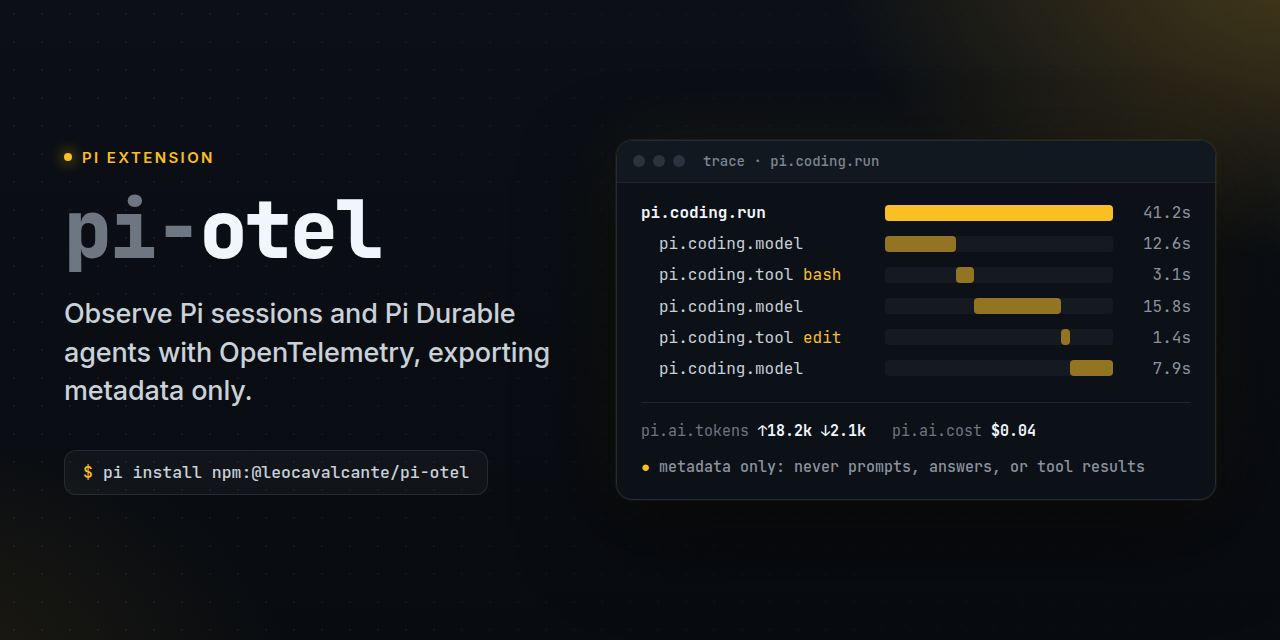
Observe Pi sessions and Pi Durable agents with OpenTelemetry, exporting metadata only.


pi-otel sends traces, metrics, and logs about model calls, timing, and tool activity to your own OpenTelemetry collector. Each agent run becomes a pi.coding.run span with pi.coding.model and pi.coding.tool children, plus token and cost counters per provider and model. pi-otel exports metadata only: it never exports prompts, answers, tool arguments, or tool results.
Contents
- Installation
- Usage
- Configuration
- Compatibility
- Privacy and security
- Troubleshooting
- More Pi extensions
- Contributing
- License
Installation
pi install npm:@leocavalcante/pi-otel
Then run /reload in Pi, or start a new session. pi-otel stays inactive until you set an OTLP endpoint, so start Pi with one:
OTEL_EXPORTER_OTLP_ENDPOINT=http://localhost:4318 OTEL_SERVICE_NAME=pi-coding-agent pi
You need an OTLP/HTTP receiver, usually an OpenTelemetry Collector. To try pi-otel once without adding it to your settings, run pi -e npm:@leocavalcante/pi-otel.
To follow unreleased changes, install from GitHub instead:
pi install git:github.com/leocavalcante/pi-otel
Git installations track main and report version 0.0.0-development, so Pi doesn't show release notes for them. Remove either installation with pi remove and the same source.
Usage
In Pi
The extension observes lifecycle events, never changes prompts or tools, and flushes its data when the session shuts down.
| Signal | What it records |
|---|---|
pi.coding.run span | One agent run, from agent_start to agent_settled |
pi.coding.model span | One assistant message, from message_start to message_end |
pi.coding.tool span | One tool execution, nested under its parent tool call when there is one |
pi.ai.tokens, pi.ai.cost counters | Reported input, output, and cache tokens, and reported cost |
pi.coding.tool.results counter | Each tool result, with its outcome and whether it ran |
pi.coding.run.duration and more histograms | Run, model, and tool durations |
| Completion logs | One fixed-text log per finished span, correlated with its trace |
Model spans cover the assistant-message lifecycle, not the provider request, which the extension can't observe. That's why they're named pi.coding.model rather than pi.ai.request. Their first event isn't necessarily the first visible text.
See signal semantics for every signal, unit, and how to interpret it.
In Pi Durable and SDK applications
npm install @leocavalcante/pi-otel
Pass pi-otel's telemetry to your existing Harness owner:
import { createPiOtel } from "@leocavalcante/pi-otel";

const otel = createPiOtel({
  serviceName: "my-agent",
  serviceNamespace: "agents",
});
const harness = await Harness.open(
  storage,
  { models, registry, telemetry: otel.telemetry },
  context,
);

// Optional: sample persisted usage totals through this owner.
await otel.observeDurable(harness, context);

// During shutdown, stop accepting requests, then close the owner before pi-otel.
await harness.close(context);
await otel.shutdown();
See the model-free Durable example. For coding-agent SDK sessions, call otel.observeCodingAgent(session) instead of installing the extension, never both for the same session. The function it returns unsubscribes. Neither path sees work that happened before you attached it.
createPiOtel() returns:
| Member | Purpose |
|---|---|
telemetry | The telemetry context to pass to a Harness |
modelRuntime(runtime) | Wraps an SDK ModelRuntime 1.5.0 so its requests are measured (see below) |
responseModel | Adds optional response-model labels to native Models telemetry |
observeDurable(harness, context) | Samples harness.usage(context) every 15 seconds; returns a stop function |
observeCodingAgent(session) | Observes a coding-agent SDK session; returns an unsubscribe function |
codingObserver() | The metadata-only event observer that the extension uses |
forceFlush(), shutdown() | Resolve to false when export was incomplete, instead of throwing |
Your application keeps owning its providers and lifecycle: pi-otel installs no global OpenTelemetry provider or context manager. Configuration errors fail immediately, with messages that contain no sensitive input.
SDK ModelRuntime 1.5.0. That runtime sends requests straight to providers, bypassing the instrumented Models path. With only telemetry passed, Durable phases are recorded but AI request latency and tokens are not. Pass models: otel.modelRuntime(runtime) to the same Harness, and wrap it once. Don't wrap createModels(), which already emits AI telemetry, or a newer runtime you haven't verified. The wrapper forwards every call unchanged, makes exactly one underlying call per request, and adds no retries or credential handling. Pending deferred polls record timing but not token or cost usage.
Usage isn't billing. Pi's persisted pi.usage stays the authoritative record for Durable accounting. Pi-reported cost in USD isn't an invoice, and zero can mean an unpriced or subscription model. Task admission isn't answer latency, and a successful tool phase doesn't mean the tool's external effect succeeded.
Attribute routed responses in the SDK
If a gateway reports which model answered a routed request, add its public ID to existing completion telemetry. provider and model still name the request. gen_ai.response.model names the response, not a specific deployment or revision.
import { createModels } from "@earendil-works/pi-ai";
import { createPiOtel } from "@leocavalcante/pi-otel";

const otel = createPiOtel({
  serviceName: "my-agent",
  responseModels: {
    provider: "example-gateway",
    model: "router",
    allowedIds: ["example/Model-A", "example/Model-B"],
  },
});
const { nativeModels, report } = otel.responseModel;
const models = nativeModels(createModels());
- Native
createModels(). Give your provider thereportcallback and register the provider withmodels.setProvider(). InonProviderStreamEvent, report the first nonempty model ID that differs from the request usingreport(options?.telemetry, id). Passmodelsandotel.telemetryto the Harness. The facade uses the request's existing telemetry parent. Calls without one stay uninstrumented. Do not usemodelRuntime()on this path. - SDK ModelRuntime and coding sessions. Use
otel.modelRuntime(runtime)orotel.observeCodingAgent(session)as before. Both read the final assistant message'sresponseModelwithout a provider callback. The standalone Pi extension does not configure this SDK opt-in.
Include only reviewed public model IDs in allowedIds. Missing, unlisted, and rejected values leave the label absent, without hiding the request or changing its result. First-chunk timing and persisted usage totals stay keyed to the requested model. To turn attribution off, omit responseModels.
Collector and dashboard examples
examples/collector.yamlprints a summary of the signals it receives.examples/grafana/pi-agents.jsonis a Grafana dashboard that expects a Prometheus data source with standard OTLP metric-name translation.
Neither example installs a backend or opens a public listener.
Configuration
pi-otel sends OTLP as JSON over HTTP or HTTPS, with one exporter per signal. It reads the standard OpenTelemetry environment variables:
| Variable | Description |
|---|---|
OTEL_EXPORTER_OTLP_ENDPOINT | Base URL. pi-otel appends /v1/traces, /v1/metrics, and /v1/logs. Required in Pi. |
OTEL_EXPORTER_OTLP_{TRACES,METRICS,LOGS}_ENDPOINT | Full URL for one signal. Overrides the base URL. |
OTEL_EXPORTER_OTLP_HEADERS | Authentication headers. They stay transport configuration, never attributes. |
OTEL_EXPORTER_OTLP_{TRACES,METRICS,LOGS}_HEADERS | Headers for one signal. |
OTEL_SERVICE_NAME | Service name. Defaults to pi-coding-agent in Pi and pi-agent in the SDK. |
OTEL_RESOURCE_ATTRIBUTES | Only service.namespace and service.version are kept. |
OTEL_METRIC_EXPORT_INTERVAL | Metric export interval in milliseconds. Default 15000; minimum 1000. |
OTEL_SDK_DISABLED | Set to true to turn pi-otel off. |
In the SDK, the endpoint, serviceName, serviceNamespace, and serviceVersion options override the base environment variables; per-signal endpoints still win. Set responseModels in SDK code only. It applies to one exact provider/model pair, with up to 128 allowlist entries of at most 128 characters each.
- Endpoints. URLs with embedded credentials, query strings, or fragments are rejected. Use HTTPS with normal certificate verification for remote receivers.
- Limits. Batch queues hold up to 512 spans and 512 logs, and each export has a 5-second deadline. Crashes, queue pressure, network failures, and shutdown can lose telemetry.
- Export errors. Failed exports are counted in
pi.otel.export.errors, which you see once metrics reach the receiver again. pi-otel never prints backend or authentication details.
Compatibility
Requires Pi 1.5.0 or newer and Node.js 22.19 or newer. Tested with Pi 1.5.2 on Linux, macOS, and Windows; CI also tests Pi 1.5.0 and checks the latest Pi release every week.
- Trace context propagates through explicit W3C
traceparentandtracestatevalues, including links. pi-otel adds no baggage and doesn't propagate context over transports such as HTTP or A2A on its own. - Durable tool phases report phase outcomes, not tool-result success.
- Recovery after a process crash isn't covered by tests.
Privacy and security
pi-otel exports metadata only. It never exports prompts, answers, reasoning, attachments, tool arguments or results, file contents, credentials, headers, exception messages or stack traces, or free-form error text. There's no switch to capture content.
- Allowlists. Every span, event, and metric field is checked against a fixed allowlist when exported. Unknown span names become
pi.operation, and unknown attributes, events, and metrics are dropped. - Remaining metadata. Service, provider, model, and tool names, operational IDs, and usage and timing numbers are still exported, and they can reveal activity. Choose names that aren't sensitive, control who can read your collector, and set its retention.
- Scope. This policy covers what pi-otel sends. It doesn't scan for secrets or sanitize other applications that send to your collector.
Tests inject synthetic private markers into prompts, model output, tool arguments and results, and errors, then inspect the actual HTTP bodies. See the full privacy boundary. To report a vulnerability, see SECURITY.md.
Troubleshooting
- Nothing reaches the collector. Pi must start with
OTEL_EXPORTER_OTLP_ENDPOINTalready set, andOTEL_SDK_DISABLEDmust not betrue. Run/reloadafter changing either, and check that the receiver accepts OTLP over HTTP. - Metrics appear but traces or logs don't. Check the per-signal endpoint variables: a per-signal URL replaces the base URL and its
/v1/...suffix. - Some exports were lost. Watch the
pi.otel.export.errorscounter, which is labeled by signal.
More Pi extensions
Each extension does one job, and all of them share the same conventions for code, tests, and releases. Combine the ones you need:
| Extension | What it does |
|---|---|
| pi-a2a | Talk to A2A agents from Pi, and serve Pi Durable agents over the A2A protocol. |
| pi-otel | Observe Pi sessions and Pi Durable agents with OpenTelemetry, exporting metadata only. |
| pi-subagents | Delegate tasks to isolated Pi subagents: single, parallel, chained, or in the background. |
| pi-tmux | Name tmux windows after your current Pi task and mark the ones waiting for your input. |
Install any of them with pi install npm:@leocavalcante/<extension>, then run /reload.
Contributing
See CONTRIBUTING.md for development setup, checks, and how releases work. Design notes are in research.md.
License
MIT. See LICENSE.