
Install
Install with PiG
pig install npm:@leing2021/super-piInstall with Pi
pi install npm:@leing2021/super-piPackages run code with your permissions and influence agent behavior. Catalog inclusion is not a security audit. Review the source before installing a third-party package.
Pi manifest JSON
The pi field of package.json.
{
  "skills": [
    "./skills"
  ],
  "extensions": [
    "./extensions"
  ]
}
README
Written by the package's publisher, shown as published in version 0.42.2 (README.md). PiG does not review it.
Super Pi
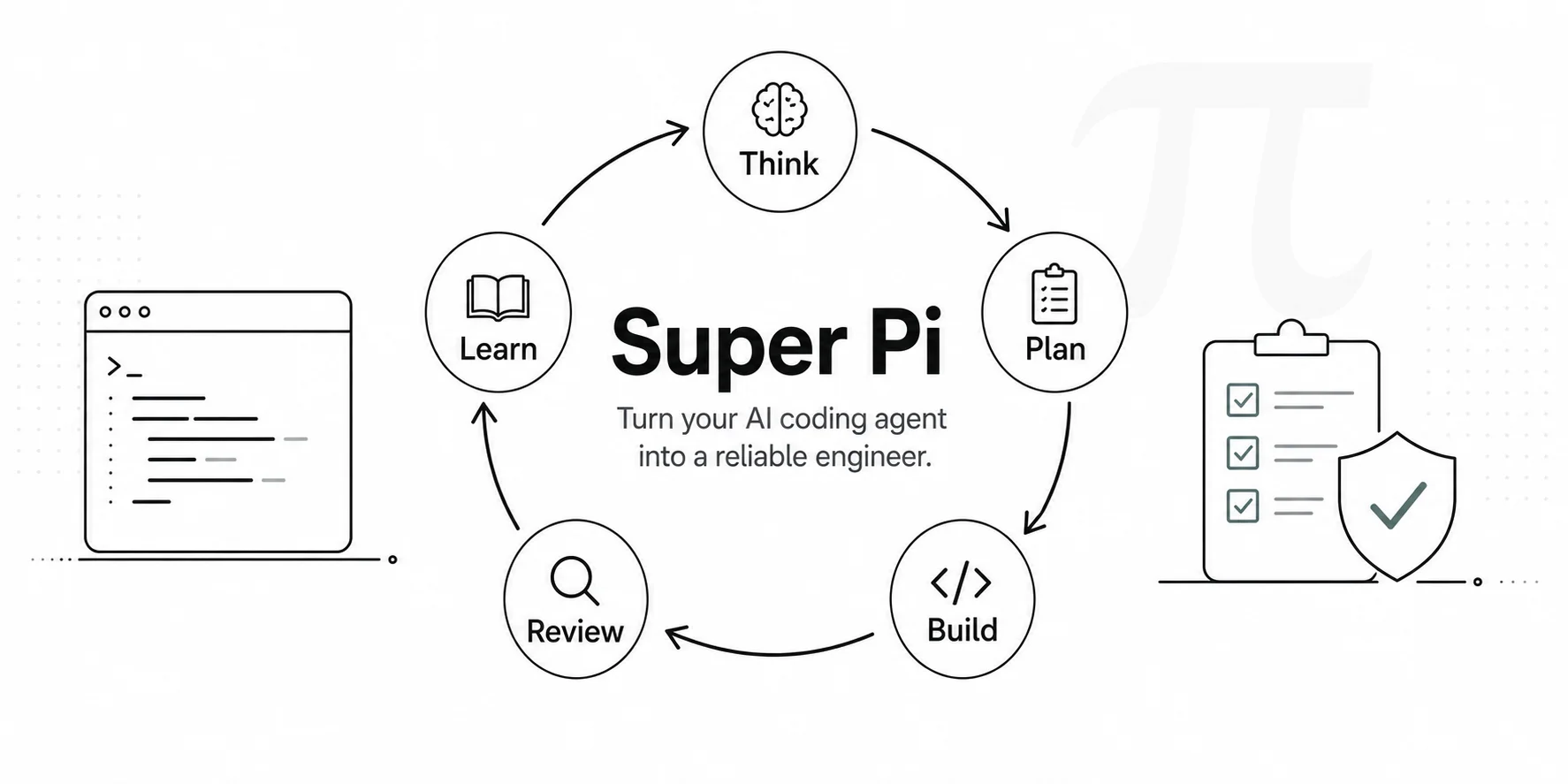
Turn your AI coding agent into a reliable engineer.
Super Pi is a Pi-native engineering workflow layer: it adds stage discipline, durable artifacts, TDD gates, checkpoints, review, and learning loops on top of your coding agent.
Install, describe what you want to build, then keep saying "continue." Super Pi drives the full loop:
think → plan → build → review → compound learnings.
pi install npm:@leing2021/super-pi
Requires pi ≥ 0.85.0 (isolated review depends on the
--mode jsontool_executionevent stream). Upgrade withpi update.Project trust (pi ≥ 0.79): Pi asks before loading project-local settings, resources, and packages. On first use, approve the project trust prompt so Super Pi can read
.pi/settings.jsonand load its skills/extensions. Usepi --approvefor non-interactive runs.
Highlights
- Five-step loop — brainstorm → plan → work → review → learn, with automatic skill routing
- Checkpoint resume — interrupted? Resume from the exact unit you left off
- TDD enforcement — every unit follows RED → GREEN → REFACTOR with hard gates
- Evidence-first review — auto-assigned reviewers across five axes, autofix loop, and isolated spawn (fresh session, no author bias)
- Knowledge compounding — solved problems become searchable solution artifacts
- Token-efficient — ~4,200 tokens new-conversation overhead; progressive loading
Quickstart
pi install npm:@leing2021/super-pi
Then in Pi:
You: I want to build a CLI tool that helps indie devs find early users

→ 01-brainstorm: structured discovery → requirements artifact
→ 02-plan: TDD-gated implementation units → plan artifact
→ 03-work: inline execution, checkpoint resume
→ 04-review: isolated spawn review, five-axis findings, author-side fix loop
→ 05-learn: knowledge compounding

You: continue
→ Next skill recommended via /skill:06-next
Resume after interruption:
You: /skill:03-work docs/plans/plan.md
→ Loads checkpoint, skips completed units, resumes from breakpoint
The Five-Step Loop
01-brainstorm → 02-plan → 03-work → 04-review → 05-learn
    think         plan      build      review      learn
| Skill | What it does | Core tool |
|---|---|---|
| 01-brainstorm | Structured multi-round discovery, domain vocabulary persistence | brainstorm_dialog |
| 02-plan | TDD-gated implementation units, optional CEO Review | plan_diff |
| 03-work | Inline execution, checkpoint resume, strict TDD, stop-the-line | session_checkpoint, task_splitter |
| 04-review | Auto-assigned reviewers, six-axis findings (Standards + Spec), autofix loop | review_router |
| 05-learn | Solution artifacts with overlap check → searchable knowledge | — |
| 06-next | Next-step recommendation + workflow status | workflow_state |
| 07-worktree | Isolated git worktree development | worktree_manager |
Auto-chaining: stages run in-session once their gate passes — requirements approval (01→02) and the work gate (02→03) are the only prompts; 05-learn ends the pipeline with a final summary.
07-worktreeruns only on explicit/skill:07-worktree.
Model & Thinking Routing
Configure in .pi/settings.json:
{
  "modelStrategy": {
    "01-brainstorm": "anthropic/claude-sonnet-4-20250514",
    "02-plan": "anthropic/claude-opus-4-20250115"
  },
  "thinkingStrategy": {
    "01-brainstorm": "high",
    "02-plan": "high",
    "03-work": "medium"
  }
}
Model and thinking level switch automatically — no manual /model needed.
Routing triggers on explicit /skill: commands and when the agent reads a stage's SKILL.md on its own. A command typed directly and the same command as the first line of a sole pi -p @file argument both trigger routing; that carrier form is only honored for the first user input of a session, so later attachments (docs, examples containing /skill: text) never route. If no strategy is configured, routing is a no-op — the session model is never touched. Project-level settings take precedence; missing keys fall back to global ~/.pi/agent/settings.json.
In headless modes (pi -p, --mode json), routing notices and warnings (invalid strategy reference, model not found, missing API key, unknown thinking level) are written to stderr as one JSON object per line — stdout stays the response stream:
{"source":"ce-core","event":"stage-routing","stage":"03-work","level":"info","message":"Switched model for 03-work: provider/model"}
Known limitation: an explicit --model/--thinking CLI flag does not pin the session against stage routing — the input-hook switch may still override it. Orchestrators that must keep a flag authoritative should pass the prompt without a leading /skill: command (e.g. strip the prefix) or omit the stage from modelStrategy.
Cache warming: pi ≥ 1.5.1 defaults to "cacheWarming": "idle", which already keeps prompt caches warm during Super Pi's long tool runs and 2-5 min isolated_review blocks — and up to 30 minutes between runs — so no configuration is needed. On older pi versions, add "cacheWarming": "streaming" to the same settings file (project .pi/settings.json, or global ~/.pi/agent/settings.json) to avoid re-paying full input price. See pipeline config for the full example including per-model compaction budgets.
Design Philosophy & Acknowledgements
80% planning and review, 20% execution.
The goal is not to make AI write code faster. The goal is to make AI think before writing, review after writing, and compound what it learns.
Super Pi is not a fork or wrapper. It extracts useful methods from the projects below and rebuilds them with Pi-native skills, tools, artifacts, checkpoints, and handoffs.
| Project | What Super Pi adopted |
|---|---|
| addyosmani/agent-skills | "Use when" skill trigger conditions, source-driven verification, stop-the-line hard gate, anti-rationalization, and the five-axis review baseline. Adopted as embedded micro-patterns only — no new skills, tools, commands, or agents. |
| everything-claude-code (ECC) | Checkpoint resume, continuous learning loops, and token-conscious agent workflow design. (Repo renamed; original link dead.) |
| humanlayer/12-factor-agents | Context window ownership, compacting resolved errors, retry caps, and pre-fetching obvious prerequisites. Adopted as lightweight context hygiene rules inside the existing Phase 1 pipeline. |
| superpowers | Strict TDD gates, design checklists, review discipline, the rationalization table (excuse → reality), and the idea that agents need hard gates instead of gentle suggestions. |
| compound-engineering-plugin | The five-step think → plan → build → review → learn loop, the knowledge-compounding backbone, and solution retirement (knowledge must be able to leave, not only accumulate). |
| gstack | YC-style forcing questions, CEO Review cognitive frameworks, browser QA patterns, failure maps, and evidence-first validation. |
| mattpocock/skills | Context glossary (CONTEXT.md), lightweight ADR (three-condition threshold + "What qualifies" catalog), feedback-loop-first debug discipline, deep-module vocabulary (module/interface/depth/seam/adapter/leverage/locality + internal seams + rejected framings), interview discipline (facts-vs-decisions, one-question-at-a-time), the review Spec axis, and the out-of-scope knowledge base. Absorbed as self-contained skills/references/ content — no external path deps, no issue-tracker deps, no standalone skills grafted (super-pi's existing 01-brainstorm/domain-language/module-design already cover the active disciplines). |
| DietrichGebert/ponytail | The Ladder (7-rung minimalism decision chain: need-to-exist → codebase reuse → stdlib → platform-native → installed dep → one line → minimum), the debt: marker convention (name the ceiling and upgrade trigger), and dependency-axis review tags (stdlib: / native: / dependency:) flowing into the 04-review Standards axis. Embedded into rules/common/ — no intensity tiers, no hooks/MCP, no standalone skills. |
Behavioral Gates
Stop-the-line (Hard gate)
When an unexpected failure occurs during 03-work:
- STOP adding features
- PRESERVE evidence
- DIAGNOSE root cause — build a feedback loop first, then reproduce → hypothesise → instrument → fix
- FIX the root cause, not the symptom
- GUARD with a regression test
- RESUME only after verification passes
Anti-rationalization: do not rationalize, downgrade, or explain away failures. Stop and report with evidence.
Source-driven verification
When implementation depends on a framework/library API, version-specific behavior, or a recommended pattern: verify against official documentation before implementing. Pure logic, renaming, or in-project pattern reuse does not require external citation.
Review five axes
All reviewers evaluate changes across: correctness, readability, architecture, security, performance.
Continuous execution (03-work)
Units run without pauses between them; report once at completion. Exactly four valves may stop and ask: stop-the-line failure that cannot self-heal, 3-failure cap, destructive/irreversible operations, spec ambiguity/plan gap. The frontend (01/02) ships every question with a ✓ recommended answer; the backend (03) doesn't ask unless a valve fires.
Token Cost
New conversation overhead: ~4,130 tokens (2.1% of 200K context).
| Component | Tokens |
|---|---|
| 17 skill registrations | ~1,710 |
| 22 tool schemas | ~2,420 |
| Skill inlining (per invocation) | ~300–1,200 |
Progressive loading: only needed skills loaded on-demand.
See docs/token-cost-evaluation.md for detailed per-skill breakdown and measurement methodology.
Generated Structure
your-project/
├── docs/
│   ├── brainstorms/      # Requirements
│   ├── plans/             # Execution plans
│   ├── adr/               # Architecture decisions (lazy)
│   └── solutions/         # Knowledge cards
└── .context/
    └── compound-engineering/
        ├── checkpoints/   # Breakpoint files
        ├── handoffs/      # Cross-stage context
        └── history/       # Execution history
Commit everything to git — these files are the project's traceable memory.
Architecture
| Component | Count |
|---|---|
| Skills | 7 |
| Tools | 12 CE + 10 Pi built-in |
| Rules | 78 |
| TypeScript lines | ~4,100 |
| Tests | 270 (1085 assertions) |
Rules in rules/ cover 12 common topics + language-specific sets (TypeScript, Python, Go, Rust, Web). Project-level overrides take priority; projects can also add other languages via a project-level rules/language-detection.md marker map plus their own rules directory (append + same-marker wins).
Commands
| Command | Description |
|---|---|
bun test | Run all tests |
npm publish --dry-run | Preview package contents |
Changelog
See CHANGELOG.md for full version history.
Links
- npm: https://www.npmjs.com/package/@leing2021/super-pi
- GitHub: https://github.com/leing2021/super-pi
- License: MIT