
Install
Install with PiG
pig install npm:@getpipher/omp-statuslineInstall with Pi
pi install npm:@getpipher/omp-statuslinePackages run code with your permissions and influence agent behavior. Catalog inclusion is not a security audit. Review the source before installing a third-party package.
Pi manifest JSON
The pi field of package.json.
{
  "extensions": [
    "./src/index.ts"
  ]
}
README
Written by the package's publisher, shown as published in version 0.8.12 (README.md). PiG does not review it.
omp-statusline
Seven lines under your editor — Hijri clock, prayer times, API-spend ledger, per-window z.ai or OpenCode Go quota rows, and a version line — styled to match omp's native chrome.


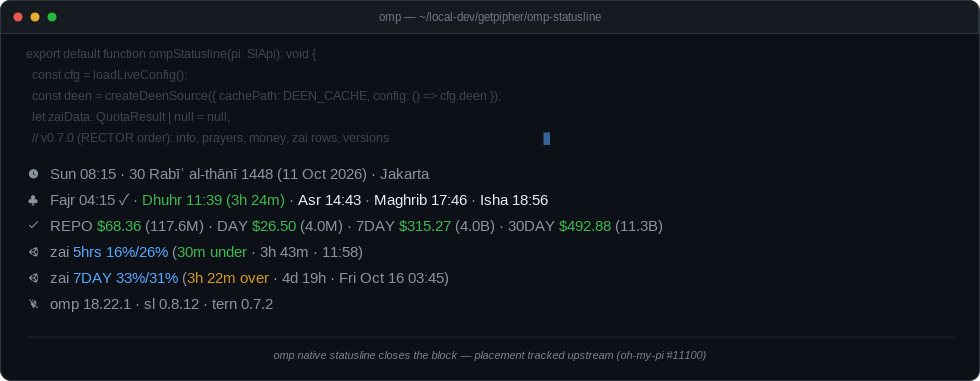
A statusline widget for omp (Oh My Pi) — the omp-native successor to pi-statusline. It renders below the editor in omp's own visual language (· separators, nerd glyphs, theme tokens), and omp's native statusline closes the block beneath it (extension widgets cannot render under it yet — tracked upstream as can1357/oh-my-pi#11100).
What it renders
Render order (top → bottom): info · prayers · money · zai (one row per window) · opencode (one row per Go window) · versions.
| Line | Contents |
|---|---|
| info | Local weekday + clock — Sun 21:12 · Hijri date with Gregorian gloss — 1 Jumādá al-ūlá 1448 (11 Oct 2026) · city — all dim. The Hijri date advances at Maghrib, not civil midnight (evening value via Aladhan gToH, cached per city-day; on failure it stays on today's date). |
| prayers | All five prayers with wall times, from aladhan (cached per local day, stale-marker on degradation). Past prayers get a dim ✓; the next prayer is green with a countdown on its segment only — Fajr 04:15 (7h 03m). |
| money | API spend + token volume per window: REPO $68.36 (1.3B) (all-time for the current project) · DAY (since 00:00 local) · 7DAY / 30DAY (rolling, hour-aligned). Token volumes are dim, from the same sessions scan. |
| zai | One row per quota window — zai 5hrs … / zai 7DAY … — each LABEL usage%/elapsed% (pace · reset · absolute), e.g. 5hrs 16%/26% (30m under · 3h 42m · Mon Oct 12 00:54) / 7DAY 33%/32% (1h 41m over · 4d 19h · Fri Oct 16 16:12). Provider-gated: renders only while the active model's provider is zai (or the provider is unreadable); vanishes entirely on other providers. |
| opencode | One row per OpenCode Go window — opencode 5hrs … / 7DAY … / MONTH … — same LABEL usage%/elapsed% (pace · reset · absolute) grammar as zai, sourced from GET https://opencode.ai/zen/go/v1/usage with the omp-stored Go key. MONTH (not 30DAY) because the Go meter is anniversary-based: the window is the calendar month before the reset stamp, 28–31 days. Provider-gated to opencode-go (or an unreadable provider) — opencode-zen is excluded (that endpoint reports the Go plan; Zen is pay-as-you-go). |
| versions | omp 18.22.1 · sl 0.8.12 · tern 0.7.2 — host from one --version spawn of the running omp binary (process.execPath, so it is install-agnostic (brew/npm/curl/source) and correct even for sessions resumed across an upgrade); plugin from its own package.json; tern from the TERM_PROGRAM/TERM_PROGRAM_VERSION env the Tern terminal sets — Tern-gated: strict env match, segment omitted outside Tern or when the version is unknown. Omitted entirely when no version is known — never a placeholder. |
Pace — window × (usage% − elapsed%)/100 — renders 1h 36m over (orange: burning faster than the clock, quota exhausts early by that much) or 30m under (green: behind the clock). Percent heat: accent < 70%, warning ≥ 70%, error ≥ 90% — raw, so over-quota stays error-red while display caps at 100%+.
The money line is a ledger, not a tracker
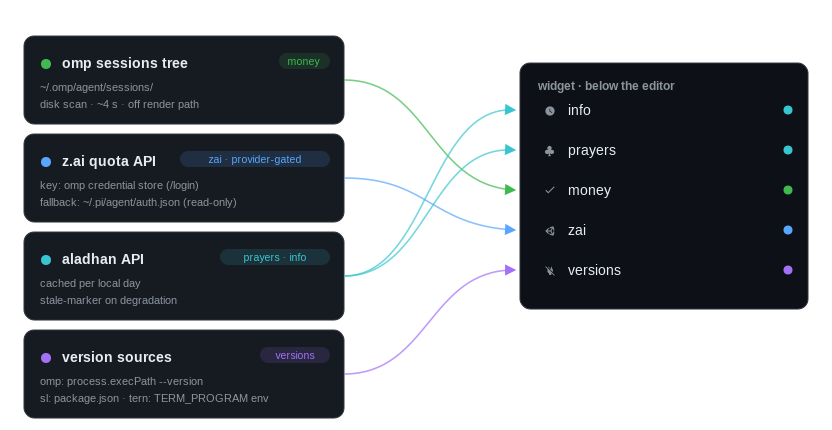
Costs are disk-scanned from omp's own session tree (~/.omp/agent/sessions/), not tracked live:
- every session file embeds its
cwdand per-assistant-messageusage.cost.total— the tree is a complete ledger; - subagent and advisor spend is included: subagent transcripts persist as session-format JSONL artifacts (
<repo-slug>/<session-id>/<Agent>.jsonl) and advisor consults as__advisor.jsonl— beside the session (<session-id>/__advisor.jsonl) and nested per agent (<session-id>/<Agent>/__advisor.jsonl) — and are scanned too; - entry ids are deduped globally, so branched/resumed session copies never double-count;
- the sessions tree (including history migrated from pi) supersedes the retired pi-statusline ledger.
The full rescan runs off the render path (~4 s over ~148 k entries) on the poll cycle; renders between polls use the cached snapshot. Countdowns (prayer, quota reset) still move — the widget re-renders every 30 s without touching the network or disk.
Install
omp plugin install @getpipher/omp-statusline
Or from a checkout: omp plugin link /path/to/omp-statusline.
Config
~/.omp/agent/omp-statusline/config.json — every key optional:
{
  "zai": {
    "pollIntervalMs": 180000
  },
  "opencode": {
    "pollIntervalMs": 180000
  },
  "deen": {
    "city": "Jakarta",
    "country": "Indonesia",
    "method": "auto",
    "escalateMinutes": 30
  },
  "accent": true
}
| Key | Default | Notes |
|---|---|---|
zai.pollIntervalMs | 180000 | Poll cycle for quota fetch + money rescan (clamped to ≥ 30000). |
zai.authJsonPath | unset | Explicit pi-style auth JSON {"zai": {"key": "…"}}, read-only — pins that file as the sole key source. Unset (default): the key resolves from omp's own credential store (omp /login → models.yml → env → auth broker) via the host, falling back to ~/.pi/agent/auth.json — omp-only setups need no pi files. |
opencode.pollIntervalMs | 180000 | Poll cycle for the OpenCode Go usage endpoint (clamped to ≥ 30000); runs alongside the zai poller. The Go key always comes from omp's credential store (no file fallback). |
deen.city / deen.country | Jakarta / Indonesia | aladhan lookup. city: "auto" resolves city/country/timezone via IP geolocation instead (cached 7 days). |
deen.method | auto | Calculation method (auto → aladhan default). |
deen.escalateMinutes | 30 | Minutes-until-next-prayer threshold for the soon escalation band. |
accent | true | Session-accent colorizer (Option A): row glyphs + zai/money/version labels pick up omp's per-session accent — the same name-hash hue omp paints the editor border and model name with, re-derived per render so /theme switches re-dress it. Values keep their semantic tokens (heat bands, next-prayer green, money green) regardless. false = tokens-only. Unnamed sessions render tokens-only automatically. |
State (deen cache) lives beside the config in ~/.omp/agent/omp-statusline/.
/sl — force refresh & full report
Forces a zai + opencode + deen + money refresh and notifies full source state: quota freshness on both plan meters, today's plan credits, 7-day per-model split, usage streaks, cache-hit rate, prayer city/hijri, and the spend breakdown including subagent + advisor share and entry count:
zai key omp credentials · 5h 16% · weekly 33% · fetched 0m ago · today 7.7K · models 7d glm-5.3 28K · gpt-5.4 9.2K · streak 46d (best 61d) · cache 71% | opencode key omp credentials · 5h 40% · weekly 16% · monthly 8% · fetched 0m ago | deen Jakarta · 1 Jumādá al-ūlá 1448 (11 Oct 2026) · fresh | money REPO $68.36 · DAY $26.50 · 7DAY $315.27 · 30DAY $492.88 · sub $11.02 · 1234 entries
The z.ai dashboard endpoints (credit-usage/usage-detail, credit-usage/activity) accept the same API key as the quota API — no browser or cookie session needed.
Provenance
Data layer (src/quota/, src/deen/, src/adapters/, src/format.ts, src/types.ts) vendored verbatim from @getpipher/pi-statusline (same author, MIT) — see NOTICE. MIT licensed.