
Install
Install with PiG
pig install npm:@evoclock/pi-poteto-modeInstall with Pi
pi install npm:@evoclock/pi-poteto-modePackages run code with your permissions and influence agent behavior. Catalog inclusion is not a security audit. Review the source before installing a third-party package.
Pi manifest JSON
The pi field of package.json.
{
  "skills": [
    "./skills/architect-pi",
    "./skills/arena-pi",
    "./skills/automate-me-pi",
    "./skills/benchmark-checklist-pi",
    "./skills/blast-radius-pi",
    "./skills/bro-pi",
    "./skills/correct-pi",
    "./skills/create-verification-skill-pi",
    "./skills/create-formal-verification-skill-pi",
    "./skills/figure-it-out-pi",
    "./skills/how-pi",
    "./skills/in-your-own-words-pi",
    "./skills/interrogate-pi",
    "./skills/ketchup-pi",
    "./skills/ketchup-video-pi",
    "./skills/maintain-verification-skill-pi",
    "./skills/maintain-formal-verification-skill-pi",
    "./skills/make-bot-ui-pi",
    "./skills/no-comments-pi",
    "./skills/poteto-help-pi",
    "./skills/poteto-mode-pi",
    "./skills/principle-attack-the-premise-pi",
    "./skills/principle-boundary-discipline-pi",
    "./skills/principle-build-the-lever-pi",
    "./skills/principle-encode-lessons-in-structure-pi",
    "./skills/principle-exhaust-the-design-space-pi",
    "./skills/principle-experience-first-pi",
    "./skills/principle-explain-the-number-pi",
    "./skills/principle-fix-root-causes-pi",
    "./skills/principle-foundational-thinking-pi",
    "./skills/principle-guard-the-context-window-pi",
    "./skills/principle-laziness-protocol-pi",
    "./skills/principle-make-operations-idempotent-pi",
    "./skills/principle-migrate-callers-then-delete-legacy-apis-pi",
    "./skills/principle-minimize-reader-load-pi",
    "./skills/principle-model-the-domain-pi",
    "./skills/principle-never-block-on-the-human-pi",
    "./skills/principle-outcome-oriented-execution-pi",
    "./skills/principle-prove-it-works-pi",
    "./skills/principle-redesign-from-first-principles-pi",
    "./skills/principle-separate-before-serializing-shared-state-pi",
    "./skills/principle-sequence-verifiable-units-pi",
    "./skills/principle-subtract-before-you-add-pi",
    "./skills/principle-test-behavior-not-implementation-pi",
    "./skills/principle-type-system-discipline-pi",
    "./skills/recall-pi",
    "./skills/reflect-pi",
    "./skills/setup-pstack-pi",
    "./skills/sharpen-pi",
    "./skills/show-me-your-work-pi",
    "./skills/swarm-pi",
    "./skills/statechart-pi",
    "./skills/tdd-pi",
    "./skills/teach-pi",
    "./skills/technical-writing-pi",
    "./skills/typescript-best-practices-pi",
    "./skills/unslop-pi",
    "./skills/why-pi"
  ]
}
README
Written by the package's publisher, shown as published in version 0.4.0 (README.md). PiG does not review it.
@evoclock/pi-poteto-mode


The skills in this package are pstack
by Lauren Tan (v0.15.36, MIT). Copyright stays with Lauren Tan. This package
includes 58 source skill procedures and 23 full playbook files for the
Pi coding agent, with additive Pi boundaries. Of the 59
folders under skills/, 58 are source skill ports and one (how/) holds shared
references. It registers all 58 instruction skills. The ketchup-video skill is
visible but its Pi video route remains unavailable; it reports that limit.
This is an instruction adaptation with declared safety and capability differences,
not a claim of runtime parity. It adds no extensions, schedulers or installers.
Packaged since 0.2.0: complete playbook procedures,
operator-selected model roles, reasoning budgets and multi-seat panels.
For what pstack is and how its workflows fit together, read Lauren Tan's upstream pstack README. This README covers the Pi skills package and shows how it fits into the wider coding system in which I use it. The surrounding integrations are separate projects and are still under active development.
System overview
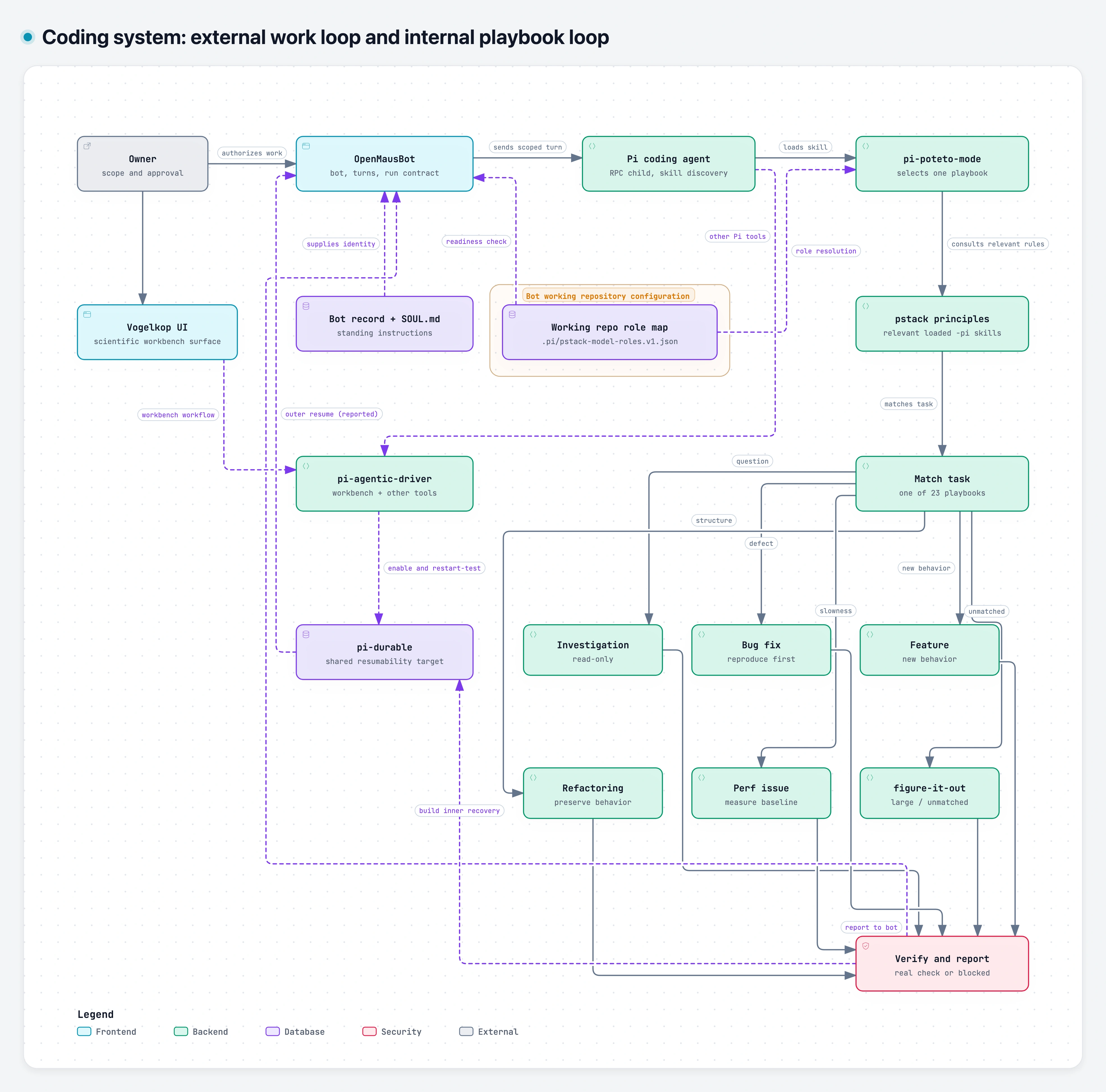
Download the interactive HTML to explore it locally. The project-local role map belongs to the bot's working repository, not to a bot identity or a running service. OpenMausBot uses it for readiness checks; skills consult it for model roles. The shared resumability connections are agreed design work, not verified crash recovery.
Inside pi-poteto-mode
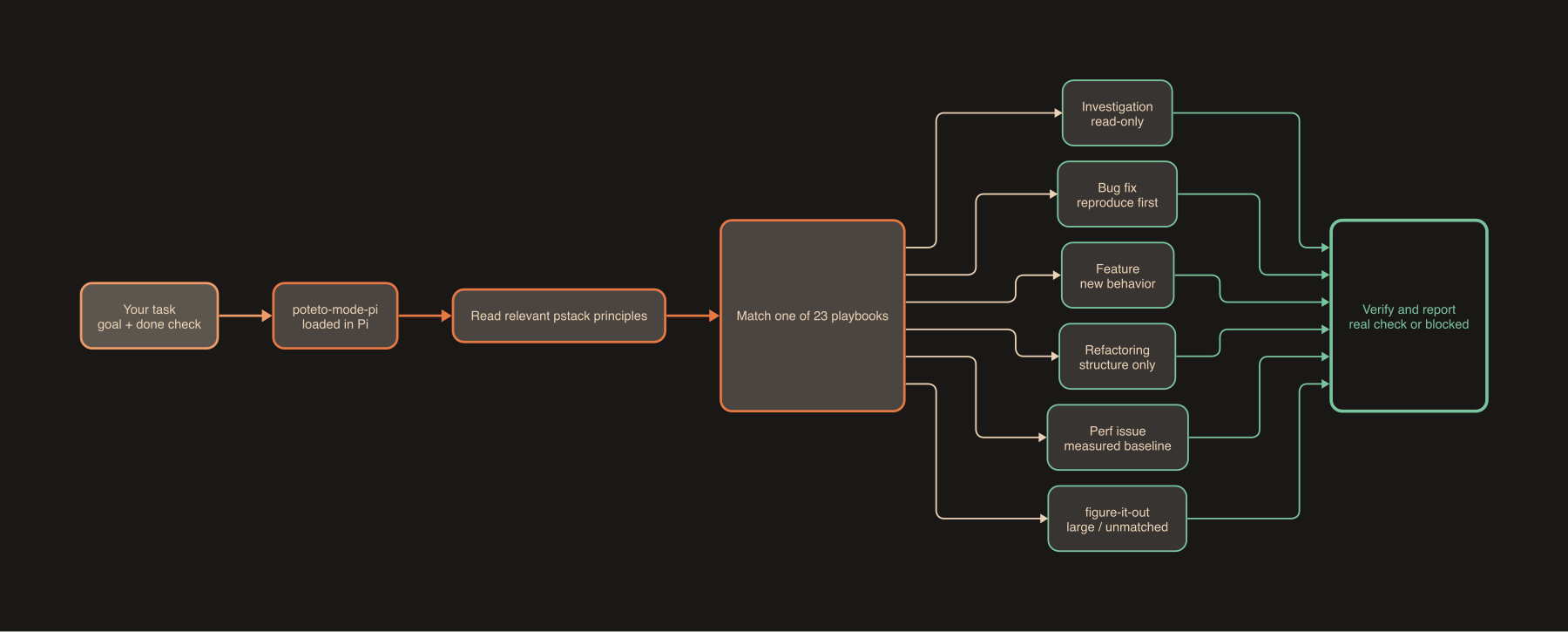
The six branches are common examples from upstream's poteto-mode guide; the full method has 23 playbooks. The principles are adapted from pstack; they are not built into Pi.
Install
pi install npm:@evoclock/pi-poteto-mode
Add -l to install it for the current project only. Remove it with
pi remove npm:@evoclock/pi-poteto-mode.
What's new in 0.4.0
With no .pi/pstack-model-roles.v1.json, every role uses the Pi default model
resolved at run time. /skill:setup-pstack-pi is optional, only for customising
roles. A present file is honoured exactly. A malformed file, or a null/missing
needed key, is an explicit error, never a fallback.
Optional role setup
Without .pi/pstack-model-roles.v1.json, every role uses the Pi default model
resolved at run time. This includes development, independent review, panels and
swarm workers. Missing configuration never stops a workflow or requires setup.
No package slug, parent inheritance or auto/inherit-parent alias is used.
Run /skill:setup-pstack-pi only when you want project-specific choices. It is
the only workflow that creates the optional file, starting from the null example
and writing only operator-approved selections. It never saves the runtime
default as an inferred choice. Keep the file out of version control if it names
your own models.
A present file is honoured exactly. Malformed JSON, schema, identities, budget pairs or shapes are explicit errors. A needed missing/null role is also an error, never a fallback or a reason to fill panel seats from core roles. Panel order and duplicates stay unchanged. Review capacity and family-diversity requirements still apply, even when every role resolves to the same Pi default.
How this works in Pi
- Naming. Each upstream skill
namebecomesname-pi, for examplepoteto-modebecomespoteto-mode-pi. The model can discover all 58 registered skills, includingpoteto-mode-pi,how-pi,figure-it-out-pi, and the 24principle-*-piskills. Every skill retains its slash command. Discovery alone does not make an unavailable Pi capability work. - Install.
pi install npm:@evoclock/pi-poteto-mode, orpi install <path>for a local checkout. Thepifield inpackage.jsonlists the 58 skill folders. The package ships no extensions and no install scripts. - Model roles. Retained source text includes upstream examples, not Pi defaults.
Actual execution resolves Pi's current default for every role when
.pi/pstack-model-roles.v1.jsonis absent. A present file supplies exact approved roles and errors on malformed configuration or needed missing/null keys. Optional/skill:setup-pstack-pialso previews native reasoning budgets (mediummeanshigh) and ordered panel seats in the same project-local map. See the setup contract for role shapes. - Sync script.
node scripts/sync-upstream.mjs <path-to-upstream-pstack>reads a local upstream copy and reports its version, upstream skills missing here, and skills here with no upstream match.
What's missing compared with upstream
docs/adaptation-guide.md lists every Cursor tool or feature the skills had to adapt, with the affected skills, the Pi handling and its status.
These upstream features do not map to Pi yet:
- Subagents. Source Cursor/cloud workers map to Pi agents in Herdr panes.
Acquire Treehouse leases, start workers with
agentic_herdr_spawn_worker, and exchange bounded briefs/reports withagentic_herdr_communication. These tools come from the installed Pi integration, not this package. A missing required worker/verifier route is blocked, not silently replaced by sequential self-review. The source text remains verbatim; the Pi boundary is the executable route. PR observation usesgh, not a required Origin install. - Model roles. Core roles, four ordered panel lists, scalar swarm workers and native reasoning budgets are supported through operator setup. Source aliases and automatic model/effort substitutions remain unsupported. Each selected identity and effort must be available on the installed Pi worker route.
- Always-on mode. Upstream's Poteto mode is a Cursor custom mode. In Pi,
poteto-mode-piapplies only when you load it. - Automations. Upstream's
automations/folder and Cursor/loophave no Pi equivalent here.
This remains a skills-only package. The concrete Herdr, Treehouse, task-tool
and gh mapping is in skills/how/UPSTREAM_MAPPING.md; required tools must
actually be installed and allowed. More role types and persistent wake support
remain separate integrations, not capabilities supplied by this package.
Maintenance
This source revision targets 0.15.36. UPSTREAM.lock.json records the actual plugin version and SHA-256 source hashes, not an assumed Git revision. The source steps remain verbatim, with Pi limits under them; playbooks.md is only an index. Read Policy divergences for owner-held landing, gated publication, restricted model routes and scratch/tool limits. I review the native-source comparison as part of maintenance; restoration and recall checks are not independent semantic or runtime proof.
Comparison with other Pi ports
On 18 Oct 2026 I compared nine published Pi ports with upstream v0.15.25. None
covered all 54 skills; the most complete had 51. Two run postinstall scripts
that write outside their install folder, and several hardcode model ids. The
method and findings are in
docs/pstack-pi-ports-comparison.md.
| # | Package | Version / last publish | Skills (missing / added) | Identical SKILL.md | Pi mapping of subagents, hooks and model roles | Install scripts / notes | Stars / open issues / last push | Hardcoded model ids |
|---|---|---|---|---|---|---|---|---|
| 1 | pi-herdr-pstack (npm, pi.dev) | 0.3.2 / 16 Oct 2026 | 51 (missing in-your-own-words, ketchup, sharpen) | 13/51 | Pi extension for mode, setup and config; subagents through the pi-herdr-agents peer dependency | None; ships THIRD_PARTY_NOTICES and a changelog | 2 / 0 / 16 Oct 2026 | Almost none |
| 2 | @casualjim/pi-pstack (npm, pi.dev) | 0.1.14 / 17 Oct 2026 | 50 (missing in-your-own-words, make-bot-ui, setup-pstack, sharpen) | 19/50 | Model roles through a config-backed roles extension | None; tarball includes node_modules (about 37 MB, 1,182 files) | 12 / 1 / 17 Oct 2026 (repo casualjim/pi-mimir) | Some model family names |
| 3 | @mccune1224/pi-pstack (npm, pi.dev) | 0.2.0 / 13 Sep 2026 | 46 + 4 added (control-cli, control-ui, create-skill, deslop); 8 missing | 7/46 | Context guard, compaction and doctor extensions; upstream sync script and sync check | None | 2 / 2 / 13 Sep 2026 | Yes |
| 4 | @whamp/pi-pstack (npm, pi.dev) | 0.10.1 / 12 Oct 2026 | 46 + code-review, deslop; 8 missing | 10/46 | Configurable model roles; ask-user-question tool | postinstall symlinks skills into ~/.agents/skills (keeps existing entries; opt out with PI_PSTACK_SKIP_SKILL_LINKS=1) | 1 / 4 / 15 Oct 2026 | No |
| 5 | @zenspc/pi-pstack (npm, pi.dev) | 0.6.0 / 9 Sep 2026 | 46 + deslop; 8 missing | 6/46 | Config plus a skill-strip extension | None | 10 / 6 / 9 Sep 2026 | No |
| 6 | potetos-for-everyone (npm, pi.dev) | 0.1.0 / 10 Sep 2026 | 49 (adds triage-issue-reports, reproduce-and-fix-issues); 7 missing | 0/47 shared | Multi-agent installer with hooks and adapters rather than a native Pi package; based on upstream v0.15.0 | postinstall writes skills into the current project on a local install | 15 / 1 / 10 Sep 2026 | No |
| 7 | poteto-pi (npm, pi.dev) | 0.1.0 / 5 Sep 2026 | 44 + loop; 10 missing | 1/44 | Generates 37 subagent files; memory, todo and update-check extensions | None | 0 / 0 / 5 Sep 2026 | Yes, in every generated agent |
| 8 | @0xrsydn/pstack-pi (npm, pi.dev) | 0.15.1 / 27 Aug 2026 | 44; 10 missing | 1/44 | Own subagent extension | None; npm repository field points to cursor/plugins | 6 / not checked / 14 Oct 2026 | Yes |
| 9 | pi-pstack (npm, pi.dev) | 0.1.0 / 8 Aug 2026 | 44; 10 missing | 1/44 | Basic agents extension | None; no repository field on npm | 8 / not checked / 8 Aug 2026 | No |
Skills
Each skill carries a -pi suffix. Another package that ships skills with the
same names will clash: Pi keeps the first one it finds and warns. To load this
package's copies, exclude the other package's duplicates in your Pi settings,
for example { "source": "npm:other-package", "skills": ["!skills/*-pi"] }.
architect-piarena-piautomate-me-pibenchmark-checklist-piblast-radius-pibro-picorrect-picreate-verification-skill-picreate-formal-verification-skill-pifigure-it-out-pihow-piin-your-own-words-piinterrogate-piketchup-pimaintain-verification-skill-pimaintain-formal-verification-skill-pimake-bot-ui-pino-comments-pipoteto-help-pipoteto-mode-piprinciple-attack-the-premise-piprinciple-boundary-discipline-piprinciple-build-the-lever-piprinciple-encode-lessons-in-structure-piprinciple-exhaust-the-design-space-piprinciple-experience-first-piprinciple-explain-the-number-piprinciple-fix-root-causes-piprinciple-foundational-thinking-piprinciple-guard-the-context-window-piprinciple-laziness-protocol-piprinciple-make-operations-idempotent-piprinciple-migrate-callers-then-delete-legacy-apis-piprinciple-minimize-reader-load-piprinciple-model-the-domain-piprinciple-never-block-on-the-human-piprinciple-outcome-oriented-execution-piprinciple-prove-it-works-piprinciple-redesign-from-first-principles-piprinciple-separate-before-serializing-shared-state-piprinciple-sequence-verifiable-units-piprinciple-subtract-before-you-add-piprinciple-test-behavior-not-implementation-piprinciple-type-system-discipline-pirecall-pireflect-pisetup-pstack-pisharpen-pishow-me-your-work-piswarm-pistatechart-pitdd-piteach-pitechnical-writing-pitypescript-best-practices-piunslop-piwhy-pi
Keeping up with upstream
node scripts/sync-upstream.mjs <path-to-upstream-pstack> compares the port with
a local copy of upstream and lists missing or extra skills and the upstream
version. It only reads and defaults to the reviewed local cache when no path is given.
node scripts/restore-upstream.mjs checks deterministic instruction restoration;
--write regenerates from an explicitly reviewed local source. No network access
or package installation occurs. Source names resolve through
skills/how/UPSTREAM_MAPPING.md, not through guessed Cursor tools.
Tests
npm test checks all source skills, frontmatter, exact source-body/hash
reconstruction, 23 per-file playbooks, changed contracts, explicit video status,
instruction-recall floors and package contents. Source model names are allowed
only in fingerprint-checked retained source blocks, never as operational Pi choices.
Personal paths and secrets remain forbidden. npm run check:recall reports
principle/playbook floors of 0.8 and skill floors of 0.6 against an offline baseline.
No low-recall exemptions are used in this revision.
The formal-verification and statechart instruction skills are new. Their actual
checks require approved installed tools. On macOS, use the bundled
statechart-pi/scripts/run-tlc.mjs --check detector, then its explicit repo-scratch
spec/config/output invocation. It uses installed TLC only, with no first-run install;
the upstream self-installing chart runtime is not bundled. A missing checker is
blocked, not a proof, and Mermaid output is view-only. Video catch-up remains
planned until a render-and-inspection route is validated. Static checks do not
establish an agent run or browser journey.
How I use it
My preferred setup is open source and on-device: Pi, with Herdr panes for parallel work, and OpenMausBot for automated work in very much the same way you use Grok Bot. Much of pstack's power comes from running it inside a full bot like Grok Bot, with background workers, routines and memory around it. This port covers what Cursor can't for me: local models and a free choice of providers, set through the two model roles along with custom seams to other tools I run in my scientific and software development work.
Licence
MIT; see LICENSE. The upstream skills are by Lauren Tan, MIT; see NOTICE.